
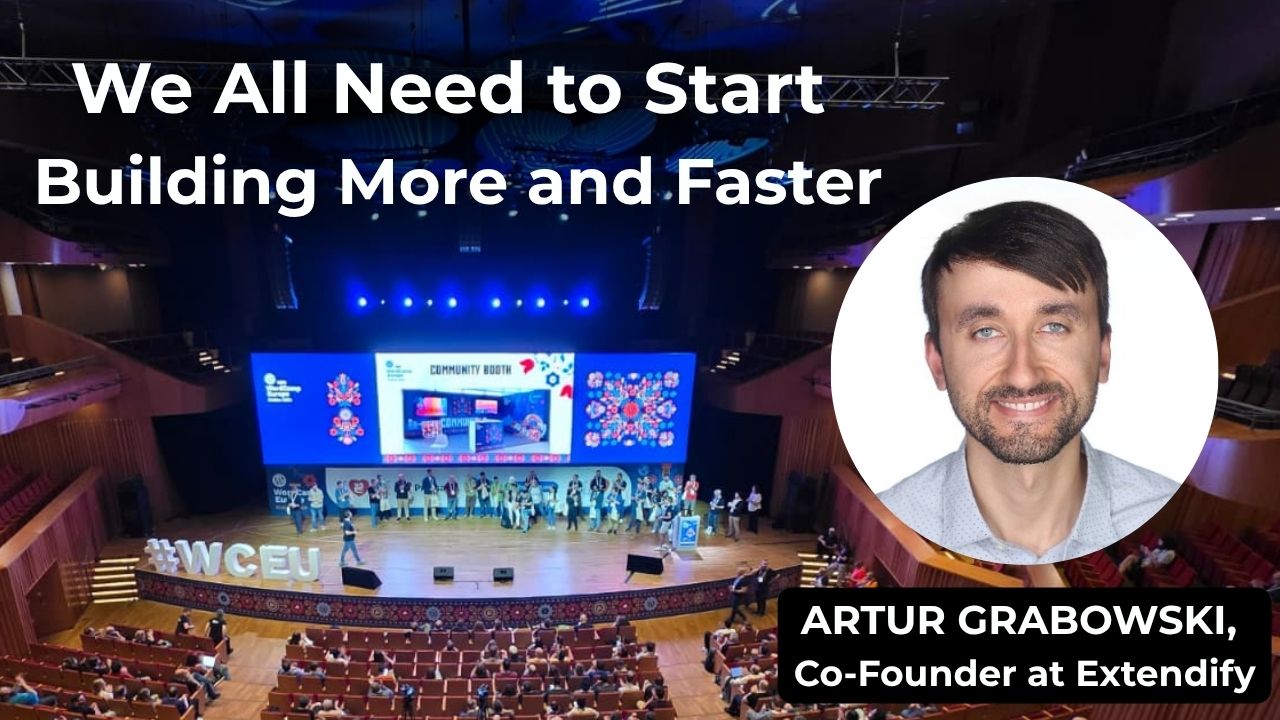
WordCamp Europe 2026 in Kraków brought the WordPress community together right after WordPress 7.0 shipped its first native AI features: connectors, the Abilities API, and the AI Experiments plugin. The question running through the event was what that actually changes for the tools and hosting companies built on top of WordPress.
Łukasz Nowak spoke with Artur Grabowski, Co-Founder at Extendify, a company that builds AI-powered website creation tools sold exclusively to hosting providers. Clients like IONOS and HostGator integrate Extendify directly into their onboarding flow; end users never buy from Extendify directly. The conversation covered why hosting companies compete with website builders rather than with each other, why WordPress AI in core is a foundation and not a threat to third-party builders, and why Extendify has one rule it will not break: it will never offer hosting.
Łukasz: Version 2.0 added 150 new design patterns. How do you decide what to add, and how do you make sure sites built with Extendify do not all look the same?
Artur: We do not think about it the way traditional WordPress templates work – where someone says “this is a template for a coffee shop” or “this is a template for yoga.” We are building the broadest possible library of patterns that an AI agent can draw from. The agent decides the structure, the visual design, and the other elements based on what a specific user needs. When we add more patterns, the agent has more options and can produce more varied results.
It is an ongoing process. With every version, we add something new. Not everything we build is AI-related either – we are about to release a new way to edit a website directly from the frontend. But AI is clearly where most of our focus is right now. Extendify is built for hosting companies. We do not sell directly to end users or agencies. We always look at the product through the lens of what helps hosting companies sell more hosting, retain their customers, and reduce churn.
Łukasz: WordPress 7.0 introduced native AI features – connectors, the Abilities API, AI Experiments. Does that threaten what Extendify does?
Artur: In practice, WordPress 7.0 has added very little that a regular user can actually use today. The connectors are there, there is a lot of discussion, there is the AI Experiments plugin. But if you are a regular user trying to do something with AI on your WordPress site right now, there is still not much there.
Łukasz: So you do not see it as a threat?
Artur: No. Everything we build at Extendify is based on Gutenberg. We are not building our own page builder. That keeps our work compatible with WordPress by default – the blocks keep working and we can move faster because of it.
The same will apply to AI. WordPress serves a very broad group of users. The AI features in core will be foundational – connectors, building blocks. On their own, they will not fully solve users’ problems. But they will give others something to build on. We are waiting for that. When those elements appear in core, we will use them too.
Łukasz: What does Extendify give hosting companies that they could not build themselves in a few months?
Artur: The most interesting examples are IONOS or HostGator. Both of them already had their own products for building WordPress websites before they started working with us. In theory, they could try to build something themselves. They still chose to use Extendify. Because this is the only thing we focus on. We work only on this, and we do it better. We are not a feature on someone’s roadmap. This is the entire product.
Łukasz: How do hosting companies that use Extendify present their advantage? What is the pitch?
Artur: In most cases, they are not competing with other hosting companies. They are competing with Wix, Shopify, and Lovable. The pitch is not “we are better than another host.” It is “you can build a real website here, and it will be yours.”
Łukasz: Let’s stay with Lovable. A user can go there and have a working app in a few minutes. Why should they choose a host using Extendify instead?
Artur: We do not make that argument directly. We do not sell to end users. It is not our role to convince someone to choose WordPress over Lovable.
What we do is help hosting companies communicate it. We help them tell users that they can build a website in 60 seconds, and that website will fully belong to them. If they later change their mind, want to move it somewhere else, or stop using AI, they can still edit it in WordPress. They also get the full ecosystem of plugins and tools that already exists.
That will not matter to everyone. Some users simply want to quickly build something simple – for example Tetris on a website – and that is fine. We are not trying to solve every possible problem. But for someone building a real e-commerce store or a real business, ownership and ecosystem matter. Agencies and developers still strongly prefer working in WordPress. I do not know whether that will still be true in 10 years, but today it remains a real advantage.
Łukasz: Have you considered selling directly? Elementor moved into hosting. You could package the whole thing and go straight to the user.
Artur: No. It is fundamental to what we are that we will never offer hosting. We do not want any channel conflict.
Hosting companies need to know that the best version of Extendify is always available to them. We do not keep features back for our own customers. We are not trying to take their users. Everything we build is focused on their success. That has to be absolute. If hosting companies are not sure about it, the whole model breaks.
Łukasz: What is your message to the WordPress community right now?
Artur: I am not sure I have one specific message, but I think it is very important right now to build faster. When you look at what Lovable and similar tools are doing, and then you see a plugin that still has no AI features, no MCP, and essentially does more or less the same thing it did two years ago – it is hard to believe it will be able to compete with new solutions.
The same applies to hosting companies. Some are trying to do more, but many still are not doing anything particularly interesting or clearly different from what they were doing two years ago. So I think we all need to start building more, and faster.
Łukasz: So it is really about adapting to AI and to a reality where everything moves very fast?
Artur: Yes, because everyone else is moving very fast. I think this also applies to WordPress itself. I know many people are working on it, but I hope that now, with AI connectors and the first steps in that direction in version 7.0, a year from now we will be talking about something truly concrete – something that an average user can use every day.
Łukasz: How was WordCamp Europe in Kraków?
Artur: Very good. Even though we are in Poland, almost all the conversations happen in English – you could be anywhere in the world and it would feel similar. But the event was well organized, Kraków made a good impression, and I heard from many people that they really enjoyed it. What I was especially happy about was seeing more representatives from Polish hosting companies. That was good to see.
Photo: Jeroen Rotty
