

In spring 2026, Hetzner raised cloud and dedicated server prices by approximately 30 to 35%. OVHcloud followed with VPS increases of 43 to 49%. Both cited hardware procurement costs driven by the AI infrastructure buildout. Shared hosting providers (Bluehost, SiteGround, Hostinger, GoDaddy) have not moved their intro prices. That is not a sign of immunity. It is a sign of where shared hosting sits in the hardware replacement cycle. The bill is delayed, not canceled. And it will arrive through the one pricing mechanism shared hosting providers have always used to recover costs: the renewal invoice.
Why VPS and Dedicated Servers Moved First
Hosting providers do not buy servers on a subscription. They buy hardware in capital cycles, typically every three to five years, and the price paid is locked in for the life of that equipment. VPS and dedicated server providers operate closer to the hardware edge: they refresh infrastructure more frequently, carry fewer customers per physical node, and absorb procurement cost changes faster when their cycles turn over.
The hardware market in 2025 and 2026 is structurally disruptive. AI training and inference require High Bandwidth Memory (HBM), produced on the same silicon wafer capacity as standard server DRAM. Producing 1 GB of HBM consumes an estimated three to four times the wafer capacity of producing 1 GB of DDR5, according to semiconductor industry analysis. Samsung, SK Hynix, and Micron, the three manufacturers controlling approximately 90% of global DRAM production, have reallocated production lines toward HBM because it is more profitable. The result is a physical reduction in the supply of conventional server memory even as demand from every other sector continues to grow.
TrendForce revised its Q1 2026 server DRAM contract price forecast upward to around 90% quarter-on-quarter. Server-grade DDR5 contract prices rose by more than 300% over the same period, according to infrastructure procurement data tracked by Worldstream. This is the cost environment Hetzner and OVHcloud were purchasing into when they refreshed infrastructure. Shared hosting providers still running on equipment bought in 2022 or 2023 are, for now, insulated. When that equipment reaches end-of-life, they will face the same procurement market.
Two Cost Vectors Converging on Shared Hosting
Hardware is the deferred vector. cPanel licensing is the active one. For the sixth consecutive year, cPanel raised its license fees on January 1, 2026. The cumulative increase since its 2019 restructuring from a flat-rate to a per-account model is substantial across all tiers, according to pricing data compiled by BaCloud. Unlike hardware costs, cPanel increases are immediate and universal: every provider running cPanel absorbs them regardless of when they last refreshed infrastructure.
The 2026 increases were uneven by tier. The Pro Cloud tier, used by a large share of small and mid-sized hosting providers, rose 17.4%, the sharpest single-year jump in the 2026 round. The overage rate per account rose 16.7%. Providers with large account bases or high growth rates feel the overage increase disproportionately.
cPanel license costs, 2025 vs. 2026 (per server, per month):
| Tier | 2025 | 2026 | Change |
|---|---|---|---|
| Solo | $16.00 | $18.00 | +12.5% |
| Admin Cloud | $19.75 | $21.00 | +6.3% |
| Pro Cloud | $27.25 | $32.00 | +17.4% |
| Plus Cloud | $39.25 | $42.00 | +7.0% |
| Premier | $47.00 | $49.50 | +5.3% |
| Overage (per account) | $0.30 | $0.35 | +16.7% |
Source: cPanel, compiled by BaCloud
The Renewal Gap: Where Hardware Costs Show Up in Shared Hosting
Shared hosting introductory pricing is a customer acquisition tool, not a cost model. The economics of shared hosting have always depended on a significant share of customers renewing, and renewal rates are where providers recover the margin compressed by promotional pricing, infrastructure investment, and licensing fees.
The gap between introductory and renewal pricing across major shared hosting providers is already substantial. The table below shows current advertised intro prices against published renewal rates, using the plan with the lowest available introductory price for each provider.
| Provider | Plan | Intro price | Renewal price | Increase |
|---|---|---|---|---|
| IONOS | Plus | $1.00/mo** | $14.00/mo | +1,300% |
| SiteGround | StartUp | $2.99/mo** | $17.99/mo | +502% |
| Bluehost | Starter | $3.99/mo*** | $9.99/mo | +150% |
| Hostinger | Premium | $2.99/mo* | $10.99/mo | +268% |
| GoDaddy | Economy | $5.99/mo*** | $11.99/mo | +100% |
All intro prices are promotional rates and do not reflect the standard list price. Renewal rates apply after the initial term. Renewal rates as of June 2026.
*Hostinger Premium intro price requires a 48-month commitment.
**IONOS Plus and SiteGround StartUp intro prices require a 12-month commitment.
***Bluehost Starter and GoDaddy Economy require a 36-month commitment.
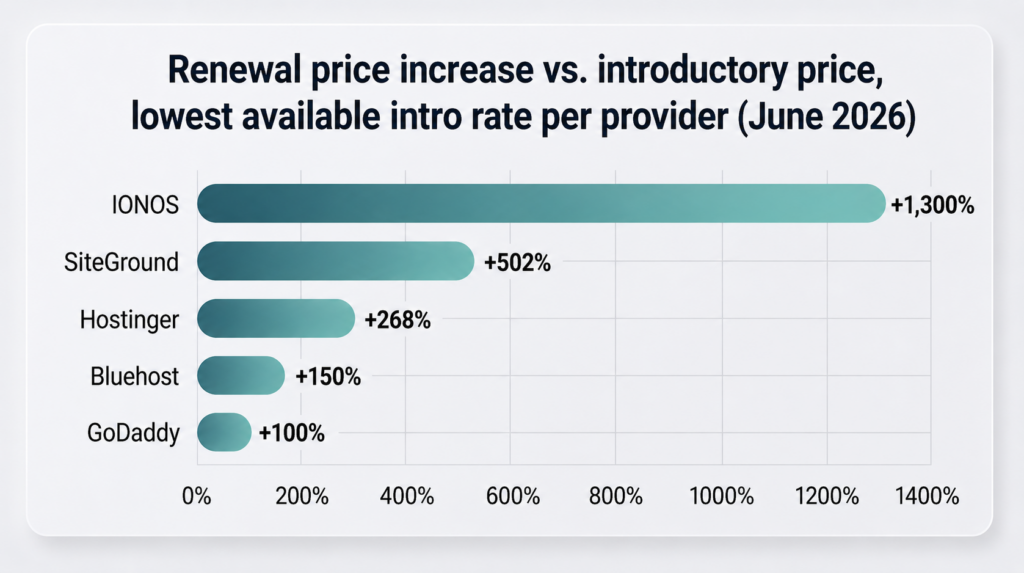
Renewal price is the real cost of shared hosting. It is also the mechanism through which hardware cost increases will reach customers. A provider that pays more for server memory in 2027 does not raise its introductory price; that would cost it new customer acquisitions. It adjusts renewal rates at the next billing cycle.
Namecheap as the Leading Indicator
Most shared hosting providers do not publicly explain the reasons behind renewal price increases. Namecheap is an exception in its transparency about cost drivers, and the sequence it has shown since 2025 is worth examining.
In January 2025, Namecheap updated pricing for VPS plans and cPanel and WHMCS licensing, explicitly citing software licensing cost increases. That signal (a provider naming cPanel as a cost driver while adjusting prices in adjacent product lines) arrived more than a year before the shared hosting increase that followed. In May 2026, Namecheap raised renewal rates on its shared hosting plans. The new published renewal prices: $5.88/mo for Stellar, $7.88/mo for Stellar Plus, $11.88/mo for Stellar Business. The stated reason was “continued investment in improving service quality through additional resources for performance and reliability.”
The sequence matters: licensing cost pressure visible in VPS and infrastructure pricing in early 2025, then shared hosting renewal rates moving in May 2026. That is the pattern of how cost vectors travel through a provider’s product stack: infrastructure tiers first, shared hosting last.
The 2026 to 2028 Window
Shared hosting providers purchasing servers today are buying into a market where server-grade DDR5 costs two to four times what it did 18 months ago. Hardware bought at those prices will underpin renewal invoices issued in 2027 and 2028, when the equipment enters its operational life.
TrendForce and infrastructure analysts at Worldstream and Avnet have described the current DRAM pricing environment as a structural reset rather than a cyclical spike. AI data centers are projected to absorb the majority of high-end DRAM production in 2026, with analyst estimates ranging from 60 to 70%. Supply growth (estimated at roughly 20% more DRAM output in 2026) is insufficient to offset AI demand. Elevated pricing is projected to persist through at least 2027.
Hardware cost cascade by segment:
| Segment | Price increase observed | Timing |
|---|---|---|
| VPS / cloud | +30-49% (Hetzner, OVHcloud confirmed) | Spring 2026 |
| Shared hosting | +10-20% projected (renewal pricing) | 2026-2028 |
The 10 to 20% increase range widely cited for dedicated and VPS hosting should be treated as a floor for shared hosting renewal pricing in this window, not a ceiling. cPanel fee increases compound on top of hardware costs. Both vectors move in the same direction, and neither has reversed.
Three Things Buyers Should Know Before Renewal
Shared hosting introductory prices will remain competitive for the foreseeable future. Providers need new customers, and intro pricing is the primary acquisition tool. Renewal pricing is a different calculation entirely.
A multi-year commitment made now locks in pricing before the hardware cost cycle turns. Providers that have not yet refreshed infrastructure at 2026 hardware prices are still offering renewal rates based on older cost structures. That window narrows as equipment ages and procurement cycles turn over.
Total cost over 36 months is the correct comparison unit, not the monthly intro price. A SiteGround customer on the StartUp plan at $2.99/mo for the first year and $17.99/mo for the following two years pays $468 over 36 months, not $108. At GoDaddy, the Economy plan locks the $5.99/mo rate for an initial 36-month term, totaling $216, then renews at $11.99/mo.
The Namecheap sequence (licensing cost pressure in VPS pricing in 2025, then shared hosting renewal rates rising in May 2026) is likely to repeat at other providers. The cPanel cost vector is universal. When shared hosting providers refresh hardware at current procurement prices, renewal pricing reflects it. The question for buyers is whether their current plan was signed before or after that refresh.

Sources
- cPanel NOC License Costs Keep Rising: A 2025-2026 Price Comparison - BaCloud
- cPanel Price Increases: A Timeline of Rising Costs Since the Acquisition - ServerPoint
- Price updates for VPS hosting plans and cPanel/WHMCS licensing, January 2025 - Namecheap Blog
- Shared Hosting pricing changes, May 2026 - Namecheap
- DDR5 Memory Prices Surged 307% - Worldstream
- DRAM price hike to hit server and infrastructure costs - The Register
- Hetzner to significantly increase prices for cloud and dedicated servers starting in April 2026 - Igor's Lab
- Pricing evolution of Public Cloud, Bare Metal and VPS at OVHcloud - OVHcloud Blog
- Server DRAM contract price increase revised upward to 90-95% QoQ in Q1 2026 - TrendForce
- Riding the AI Supercycle: Navigating the 2026 Memory and Storage Market - Avnet
- Shared Hosting Plans and Pricing - SiteGround
- Hosting Plans and Pricing - Hostinger
- Renewal Price FAQ - Bluehost
- Web Hosting Plans and Pricing - IONOS
- Plans and Pricing - GoDaddy