
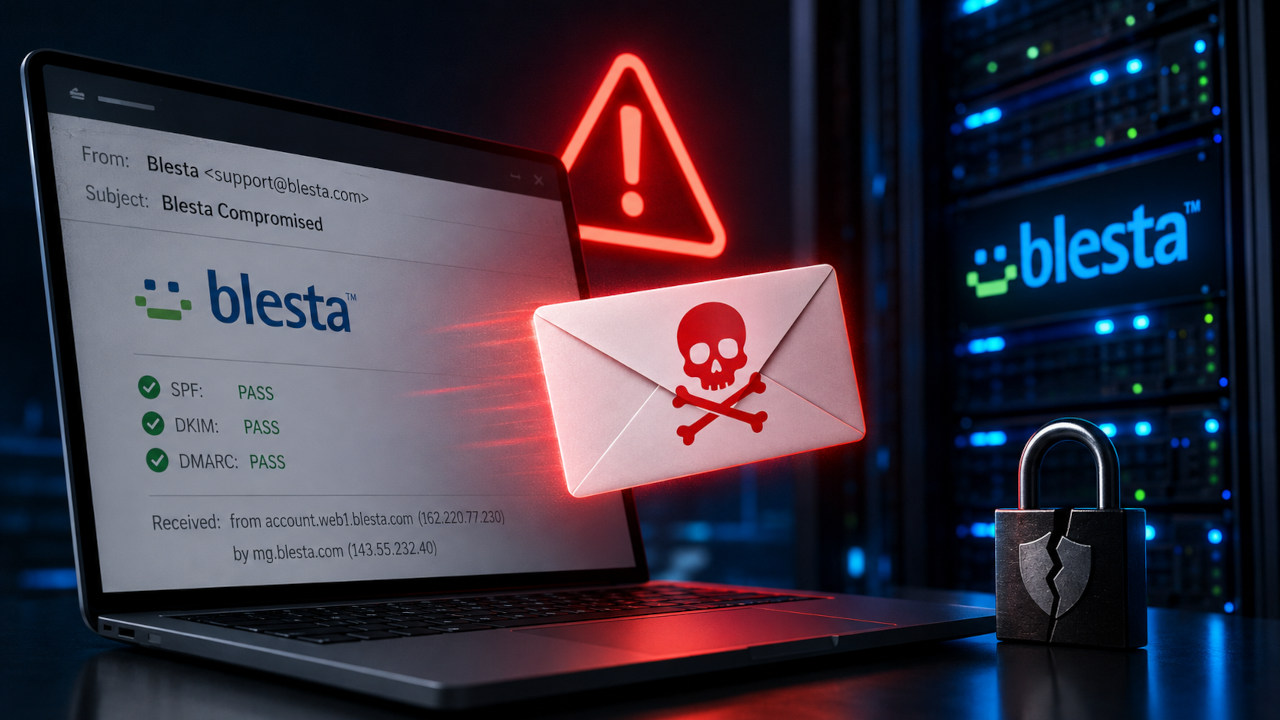
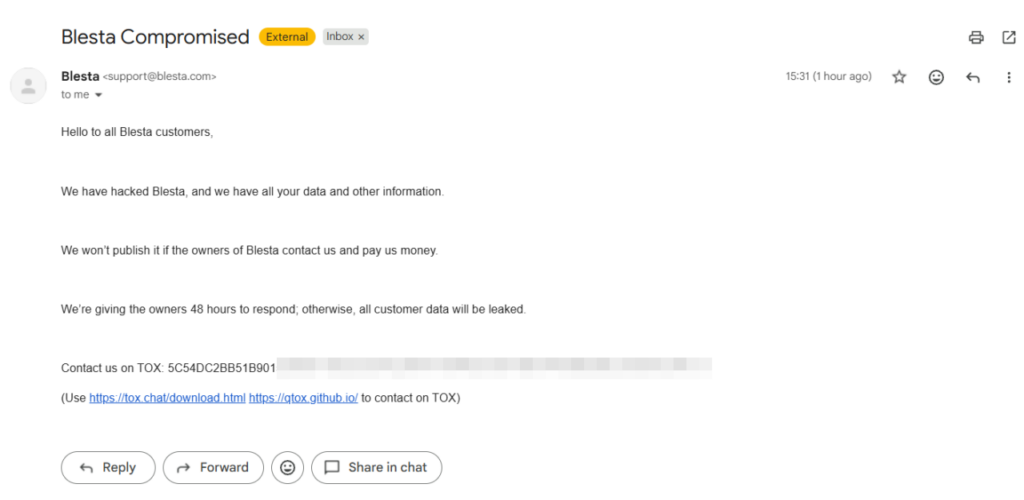
On June 26, recipients began receiving an email from Blesta <[email protected]>, subject line “Blesta Compromised,” telling “all Blesta customers” that the sender had hacked the billing-software vendor, held all their data, and would leak it within 48 hours unless the owners paid. The instinctive read is the right starting point and the wrong conclusion: this looks like the fake-breach extortion spam that hits the industry constantly, and the safe assumption with any such message is that it is a bluff sent from a forged address. The message headers say otherwise, and that is the story. The email passed SPF, DKIM, and DMARC, and was sent through Blesta’s own email infrastructure, from Blesta’s own server. A spoofer cannot do that. The authentication that normally tells you a message is genuine is, in this case, the evidence that something is wrong: it points to a real compromise of Blesta’s systems, and as of publication Blesta has issued no advisory and not confirmed an incident.
Key facts (from message headers and DNS records we reviewed, June 26, 2026)
- The message: From
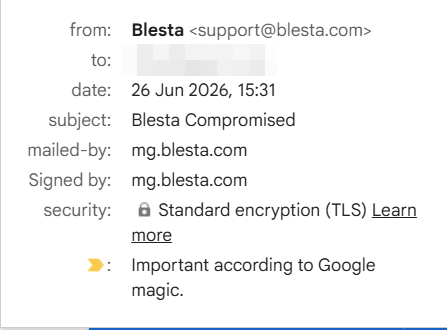
Blesta <[email protected]>, subject “Blesta Compromised,” received June 26, 2026 at 14:31 UTC; it claims the sender “hacked Blesta,” holds “all your data,” gives the owners 48 hours to pay or “all customer data will be leaked,” and directs contact to a TOX messenger ID - It is not a spoof: the email passed SPF (pass), DKIM (pass, signed with Blesta’s own key
d=mg.blesta.com s=k1), and DMARC (pass, with Blesta’s policy atp=REJECT) for the From domain blesta.com; a forged sender would have failed the reject policy - It came from Blesta’s own infrastructure: the message was relayed by Blesta’s Mailgun account (
mg.blesta.com, sending IP 143.55.232.40, reverse DNS tosend.mailgun.net) after being injected from Blesta’s own server,account.web1.blesta.com(162.220.77.230, confirmed by reverse DNS) - What that demonstrates: the email genuinely originated inside Blesta’s email pipeline, which cannot be forged without access to Blesta’s systems, strongly indicating a real compromise of at least Blesta’s email-sending and account infrastructure
- What remains unverified: the attacker’s claim to hold “all customer data” is unproven; the headers establish unauthorized sending from Blesta’s systems, not the scope of any data theft
- Blesta has not commented: its public security page shows only routine recent posts (a 5.13.10 patch on June 24 and a low-severity advisory on June 8) and no statement about this email; no breach tracker or security outlet had reported it at publication time
Why the Authentication Is the Whole Story
Email authentication, SPF, DKIM, and DMARC, became a precondition for reaching the major inboxes when Google and Yahoo began enforcing it for bulk senders in February 2024, with Microsoft following in 2025. The point of SPF, DKIM, and DMARC is to let a receiving server verify that a message claiming to come from a domain really did come from that domain’s authorized infrastructure. Normally a passing result is reassuring: it means the email is genuine and not a forgery. Here it is the opposite of reassuring, because the message it authenticates is an extortion demand. DKIM passed because the email was signed with Blesta’s own private key, the one held only by Blesta’s Mailgun sending account, which a third party cannot reproduce. DMARC passed at Blesta’s own reject policy, meaning the From address was not spoofed; a forged [email protected] from outside would have been rejected by the receiving server before it ever landed. The same authentication that normally certifies a message as genuine is, in this case, the proof that the attacker is operating from inside the trusted boundary.
The routing makes the point concrete. The message was injected into Blesta’s Mailgun account from account.web1.blesta.com, an address that reverse-DNS confirms as Blesta’s own server, and Blesta’s Mailgun sending domain mg.blesta.com is handled by mg.phillipsdata.com, the infrastructure of Phillips Data, the company behind Blesta. In plain terms, the email did not come from some lookalike domain or a hijacked unrelated mailbox. It came from Blesta’s server, through Blesta’s mail provider, signed as Blesta. The simplest explanation is that an attacker got into Blesta’s own systems, the web/account server or the Mailgun-connected sending capability, and used them to blast Blesta’s customer and contact list with a ransom demand. The message also reached at least one person who says he is not a Blesta customer, which suggests the attacker is working from addresses held inside Blesta’s systems. That makes the case stronger, not weaker.
What Is Established, and What Is Not
The distinction matters, because Blesta has confirmed nothing and because it is the whole risk picture. What the technical evidence establishes is narrow and solid: an unauthorized party sent authenticated email from Blesta’s own infrastructure, which is itself a serious security incident regardless of what else is true. What the evidence does not establish is the attacker’s headline claim. “We have all your data and will leak it” is an assertion in a ransom note, and ransom notes routinely overstate. The headers prove the sending system was compromised; they say nothing about whether the customer database was actually exfiltrated, partially accessed, or merely claimed. A real intrusion into the mail-sending and account layer is fully consistent with both a complete database breach and an attacker who got that far and is bluffing about the rest. Until Blesta or outside forensics pin down the scope, the honest position is that Blesta’s email systems were almost certainly compromised, and how much data was taken, if any, is unknown.
Blesta’s silence does not point either way. Its security blog, checked at publication time, shows only its routine June posts, a 5.13.10 patch and an unrelated low-severity advisory, with nothing about an unauthorized email or a compromise. That is what one would expect in the first hours of an incident a vendor has not yet investigated or chosen to disclose, and it is also what one would expect if the vendor believed the email was an external fake. Blesta had issued no public statement at publication time. We have contacted Blesta for comment and will update this report with any response. Silence is neither a denial nor a confirmation; it is just where things stand right now.
Why This Lands on the Whole Hosting Industry
Blesta is a billing and client-management platform used by hosting providers to run their commercial operations, a direct competitor to WHMCS, and that is exactly why an incident at this layer matters beyond Blesta’s own customers. As Michael Pearce, the founder of Hosting Verified who surfaced the email publicly, noted, a billing panel is not just an admin tool: it holds customer records, invoices, payment metadata, support history, API keys, server links, and automation access. A compromise of the vendor that makes that software, or of the vendor’s own systems, is a compromise one level above every host that depends on it. The hosting industry has spent this year learning the same lesson from several directions, the OptinMonster supply-chain attack, the self-propagating npm worms, the cPanel authentication-bypass episodes: the trust boundary has moved to the vendors and the infrastructure beneath the host, and an attacker who reaches that layer reaches everyone downstream at once.
The practical response is the unglamorous discipline Pearce laid out, and it applies whether or not this specific incident proves out: do not treat a scary email as proof, and do not ignore it either. Verify the message against the vendor’s official channels rather than the contact details in the email itself. Check your own installed version and patch level. Rotate admin and API credentials if there is any plausible exposure, because in this case the credentials and keys stored in billing panels are precisely what a compromise of that layer would expose. Review logs before concluding you are fine. And treat any billing platform, control panel, or automation stack exposed to the internet with the same security discipline as production infrastructure, because that is what it is. The irony is that the email authentication the major inboxes forced on senders did its job perfectly here. It told the truth. The truth was just the bad news.
What to Watch
The next clear answers will come from Blesta itself: an advisory confirming or denying an incident, guidance to customers, and any statement on scope. Independent corroboration would come from other recipients confirming authenticated headers identical to those reviewed here, from breach-monitoring services, or from any appearance of Blesta customer data on leak channels, none of which had surfaced at publication. We are not naming or contacting the extortion channel, and we urge recipients not to engage with it. We will update this report as Blesta responds and as the scope, the part the headers cannot settle, becomes clearer. What the evidence supports today is a narrow claim: an extortion email was sent from Blesta’s own authenticated email infrastructure, which points to a real compromise of Blesta’s systems, and how much customer data was taken, if any, is for now just the attacker’s word.
How We Verified This
This report is based on the full message headers of the email, shared by the recipient and reviewed by us, and on DNS records we verified independently on June 26, 2026. The authentication results (SPF pass, DKIM pass with d=mg.blesta.com s=k1, DMARC pass at p=REJECT for header-from blesta.com) are read directly from the receiving server’s Authentication-Results and ARC headers. The sending path is read from the Received headers and confirmed by reverse-DNS lookups: 162.220.77.230 resolves to account.web1.blesta.com and 143.55.232.40 resolves to a send.mailgun.net host; mg.blesta.com mail is handled by mg.phillipsdata.com (Phillips Data, the maker of Blesta). The email was surfaced publicly by Michael Pearce of Hosting Verified on LinkedIn. We state as established only what the headers and DNS demonstrate, the authenticated origin of the message from Blesta’s infrastructure; we treat the claim of full customer-data theft as unverified, and we note Blesta has not issued a public statement and was contacted for comment. We are deliberately not reproducing the TOX contact identifier.
