
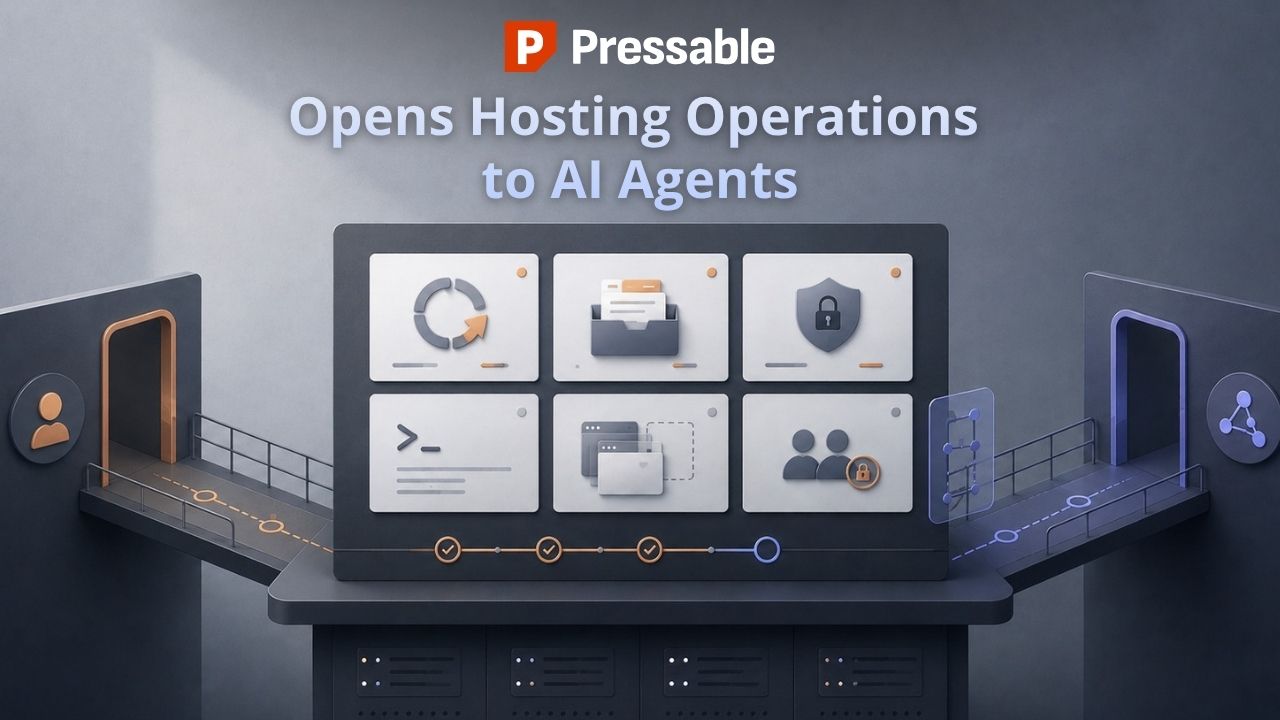
An AI agent can now clear a cache, download a backup, run a WP-CLI command across many sites at once, and retry an SSL certificate on Pressable, all from a chat window. In its June 2026 product update, Pressable, a managed WordPress host that describes itself as an Automattic hosting lab, sharply expanded the operations its Model Context Protocol integration exposes to AI assistants like Claude, ChatGPT and Gemini. Model Context Protocol, or MCP, is an open standard that lets an AI assistant connect to an outside service and operate it through a single, common interface. The significance is not any single feature. It is that the hosting control plane, the place where sites are provisioned, backed up and secured, is becoming something an AI agent operates directly, and Pressable has just pushed that idea well past writing content and into running infrastructure.
From Content to Operations
Until recently, letting an AI agent touch WordPress mostly meant working with content. Pressable’s expansion is about the hosting layer underneath. The update adds eight categories of operational commands to its MCP server:
- Caching and defensive mode: clear edge, object or CDN cache and toggle defensive mode
- Backups: list and download file and database backups
- WP-CLI and shell: run commands on a single site or across many at once
- Environment transfer: copy files and databases between environments
- WordPress admin: reset passwords and open phpMyAdmin
- SSL: check certificate status and retry issuance
- Site organization: tag sites, add notes and mark favorites
- Access management: disconnect SSH sessions and toggle MCP connections
On top of those sit twelve bulk operations that act across a whole portfolio at once, among them cloning sites, removing plugins, toggling maintenance mode and converting environments. The capabilities are in public beta and included free on every plan, with no reconfiguration for accounts already connected.
Automattic Is Building for the Agentic Web
Pressable’s move fits a deliberate pattern at its parent. In February the WordPress project introduced the WordPress MCP Adapter, a way to expose a site’s data and actions to MCP-compatible AI clients. On March 20, WordPress.com switched on nineteen write operations across six content types, letting agents create and publish content with human approval at each step and new posts defaulting to draft. In April, Automattic published a piece titled “WordPress: The Operating System of the Agentic Web.” Pressable’s June update carries that thesis onto the server itself, shipping two MCP layers: a hosting-level integration for account and infrastructure tasks, and the WordPress MCP Adapter for site-level content. Automattic is assembling an AI-agent-native stack across its properties, and Pressable is where it reaches the server.
The Category Is Forming, Native and DIY
Automattic is not alone. Rocket.net ships an official MCP server that exposes its hosting capabilities as agent tools, to the point that, by the company’s own description, an agent can sign up, provision a WordPress site, attach a domain and issue SSL without a human ever logging in. Others take a build-your-own route: Kinsta publishes a guide for wiring an MCP server to its API, framed explicitly as a developer exercise rather than a native product. The distinction matters. A vendor-run MCP server is a supported part of the hosting product, while a DIY server built on an API is a customer’s own integration to maintain. Either way, the managed WordPress market is starting to treat agent access as something to compete on.
Handing an Agent Shell Access Is a New Risk Surface
Operational power cuts both ways. An agent that can run shell commands, download backups and remove plugins across an entire portfolio is also an agent that can do real damage from a misread instruction, and it widens the attack surface if its credentials are compromised. The safeguards are still being defined. WordPress.com’s write features are built around explicit human approval, with the agent describing each action before it runs and edits to a published post triggering a warning. Pressable used the same June update to consolidate its team permissions, folding collaborator and backup-and-restore controls into clearer roles. The two changes sit well together: as agents gain reach, who and what can act matters more. Access management is itself one of the MCP categories, including the ability to toggle MCP connections and cut SSH sessions. For a host, the permission model is becoming as important as the feature list.
The Dashboard Is No Longer the Only Front Door
The through-line is that the control panel is no longer the only way into a hosting account. For years the dashboard was the product surface, the thing hosts designed, differentiated and supported. MCP adds a second front door, one built for an agent rather than a person, and the update cadence at Pressable and Rocket.net suggests hosts now see that door as competitive ground. It reshapes support, where a customer’s “how do I” may increasingly be answered by their own agent, and it raises the stakes on reliability, because an interface an agent drives at machine speed leaves less room for a human to catch a mistake. The dashboard is not going away. It is just no longer the only thing a host has to get right.

Sources
- June Product Update: Bulk Operations, a Major MCP Expansion, and Smarter Team Controls - Pressable
- Pressable MCP: Control Your WordPress Hosting With AI - Pressable
- WordPress: The Operating System of the Agentic Web - Automattic
- From Abilities to AI Agents: Introducing the WordPress MCP Adapter - WordPress Developer Blog
- WordPress.com Lets AI Agents Write, Publish, and Manage Your Site - The Next Web
- Rocket.net Launches a New Developer Hub With Full MCP Integration - Rocket.net
- Create Your Own MCP Server to Control WordPress Hosting With AI - Kinsta