

Leaseweb raises its virtual private server prices on August 1, but the increase is not spread evenly. The cheapest US plan nearly doubles, from $3.50 to $6.99 a month, while the premium tiers rise far less and, in several markets, the mid-range does not move at all. Averaged out it reads as a 20% rise; in practice it is a targeted correction that lands hardest on the plans that were cheapest to begin with. Leaseweb is less taxing its whole range for the year’s memory shortage than ending the era of the near-free VPS.
The gradient is consistent across Leaseweb’s price lists: the entry tier takes the biggest increase in every market, while the upper tiers rise far less.
- United States: 41% average, the entry plan up 99.7% and an upper tier up 53%, but the top tier up only 11%
- United Kingdom: 24% average, the entry plan up 47%
- Netherlands, Germany, and Canada: 16% average, with only the entry and top tiers moving in the Dutch and German lists
- Japan: 7%, where only the entry plan changes; Singapore and Australia are unaffected
The change applies only to new contracts signed on or after August 1. Existing contracts keep auto-renewing at their current price, and there is a July 31 window to order at today’s rates.
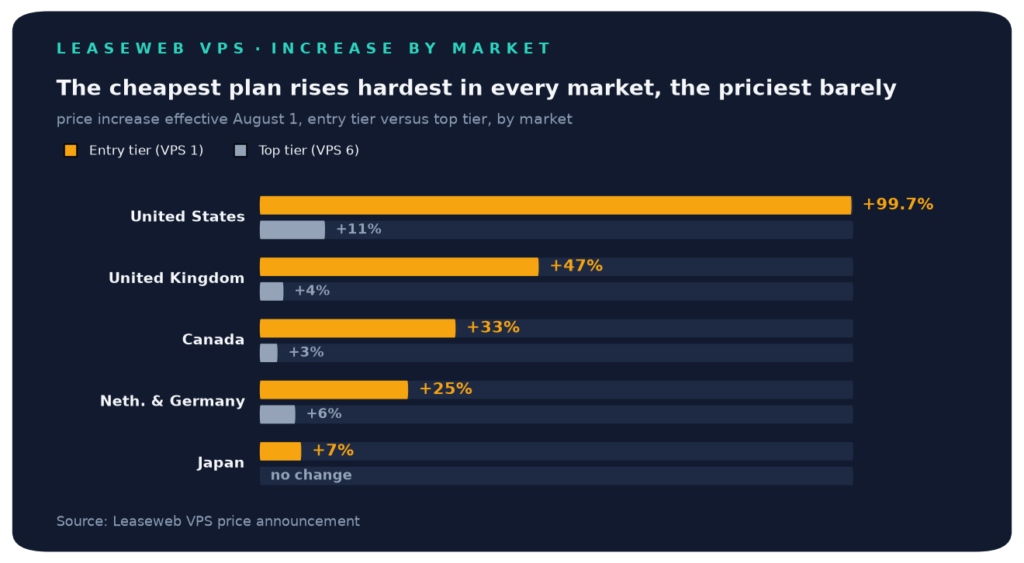
In every market the cheapest plan takes by far the biggest increase, and the most expensive the smallest.
Source: Leaseweb VPS price announcement.
The Shortage Explains the Rise, Not Its Shape
Leaseweb points to rising costs, above all the memory shortage, and memory has indeed roughly doubled in price. But that explains why prices rose, not why they rose in this shape. A memory-cost increase falls on RAM, and RAM scales with the plan: a large VPS carries many times the memory of a small one, so in percentage terms a memory rise lands about evenly across the range, if anything harder on the big, RAM-heavy plans. On its own it would never take the cheapest plan up nearly 100% while the dearest moves 11%. Leaseweb’s other cited cost, a shortage of IPv4 addresses, is a flat per-instance charge that does fall harder on a cheap plan, but the price of IPv4 has been drifting down, not up, as recovered blocks flood the transfer market, so it cannot explain a rise either. Neither cost produces this gradient. It reflects a pricing decision rather than a cost one: the cheapest plans carry the thinnest margins, so they are where the year’s rises bite first and where Leaseweb has both the most need and the most cover to correct. The shortage is the occasion to reset them, not the reason the increase lands where it does. And since Leaseweb expects memory pressure to last into early 2027, the cheap tier is not drifting back down.
The Buyers Who Chose Cheap Feel It Most
Shaped this way, the increase is regressive in who it touches. Someone who picked a $3.50 plan did so because it was $3.50, and a near-doubling is precisely what that buyer can least absorb; unlike an enterprise on dedicated servers, there is no larger relationship to soften it. The resellers, agencies, and side projects that run on cheap VPS either wear the cost or pass a double-digit rise to their own customers and risk losing them. The protection Leaseweb gives existing contracts, which auto-renew at the old price, is real but temporary, lasting only until the next time a buyer needs fresh capacity or the terms reset.
Leaseweb is neither the first to raise prices this year nor likely the last. OVHcloud, Netcup, and Scaleway moved earlier on the same AI-driven memory shortage, while a few large hosts such as Contabo have held the line and even cut. What Leaseweb’s price list adds is a sharper picture of where the increases land. The few-dollars-a-month VPS that a decade of competition pushed toward zero is being repriced toward cost, and the buyers who treated that floor as permanent now need a new one.

Sources
- VPS Price Increases Are Coming for New Contracts in 2026 - Leaseweb (official)
- What to Do About Rising Server and Cloud Prices in 2026 - Leaseweb (official)
- Pricing Evolution of Public Cloud, Bare Metal and VPS at OVHcloud - OVHcloud (official)
- Information on the 2026 Price Adjustment - netcup (official)
- A Transparent Update on Scaleway Pricing - Scaleway (official)
- Contabo Wrapped 2025: The Year of Always Improving - Contabo (official)
- Expect More DRAM Price Hikes as the Memory Shortage Continues to Bite - The Register
- IPv4 Address Prices Fall as Supply Surges - CircleID