
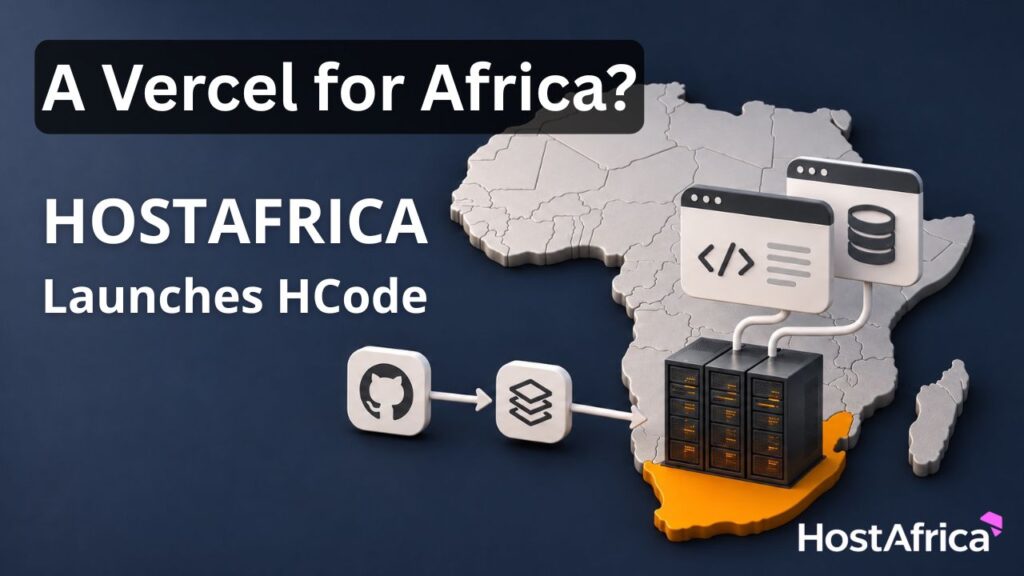
On November 5, HOSTAFRICA launched HCode as its answer to platforms like Vercel. Developers push code from GitHub, the platform runs it, and customers in six African countries pay in rands, naira or another local currency. The apps themselves run in South Africa. HCode, a rebranded version of the Zanode platform HOSTAFRICA bought in May, starts at R50 a month, or about $3 internationally.
Customers connect a GitHub repository or upload a .zip file. HCode then detects and builds Node.js, Python, Go, Ruby or PHP projects, or builds from a Dockerfile. Managed PostgreSQL, custom domains and SSL come with every plan. According to the launch release, HOSTAFRICA has moved Zanode onto its own infrastructure, client area and support team.
HOSTAFRICA announced the deal on May 14, presenting the platform as an extension of its offering “beyond traditional shared, reseller, and VPS products.” It was the company’s second South African purchase in nine days, after Evoweb’s hosting division on May 5. At the launch, chief executive Michael Osterloh pitched HCode to African developers: “What still slows African builders down is everything after the code: offshore servers, dollar invoices and a database on another continent.” Zanode’s plans are billed in rands, while HCode is listed in rands, dollars, naira and other currencies across HOSTAFRICA’s country sites, a wider storefront than the platform had alone.
HCode’s Pitch: South Africa by Default, Billed in Local Currency
The product page compares HCode directly with Vercel, Netlify, Railway and Render. South Africa is not out of reach for global platforms. Vercel’s documentation lists a Cape Town region, and Fly.io’s lists Johannesburg. HOSTAFRICA’s pitch rests on what a customer gets without configuring anything: the app and its PostgreSQL database in the same country, billing in local currency and an entry plan that stays on.
| Platform | South African region | Default or listed compute regions | Lowest entry point |
|---|---|---|---|
| HCode | Yes, by default | South Africa | R50 or $3 a month, always on |
| Vercel | Cape Town, if selected | Functions default to Washington, D.C. | Free Hobby plan, non-commercial personal use |
| Netlify | None listed | Functions default to Ohio | Free plan with a credit limit |
| Railway | None listed | US, Netherlands, Singapore | Free plan with $1 of credit a month |
| Render | None listed | US, Germany, Singapore | Free web services that spin down after 15 idle minutes |
Paid entry points differ too. Railway’s Hobby plan costs $5 a month, Render’s smallest paid web service $7 for 512 MB of RAM, and Vercel’s Pro plan starts at $20 with one developer seat and $20 of usage credit. These prices are not like for like, since each platform measures resources and usage differently. The table also compares where backend code runs, not each platform’s full architecture. Vercel, for example, serves content through a global CDN as well.
HOSTAFRICA’s international page presents HCode as “Modern App Hosting, Built in Africa,” and the company also lists it on its sites for Nigeria, Kenya, Ghana, Egypt and Rwanda. The Nigerian page starts at ₦4,500 a month and adds that apps “run on the continent,” with the deployment in South Africa.
On data rules, the company is careful. Its FAQ allows that local hosting can simplify conversations about South Africa’s POPIA privacy law, but advises customers to treat HCode as “the hosting half of the answer, not the whole of it.”
How HCode’s Plans Compare With Zanode’s
Zanode still sells its own plans, and its customers have not moved yet. According to HCode’s FAQ, they “will be emailed about the move.” The two price lists use the same rand amounts, but HCode’s allowances are lower on most lines.
| Plan | Price per month | Zanode: projects, RAM, storage | HCode: projects, RAM, storage |
|---|---|---|---|
| Solo | R50 | 3, 1 GB, 15 GB | 3, 1 GB, 10 GB |
| Developer | R200 | 6, 6 GB, 30 GB | 5, 4 GB, 20 GB |
| Pro | R499 | 15, 12 GB, 75 GB | 10, 8 GB, 40 GB |
| Team | R999 | Unlimited with a soft cap of 20, 32 GB, 150 GB, priced per seat | 20, 16 GB, 80 GB, priced per seat in the launch release |
Zanode also lists a free first month on Solo, in a reduced mode with 512 MB of RAM and sleep after 60 minutes idle.
HCode’s plans work as a pool of memory and storage shared by apps and databases. New apps and PostgreSQL databases start at 512 MB with half a CPU, so the Solo plan’s 1 GB covers one app and one database at those sizes. Solo allows one database and keeps daily backups for three days. HOSTAFRICA describes releases as going live without downtime, with a failed release never replacing the running app.
What HCode Covers and What It Leaves Out
HCode’s documentation is direct about what the service leaves out. Its dashboard has no preview or pull request deployments, which Vercel creates by default when a commit is pushed to a non-production branch. There are no scheduled jobs, so timed tasks need a scheduler running inside an app or worker. MySQL is not offered, and neither are WordPress sites, although Zanode’s site lists WordPress hosting. Outbound connections to SMTP ports are blocked, so apps have to send email through a provider’s HTTPS API. HOSTAFRICA’s separate shared Node.js hosting includes Git and cron jobs.
Apps do not sleep, and reaching a plan limit stops new work without stopping apps already running. Plans also cap bandwidth and build minutes, but neither appears in the dashboard. Warning emails go out at 80%.
For teams whose users are in South Africa, HCode offers local hosting and bills in rands, with a shorter feature list than Vercel’s. Teams elsewhere on the continent get the same platform and billing in their own currency, with their apps hosted in South Africa.

Sources
- HCode: AI-ready GIT app hosting for Node.js, Go, Ruby with PostgreSQL - HOSTAFRICA release via Bizcommunity
- HCode: Modern App Hosting on South African Soil - HOSTAFRICA
- HCode: Modern App Hosting, Built in Africa - HOSTAFRICA
- HCode, Nigeria - HOSTAFRICA
- FAQ - HCode docs
- App and database sizes - HCode docs
- Usage and limits - HCode docs
- Build minutes - HCode docs
- HOSTAFRICA acquires zanode.co.za, bringing the AI deployment toolset to South African developers - HOSTAFRICA
- HostAfrica acquires Evoweb's hosting division - HOSTAFRICA
- South African app hosting for SaaS teams, agencies, and developers - Zanode
- Global network and regions - Vercel
- Configuring regions for Vercel Functions - Vercel
- Vercel Hobby Plan - Vercel
- Vercel Pricing: Hobby, Pro, and Enterprise plans - Vercel
- Environments - Vercel
- Configuration for functions - Netlify
- Pricing - Netlify
- Regions - Railway
- Pricing Plans - Railway
- Regions - Render
- Deploy for Free - Render
- Pricing - Render
- Regions - Fly.io