
Of 600 US non-developers who use AI to write code, around one in six builds entire websites with it and a similar share builds single web pages, according to a survey published by the hosting provider 20i. Across the sample, 31.5 percent have their AI-written code reviewed by a professional developer. Six in ten test it themselves. Those sites have to run somewhere, and whoever hosts them inherits the consequences of code they never saw.
Key facts
- What they build: 17.2 percent use AI to create single web pages, 16.3 percent entire websites, 14 percent API integrations, 13.5 percent database queries and 7 percent custom plugins.
- Who checks it: 61 percent self-test their own code, against 31.5 percent who get a professional developer’s review.
- Formal policy: 26 percent of organizations have one on AI-assisted coding. Another 34.2 percent rely on informal guidance only, 31.7 percent have nothing and 8.2 percent do not know.
- Independent testing: Veracode’s spring 2026 update found that 55 percent of generation attempts passed its security tests for the four vulnerability classes examined, a rate essentially unchanged in two years.
- The professional comparison: in Checkmarx research covering 2,350 developers and security managers, 70 percent report significantly more vulnerabilities with AI-generated code. Separately, 30 percent say they knowingly ship vulnerable code into production.
Single Pages, Whole Websites and API Integrations
Most of what the survey captures is unremarkable. Among the everyday uses it lists, data analysis leads at 48.5 percent, followed by workflow automation at 37 percent, bug fixing at 27.8 percent, code review at 27.7 percent and script writing at 25.5 percent. That is a picture of employees clearing their own small technical obstacles rather than replacing an engineering team, and 36.4 percent do it at least weekly.
The survey reports the web-facing work separately, and that is the part most likely to end up on the public internet. A reported 17.2 percent use AI to create single web pages and 16.3 percent build entire websites. API integrations are reported by 14 percent, database queries by 13.5 percent and custom plugins by 7 percent. An insecure database query or a plugin nobody reviewed does not stay a private problem once it is deployed under a domain name.
Most of the Checking Is Done by the Person Who Wrote It
The verification numbers are where the survey earns attention. Six in ten respondents, 61 percent, self-test their own code, against 31.5 percent who have it reviewed by a professional developer. A second AI tool is used by 23.3 percent, 20.2 percent ask a colleague who is also not a developer, and 9.3 percent check nothing at all. Respondents could name more than one method, so the figures overlap rather than divide the sample. The question 20i put to them asks how they check that the code “works as intended”, so what these figures measure is functional checking rather than security review.
Self-testing can catch code that does not work, which is what the question asked about. It is not an independent review and not a security test. What the survey does establish is where this group started rather than where it is now: only 12.5 percent regularly wrote code before they began using AI tools, and 51.1 percent had very limited or no prior coding knowledge. Confidence has not followed the same curve: 73.5 percent say they feel confident generating code with AI without support from a developer, including 21.7 percent who describe themselves as very confident. Among users aged 18 to 24 that figure reaches 95.5 percent.
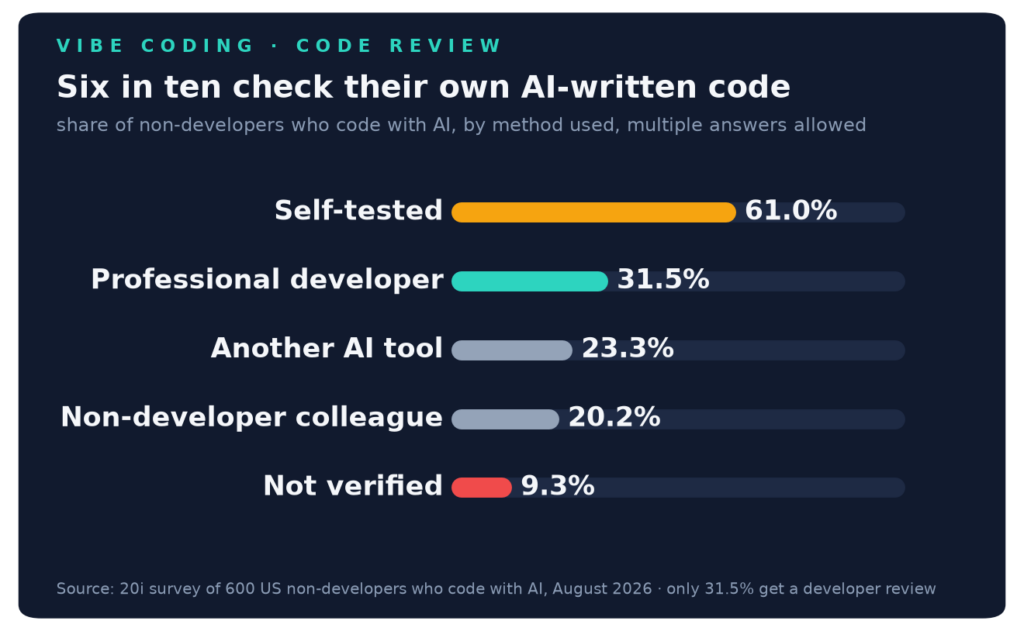
Nearly twice as many check their own work as hand it to a developer. Source: 20i survey of 600 US non-developers who code with AI, August 2026.
The respondents are not oblivious. A large majority, 83.8 percent, report having run into problems with AI-generated code. Asked to name their biggest challenge, 35.2 percent chose knowing whether the output can be trusted, ahead of integration issues at 27 percent, difficulty understanding the code at 25.5 percent and bugs at 25.3 percent. The difficulty is that recognizing the problem in the abstract and catching an injection flaw in a specific file are different skills.
A Quarter of Organizations Have a Formal Policy
Governance is thinner than the activity it would need to cover. Just over a quarter of the organizations covered, 26 percent, have a formal policy on AI-assisted coding. Another 34.2 percent operate on informal guidance alone, 31.7 percent have no policy at all and 8.2 percent are not sure whether one exists. Taken together, 65.9 percent say their organization works under either informal guidance or no formal policy on AI-assisted coding.
The survey also reports that 20.5 percent say AI-generated code has contributed to a security breach at their organization. That is the figure most likely to be quoted elsewhere, and the one to hold most loosely. The survey does not explain how respondents established the causal link between the code and the breach, so it belongs in the picture as a self-reported attribution and not as a measured breach rate.
Three separate pieces of research sit behind the rest of this article, and they are not the same kind of evidence.
| Research | What was measured | Method | Published |
|---|---|---|---|
| 20i | 600 non-developers in the US who code with AI | Self-reported survey | August 2026 |
| Veracode | 80 coding tasks run through more than 150 language models | Laboratory testing | March 2026 |
| Checkmarx | 2,350 developers, CISOs and application security managers | Self-reported survey | June 2026 |
Independent Testing Puts the Failure Rate Near Half
Evidence that does not depend on self-assessment points the same way. Veracode’s spring 2026 update to its GenAI code security research ran 80 coding tasks across Java, JavaScript, C# and Python through more than 150 large language models, checking for four critical vulnerability types. Across all models and all tasks, 55 percent of generation attempts passed Veracode’s security tests for the four vulnerability classes examined. The other 45 percent introduced a flaw when no security guidance was supplied.
Two details in that finding matter more than the headline rate. Veracode puts the overall pass rate at approximately 55 percent and virtually identical to where it stood two years earlier, with one exception it names: OpenAI’s reasoning models posted the largest gains, and the GPT-5 series with extended reasoning reached 70 to 72 percent. For the field as a whole, waiting for a better model has not moved the number. And the spread by language is wide: Python passed 62 percent of the time, C# 58 percent and JavaScript 57 percent, while Java managed 29 percent. Veracode sells application security testing, which is worth keeping in view, but this is laboratory measurement, not an opinion poll. It also tests what a model returns without security-specific prompting, which is not necessarily what an employee ships after working iteratively with an assistant. The figure sets the scale of the underlying problem, not the flaw rate of any particular published page.
Professional Teams Report Their Own Security Gap
Professional teams describe a different version of the same problem. Research by Checkmarx covering 2,350 developers, CISOs and application security managers, reported by The Register in June, found that 70 percent believe AI-generated code carries significantly more vulnerabilities.Thirty percent said they knowingly ship vulnerable code into production. Organizations where 81 to 100 percent of code is AI-generated were found to ship vulnerable code at 3.4 times the rate of those in the 1 to 20 percent band.
One figure in that research cuts against the idea that the volume is only rising. The reported share of production code that is AI-generated declined from 54 percent to 49 percent. The respondent pool, however, was 54 percent larger this year than last, so the survey cannot show whether individual teams are pulling back or whether a changed sample accounts for the shift. The two surveys are not directly comparable and neither measures the other’s population. The Checkmarx sample consists of developers, CISOs and application security managers, while 20i deliberately surveyed non-developers. In the 20i sample, most get no professional review, and roughly two thirds work without a formal policy on AI-assisted coding.
Where the Cleanup Lands
For a hosting provider, the practical consequence is a support queue. A marketing employee’s AI-built landing page, an operations team’s API integration and a custom plugin written in an afternoon all end up on someone’s infrastructure, and when one of them is exploited, the host is the party the customer is likely to call, not the employee who generated the code. The host may also be the party with access to backups, infrastructure logs and the ability to take the affected service offline.
Lloyd Cobb, director at 20i, framed the governance gap in the company’s own terms when the survey was released. Without a clear policy, he said, businesses risk losing visibility over what is being built, where it is deployed and what data it touches, “a form of ‘shadow AI’ that mirrors earlier concerns around shadow IT.” His suggested remedy is a defined threshold for when a project has to be handed to a professional developer, particularly for customer-facing, data-handling or business-critical work. Review before deployment should be mandatory, he argues, not left to whoever wrote the code.
The recommendation is aimed at businesses, not at their hosts, and most of it sits outside a provider’s control. What is inside it is narrower but not trivial: staging environments that make pre-production testing easier, backup retention long enough to survive a slow-burning compromise, and clarity in support documentation about what a customer is responsible for when the code on their account is something the customer may not fully understand and the provider never reviewed.
About the Data
The employee figures come from 20i’s survey of 600 non-developers in the United States who use AI to write code, published in August 2026, and the quotation from the material 20i circulated alongside it. 20i is a hosting provider. Its published methodology gives the sample size, the country and the month, and does not include the questionnaire, the recruitment method, any weighting, or the size of subgroups such as the 18 to 24 year olds. The testing figures come from Veracode’s spring 2026 GenAI code security update and the developer figures from Checkmarx research reported by The Register; both of those companies sell application security products.
