

For years, Cloudflare and web hosting grew together. It was one of the tools that made traditional hosting look better.
A shared hosting provider could keep selling the usual stack: PHP, MySQL, email accounts, cPanel, WordPress installer, storage and bandwidth. Then Cloudflare added the modern layer on top: CDN, SSL, DDoS protection, cache, faster delivery and a stronger security story. As a result, for many customers, Cloudflare became part of the hosting experience, even though it was not actually the host.
This relationship was not accidental. For years, Cloudflare grew inside the hosting industry through reseller programs and integrations for cPanel, Plesk and WHMCS. That model changed in 2022, when Cloudflare discontinued its legacy Host and Reseller APIs. The old plugin-driven ecosystem around shared hosting started fading, while Cloudflare moved toward a more direct relationship with users through its own platform and dashboard.
At the same time, Cloudflare also moved upmarket. Instead of mass-market shared hosting integrations, Cloudflare Enterprise became part of premium managed platforms like Rocket.net, Kinsta or WP Engine. In practice, Cloudflare split in two directions: Enterprise partnerships on one side, and direct developer adoption on the other.
That leaves the traditional middle of the hosting market exposed. Cheap shared hosting built around WordPress, cPanel and bundled add-ons is no longer just competing with other hosters. It is competing with a workflow where the customer may never look for hosting at all.
The old website workflow was built around hosting
For the last 20 years, the small website workflow was predictable. A customer bought a domain, bought hosting, opened cPanel, installed WordPress, picked a theme, added plugins, configured email and SSL, and only later maybe connected Cloudflare for performance or security.
That made hosting the natural first purchase. The customer needed a place to put the website, so the hosting company owned the starting point.
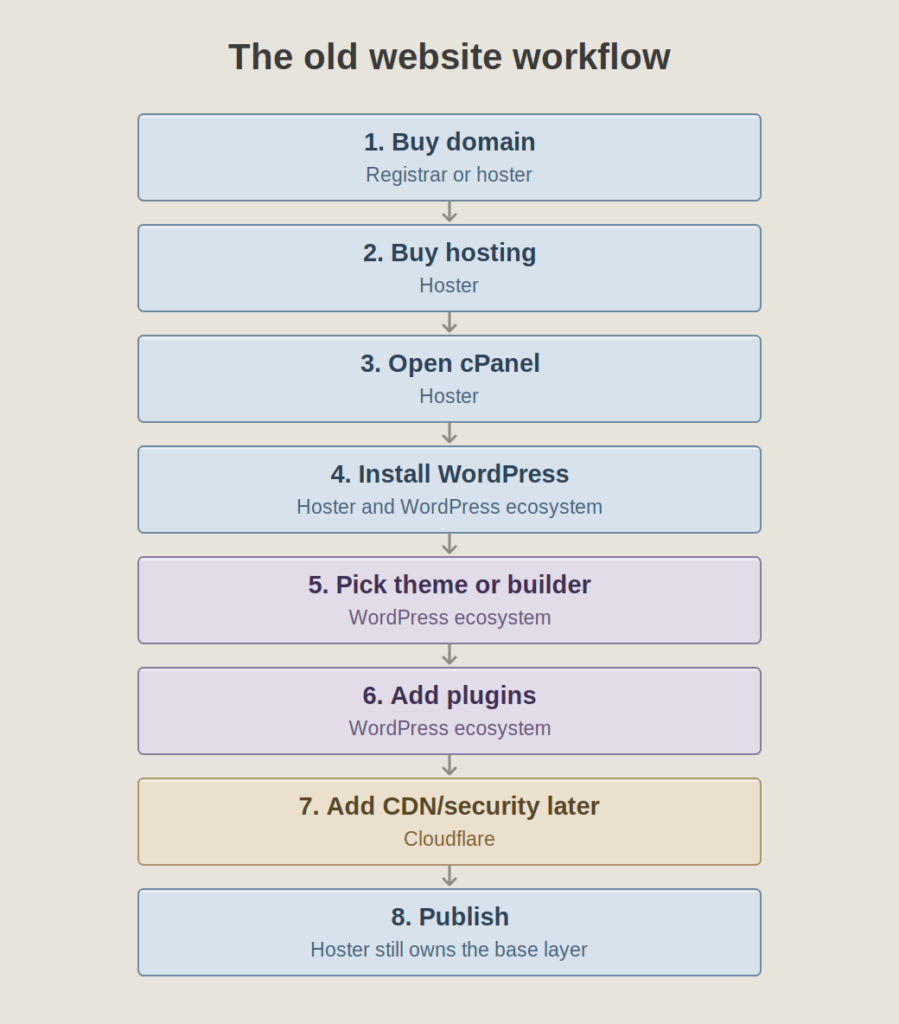
My view is that this was one of the main engines behind WordPress becoming so powerful, with shared hosting growing around it as a result. WordPress was not only a CMS. For many customers, it was the shortcut from “I need a website” to “my website is online”:
- A theme replaced design.
- A plugin replaced custom development.
- A one-click installer replaced technical setup.
The data fits the pattern. Hostinger says that, as of April 2025, more than 54% of the 9.5 million websites it hosts were built with WordPress. In private industry conversations, I have also heard hosting operators describe WordPress dependency much higher than that, sometimes around 80% of their customer base. That part is anecdotal, but it points in the same direction: many “general hosting” companies are, in practice, WordPress infrastructure companies.
Websites no longer start with hosting
By 2026, it is hard to argue that AI has not changed how websites, tools and small applications are created. This is no longer only about developers writing code faster. The bigger change is that founders, marketers, agencies and small teams can create the first version of a project without starting from a WordPress template or buying a shared hosting plan.
A new project is now much more likely to start in Claude Code, Cursor, Lovable, Bolt, Replit, v0 or another AI-assisted tool. Lovable alone reports more than 50 million projects and over 1 million generated every week, while Replit has passed 50 million users and Bolt has passed 5 million. The result is GitHub, deploy buttons and cloud platforms, not FTP, PHP folders and a shared hosting plan.
The commercial moment changes:
The old question was: Which hosting plan should I buy?
The new question is: How do I deploy this?
That is a major shift. Hosting companies were built around the first question. Cloudflare, Vercel, Netlify and similar platforms are built around the second one.
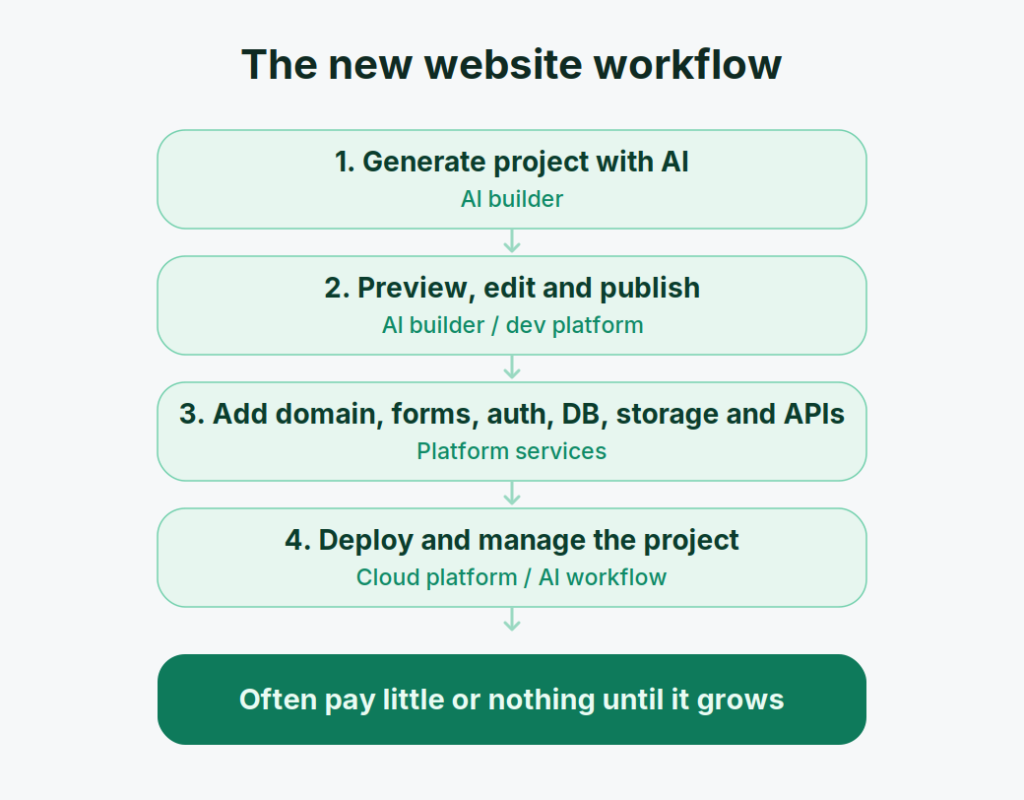
Yes, we can argue that this is still a more technical workflow for developers and agencies. But the broader SMB market had already started to shift toward social media and platforms like Wix long before ChatGPT became mainstream. The part that still bought hosting was already more technical or agency-driven.
That matters because this entry-level demand was one of the main engines of hosting growth. If AI tools and deployment platforms pull those users away too, the impact is not small. It cuts into the top of the funnel.
Cloudflare fits this new workflow
Cloudflare’s advantage is not only the technology itself. The bigger advantage is that it aligned with these trends early, while already being a trusted name among developers and technical users.
As the workflow for building websites changed from “buy hosting and install WordPress” to “describe an idea and launch it”, Cloudflare already had a simple answer ready for most of it. A freelancer, agency or small business can generate a landing page, connect a domain and publish it online in minutes without thinking much about servers, VPS plans or traditional hosting setup. In many cases, the first version can still go live for almost no cost.
From the user’s point of view, the offer is clear.
| User problem | Cloudflare answer | Starting price |
|---|---|---|
| I generated a static website | Pages or Workers static assets | $0 |
| I need a landing page or docs site | Global static hosting | $0 |
| I need frontend hosting | Static assets with Cloudflare cache | $0 |
| I need a small API | Workers Free | $0 |
| I need more backend usage | Workers Paid | $5/month |
| I need object storage | R2 | Free tier, then usage-based |
| I need a small database | D1 | Free tier, then usage-based |
| I need a domain | Cloudflare Registrar | At-cost pricing |
The pricing point is what hosters should worry about.
Cloudflare Pages says static asset requests are free and unlimited. Workers static assets follow the same direction: HTML, CSS, images and other files can be uploaded and served by Cloudflare. For a simple website, landing page, documentation site, product page, marketing campaign or AI-generated frontend, the hosting bill can be $0.
If the project needs backend logic, Workers Free can cover many early use cases. If it grows, Workers Paid starts at just $5/month. That is the price point Cloudflare puts against the old hosting decision.
The old hosting offer says: buy a plan before the site goes live.
Cloudflare’s offer says: deploy first, pay later if the project becomes real.
Cloudflare wants to be the place where the project is launched, hosted and kept running long term.
That is not only a technology shift. It is a sales funnel shift.
And this is where AI makes the shift bigger. Cloudflare has already connected AI coding with its platform in investor communication. Matthew Prince said it is not a coincidence:
“When the cost of generating code drops to near zero, the volume of new applications explodes. It’s not a coincidence that most so-called vibe coding platforms are either built on Cloudflare Workers or have us as their preferred deployment target. We exited 2025 with more than 4.5 million human developers active on our platform.”
In other words: AI creates more code. More code creates more deployment moments. Cloudflare wants to own those moments.
This is the metric hosters should think about. Not only how many websites Cloudflare Pages hosts today, but how many new projects start in workflows where shared hosting is never considered.
Cheap domains are another hit for hosters
If Cloudflare attacks the workflow from one side with free deployment, it attacks it from the other with domains.
| Month | Cloudflare Registrar domains | Monthly net gain |
|---|---|---|
| Jan 2025 | 2,056,086 | 78,864 |
| Feb 2025 | 2,137,661 | 81,575 |
| Mar 2025 | 2,225,339 | 87,678 |
| Apr 2025 | 2,308,640 | 83,301 |
| May 2025 | 2,393,967 | 85,327 |
| Jun 2025 | 2,481,556 | 87,589 |
| Jul 2025 | 2,575,436 | 93,880 |
| Aug 2025 | 2,673,987 | 98,551 |
| Sep 2025 | 2,775,335 | 101,348 |
| Oct 2025 | 2,879,911 | 104,576 |
| Nov 2025 | 2,991,252 | 111,341 |
| Dec 2025 | 3,113,566 | 122,314 |
| Jan 2026 | 3,276,684 | 163,118 |
In January 2026 alone, Cloudflare added 163,118 domains, and the pace was clearly accelerating. Cloudflare is adding more domains in one month than some mid-sized hosting companies manage in total.
To put it into perspective, Cloudflare is already in the same league as leaders in the hosting and domain industry in terms of growth:
| Registrar | Domains Jan 2025 | Domains Jan 2026 | 12-month net growth | Growth rate | Jan 2026 net gain |
|---|---|---|---|---|---|
| Cloudflare | 2,056,086 | 3,276,684 | 1,220,598 | 59% | 163,118 |
| Hostinger | 2,655,547 | 4,094,177 | 1,438,630 | 54% | 146,417 |
| Spaceship | 1,251,632 | 2,892,265 | 1,640,633 | 131% | 167,257 |
This is the wider market signal. The domain entry point is being rebuilt by companies with aggressive pricing, modern dashboards and very strong onboarding. Hostinger is doing it with hosting bundles and a broader website platform. Spaceship is doing it as a modern low-cost registrar. Cloudflare is doing it with a different advantage: domains are just one step into the rest of its infrastructure.
| TLD | Cloudflare | Spaceship | Porkbun | Namecheap | Hostinger | GoDaddy |
|---|---|---|---|---|---|---|
| .com | $10.46 | $10.18 | $11.08 | $14.98 | $19.99 | $23.19 |
| .net | $11.86 | $11.40 | $12.52 | $15.06 | $18.19 | $25.19 |
| .org | $10.13 | $10.00 | $10.74 | $12.98 | $16.19 | $24.19 |
| .io | $50.00 | $51.75 | $51.80 | $60.78 | $67.99 | $89.99 |
| .ai | $80.00 | $79.98 | $82.70 | $91.98 | $89.99 | $159.99 |
| .dev | $12.20 | $12.62 | $12.87 | $21.18 | n/a | n/a |
| .app | $14.20 | $14.69 | $14.93 | $23.18 | n/a | n/a |
The pricing explains the behavior. Spaceship is extremely aggressive on pricing, but in my opinion, that also fits a broader market segmentation strategy: Namecheap raised prices across parts of its main brand while launching Spaceship as a lower-cost alternative to capture more price-sensitive customers. That can drive very fast growth, but it also means today’s pricing should not automatically be treated as a permanent long-term baseline, especially because companies like Spaceship and Namecheap still rely heavily on domains as a core revenue source.
Cloudflare is different because domains do not appear to be the business it is trying to maximize profit from. The domain is the entry point. Cloudflare can keep pricing extremely low because the real monetization happens elsewhere: DNS, Workers, Pages, storage, databases and the broader platform ecosystem. For many registrars and hosting companies, domains are still a margin product. For Cloudflare, domains are customer acquisition.
Registrar API closes the loop
The next step is more important than cheap domains. In April 2026, Cloudflare launched Registrar API in beta. The API lets users search for domains, check availability and register domains programmatically.
This connects directly to AI project creation. In the old model, the domain search page was the commercial doorway. A customer searched for a domain at a registrar or hosting company, and the provider had a chance to sell hosting, email, SSL and other add-ons.
In the new model, an agent inside Claude Code, Cursor or another tool can generate the project, suggest domain names, check availability, show the price, register the domain, connect DNS and publish the application almost instantly through APIs. The registrar is no longer only a website. It becomes part of the entire creation and deployment workflow.
If the same workflow can generate the project, register the domain and deploy it, the traditional hosting company may never get the chance to sell.
EmDash is a signal, not the story
Cloudflare introduced EmDash on April 1, 2026 as a “spiritual successor to WordPress”, built mainly around its own platform and modern serverless infrastructure. But the product itself is not the most important part. The signal is.
EmDash points to what website creation now needs: fast deployment, secure architecture, flexible workflows and lower delivery costs. In an AI-driven market, the winning platform is not the one that only manages content. It is the one that helps teams ship websites faster, safer and with less operational weight.
Matt may be right about EmDash adoption today. But this is not about EmDash becoming the next default CMS. It is about developers and agencies searching for a new way to build. Astro shows the same pressure: better performance, AI-first workflows, quick deployment… and as a result less dependence on the old hosting stack.
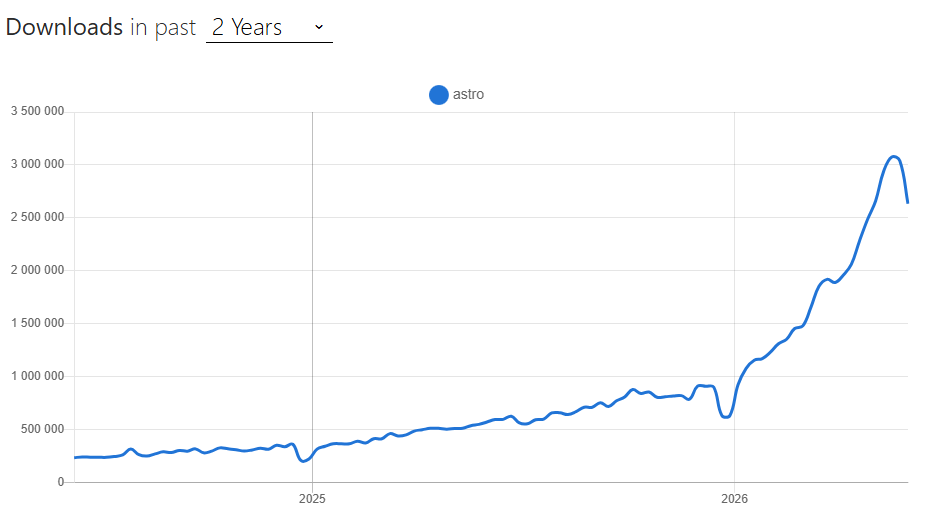
Astro’s growing popularity, based on data from https://npmtrends.com/astro
Is this the end of the old hosting playbook?
Cloudflare is not killing hosting by becoming a hosting company. It is positioning itself in a new market where traditional hosting does not apply at all.
For years, hosters owned the starting point of a website: domain, hosting plan, panel, WordPress, DNS, SSL, email, backups and support. That path gave them the customer relationship.
AI-driven development changes it. A project can now start in an AI tool, move to GitHub, deploy to a platform, connect a domain and go live without the customer ever comparing hosting plans.
But “does not apply” cuts both ways. There is still a big part of the market the Cloudflare workflow does not reach, and that is where web hosting still has a role:
- Existing WordPress, WooCommerce and PHP sites – Millions of running businesses that nobody will rebuild as serverless projects. They need PHP, MySQL, staging, backups and updates for years to come.
- Email – A company runs on mailboxes, not forwarding. Invoices, contracts and client communication need real email hosting with storage, spam filtering and archiving. Hosting providers can be strong in this regard.
- Managed services – Migrations, security incidents, performance problems, a hacked site at 2 AM. Someone has to do the work, and it will not be a self-service dashboard.
- Local market and compliance – Customers who need to know exactly where their data lives, under which jurisdiction, with a provider that answers in their language.
For most hosting companies, the smart strategy is probably to position themselves where the big platforms will never even look. Cloudflare optimizes for scale and self-service. It will not pick up the phone for a local law firm, migrate a 10-year-old WooCommerce store or hold an agency’s hand through a client emergency. Too small, too manual, too local. For a hoster, that is the moat.
Cloudflare understood the new reality early and already built the blocks for it. It owns more and more of the layer around the project: domain, DNS, security, performance, deployment, storage, compute and AI workflows. Not as a classic host, but as the operating system between the idea and the live application.
Never in history has the slow and steady hosting business model been so exposed. Good service, fair pricing and reliable support still matter, but they may no longer be enough if the next generation of projects never enters the hosting category at all.
So the real question for the industry is: what does a hosting company become when hosting is no longer the starting point?

Sources
- Cloudflare Self-Serve Partner Beta - legacy Host and Reseller APIs discontinued
- Rocket.net and Cloudflare case study
- Kinsta and Cloudflare case study
- WP Engine and Cloudflare case study
- WordPress Statistics - Hostinger
- Wix reaches 200 million users after adding more than 31 million users in 2020 - Reuters via Yahoo Finance
- Cloudflare Pages Functions pricing
- Cloudflare Workers pricing
- Cloudflare Workers Static Assets
- Cloudflare R2 pricing
- Cloudflare D1 pricing
- Cloudflare 2025 Form 10-K
- Cloudflare Q4 2025 earnings call transcript
- Cloudflare domain pricing list
- Cloudflare Registrar growth data - DomainState
- Hostinger registrar growth data - DomainState
- Spaceship registrar growth data - DomainState
- Spaceship domain pricing
- Porkbun domain pricing
- Namecheap domain pricing
- Hostinger domain pricing
- GoDaddy TLD pricing
- Cloudflare Registrar API beta
- EmDash, a spiritual successor to WordPress - Cloudflare Blog
- Matt Mullenweg post about EmDash
- Astro package trend - npm trends
- Lovable, Bolt, and Replit Are Generating Millions of Projects Every Week - webhosting.today
- Some Hosts Are Losing a Lot of Sites - Lasse Hall, CEO of Servebolt - webhosting.today
- Social media - statistics on the use by enterprises - Eurostat