

Domain counts are one of the industry’s default measures of market share. They are among the easiest numbers to measure from the outside, which is one reason they get quoted so often. Our own Market Insights platform produces those counts too. It puts GoDaddy first, with 73.1 million domains on its nameservers, ahead of Cloudflare on 49.8 million. Further down sit Namecheap on 11.7 million and Hostinger on 10 million.
Put those same four companies in order by the platform’s hosting attribution and the table turns over. Hostinger rises, GoDaddy falls to 3.5 million, and it is tempting to read that as a statement about how much hosting each company sells. It is not. Each domain is attributed to whoever owns the address it resolves to, so the hosting column records whose address space a site is served from, which is a different question from whose customer that site is. We went and checked what the distinction is worth. On GoDaddy it turns out to matter a great deal.
Key facts
- What the hosting column measures: the owner of the IP address a domain resolves to, which is not the same as the provider the site’s owner buys hosting from.
- Where GoDaddy’s domains point: of 108 sampled domains on its nameservers, every one resolved to an IPv4 address and 96, or 89%, landed in Amazon-registered blocks.
- What that does to the spread: Hostinger’s IP-attributed footprint is 96% the size of its DNS footprint and GoDaddy’s is 4.8%, a gap that partly measures who runs their own address space.
- The largest single movement: 318,721 domains were recorded as moving from Hostinger to dns-expired.com, a destination registered to Hostinger itself.
Two Footprints, One Company
The platform reports more than one footprint for each provider. Two matter here: the domains its nameservers answer for, and the domains that resolve to addresses attributed to it. Read together they describe a business more precisely than either count alone.
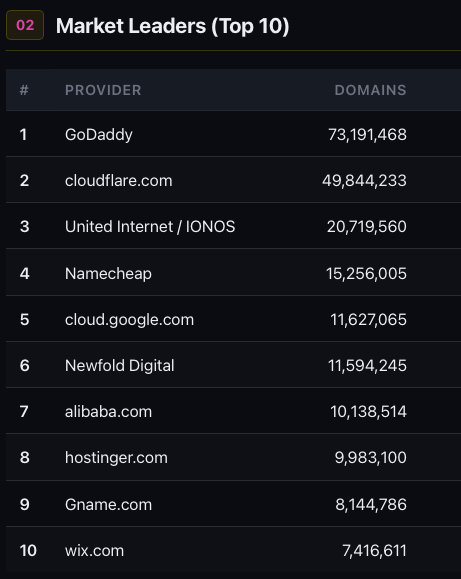
The ten largest by domains on their nameservers, grouped by parent company. Namecheap here includes Spaceship, which the table below counts separately. Source: our Market Insights platform, snapshot of 29 August.
| Provider | Domains on its nameservers | Resolving to its addresses | IP attribution as % of DNS footprint |
|---|---|---|---|
| godaddy.com | 73.1M | 3.5M | 4.8% |
| cloudflare.com | 49.8M | 42.5M | 85.3% |
| namecheap.com | 11.7M | 7.2M | 61.5% |
| hostinger.com | 10.0M | 9.6M | 96.0% |
| spaceship.net | 3.6M | 14.6K | 0.4% |
| tucows.com | 1.1M | 0 | 0% |
One reading has to be ruled out first. The “Resolving to its addresses” column is not a census of live websites. It counts domains resolving to addresses attributed to that provider, so a domain registered at Namecheap and served from Hostinger’s address space appears in Namecheap’s first column and Hostinger’s second. The two columns are separate populations that overlap, so the ratio between them compares the size of a company’s hosting footprint with the size of its DNS footprint. It does not say what share of one sits inside the other.
What the Hosting Column Actually Records
The attribution works from the address a domain resolves to, and reads off the owner of the block that address sits in. That is a reasonable way to see hosting from the outside, and it has one consequence worth stating plainly: a provider that serves customer sites from someone else’s address space is not counted as hosting them.
To see how much that matters we ran a small check of our own. We drew 1,199 English dictionary words at random, treated each as a .com domain and kept the 1,091 that had nameservers delegated. Of those, 108 sat on GoDaddy-operated nameservers: 48 on afternic.com, 40 on domaincontrol.com and 20 on namefind.com. On September 14 we looked up the IPv4 addresses each of the 108 returned and read off the owner of the block each address sits in, then repeated the lookups the next day with the same result. Where a domain returned more than one address, as 95 of them did, every address was classified, and no domain’s addresses fell into different owner categories.
Three findings. Every one of the 108 resolved to an IPv4 address, so non-resolving domains do not explain the pattern within this sample. 96 of the 108, or 89%, resolve into address blocks registered to Amazon, and 94 of those return reverse-DNS hostnames identifying them as AWS Global Accelerator endpoints. Only two resolve into a block registered to GoDaddy. Both sat among the 40 domains on GoDaddy’s ordinary domaincontrol.com nameservers, where 28 landed in Amazon blocks, two in GoDaddy blocks, and the remaining 10 in blocks registered to Squarespace, Webflow, HubSpot, Vercel and others.
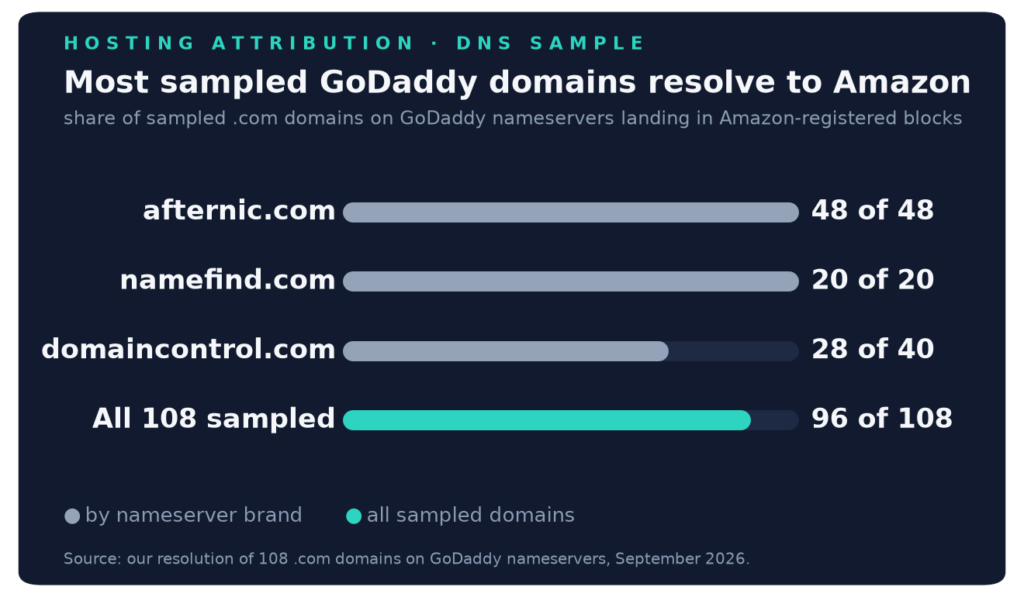
The resale nameservers point entirely at Amazon. The ordinary customer nameservers mostly do. Source: our resolution of 108 .com domains on GoDaddy nameservers, September 2026.
GoDaddy’s own filing points the same way. Its latest quarterly report tells investors the company expects to “increasingly rely on third-party cloud computing and hosting providers, such as AWS, as we transition services to the public cloud.”
So the 3.5 million figure is not a count of GoDaddy’s hosting customers. It is a count of domains resolving into address space our method recognizes as GoDaddy’s, and most of the sampled domains on GoDaddy’s nameservers did not resolve to GoDaddy-registered address space. The sample cannot say who serves each of those sites: some may be GoDaddy products running on AWS, others independent services on AWS that kept GoDaddy’s DNS. All three Hostinger-nameserver domains that appeared in the sample resolved to Hostinger-registered blocks. That subgroup is too small to support a broader conclusion, although it is consistent with Hostinger’s much closer DNS and IP-attribution totals. The contrast between 96% and 4.8% reflects more than product mix. It is also shaped by infrastructure strategy and by what an IP-based method can see.
One limit on our own check: a sample drawn from dictionary words over-represents domains held for resale, and two of GoDaddy’s three nameserver brands in the sample, afternic.com and namefind.com, are exactly that. All 68 of those domains resolve into Amazon ranges. The ordinary customer nameservers show the same pattern less completely, at 28 of 40, or 70%.
The Registrar End and the Operator End
At one end sits Hostinger, founded in Kaunas in 2004 and now reporting more than five million customers. It answers DNS for 10 million domains, and 9.6 million resolve into address space attributed to it. Its two footprints are nearly the same size.
At the other end sits Spaceship, the platform Namecheap launched in unrestricted open beta in August 2023. Its nameservers answer for 3.6 million domains, while around 14,600 resolve into address space attributed to it. Tucows, the registrar behind OpenSRS and Enom, answers for 1.1 million and has none. Tucows describes itself as a domain registrar, and a zero in this column means the method attributed no domains to it, not that it runs no workloads. Spaceship does sell hosting: its site offers shared web hosting plans, EasyWP managed WordPress hosting and VPS. Four of its domains appeared in our sample. Three resolved, all into Amazon-registered blocks, so its 0.4% carries the same caution as GoDaddy’s figure.
GoDaddy is the largest mismatch in this comparison. The platform files it as a hosting provider and it sells hosting at mass-market scale, yet only 3.5 million domains resolve into address space we recognize as its own. For scale, the company reported 20.5 million total customers across all its products at the end of June.
GoDaddy’s own count runs higher than ours. Its quarterly report puts domains under management at 82.0 million at the end of June 2026, a figure the company defines as domains registered through GoDaddy and its affiliated registrars. The 73.1 million our nameserver count sees is about nine tenths of that. One expected source of the gap is the method itself: a domain registered at GoDaddy but pointed at another provider’s DNS is counted where its DNS sits. A registration count and a DNS count are different populations by definition.
Cloudflare is the case that has to be read differently. The platform files it under cloud and infrastructure rather than as a hosting provider. It holds the second-largest DNS footprint in the measurement, and its hosting footprint is 85.3% the size of it.
That second figure carries a qualification the others do not. Cloudflare operates as a reverse proxy: a site routed through it resolves to a Cloudflare address, while the server behind it can belong to any hosting company. A method that reads hosting from the address a domain resolves to sees Cloudflare’s delivery footprint and cannot separate it from origin hosting. Cloudflare therefore cannot be ranked alongside origin-hosting providers on this column. Its 42.5 million measures the visible delivery layer, not where the underlying sites are hosted.
What the Flows Add, and What They Do Not
The platform also records where domains move between one snapshot and the next. Between the platform’s two most recent snapshots, the largest single movement in the set we examined was 318,721 domains recorded as moving from Hostinger to dns-expired.com.
That destination appears to be Hostinger’s own infrastructure rather than a competing provider. The registry record for dns-expired.com names Hostinger operations, UAB as its registrar and delegates it to two nameservers carrying Hostinger’s name on the orderbox-dns.com platform, hostinger.earth and hostinger.mars. The zone itself lists four, adding hostinger.mercury and hostinger.venus, and dns-suspended.com is set up the same way. The comparison cannot establish whether every one of those changes was a newly expired domain or a bulk reassignment of domains already in that state. Among the largest movements we examined, 379,149 domains left Hostinger, so that one route accounts for 84% of them.
It would be convenient to extend that pattern across the table, and we cannot. One large destination in the same period turned out to be an artifact of our own measurement rather than a movement of domains. Once it is removed, no other route in the top movements could be verified the same way. What the flows support is narrower than it first appears: one clear case, not a rule.
What a Domain Count Can and Cannot Settle
For anyone weighing one of these businesses, the distance between the two footprints is still worth reading, as long as it is read for what it is. Leaving the reverse-proxy case aside, a company whose DNS and IP-attributed footprints are close in size, as at Hostinger, presents an aggregate picture consistent with a business that operates much of its hosting on its own address space. The totals alone do not establish how many of the same domains appear in both populations. Where the footprints sit far apart, the count alone cannot tell you whether the customers went elsewhere or the servers did, and those two answers point to opposite conclusions about the company.
None of that is visible in the domain counts the industry commonly quotes, and the second count does not settle it either. Our own IP attribution moves the largest company in this comparison from first place to fourth. Our sample, read alongside GoDaddy’s own disclosure that it is moving services to AWS, supports rented infrastructure as one reason the IP-attributed count runs low. The data does not establish how much of the full gap it explains. A domain count is the beginning of the question. A second count is a better beginning, not the answer.
About the Data
Footprints come from Market Insights, our own platform, read on September 14 and drawn from its 29 August snapshot. It attributes DNS by the nameservers answering for a domain and hosting by the owner of the address block the domain resolves to. A provider serving sites from rented address space is therefore undercounted, and for a reverse proxy such as Cloudflare the figure includes sites whose origin servers sit elsewhere. The GoDaddy sample is ours, described in the text, with every address classified by block owner from the regional registries. The delegation and registrar of dns-expired.com come from the .com registry’s public record. Movement compares that snapshot with the one 30 days before it, and excludes one destination that arrived with its whole population at once.

Sources
- GoDaddy Inc. Quarterly Report on Form 10-Q for the quarter ended June 30, 2026 - SEC EDGAR
- Namecheap Officially Reveals Plans for Spaceship - Its Next-Generation Domain Registration & Web Services Platform - PR Newswire (Namecheap release)
- About Hostinger: our company, products & people - Hostinger
- Tucows | Making the Internet Better Since 1993 - Tucows
- Cloudflare DNS - World's Fastest DNS - Cloudflare
- Shared Hosting - Secure and Fast Web Service by Spaceship - Spaceship
- Proxy status - Cloudflare DNS docs