
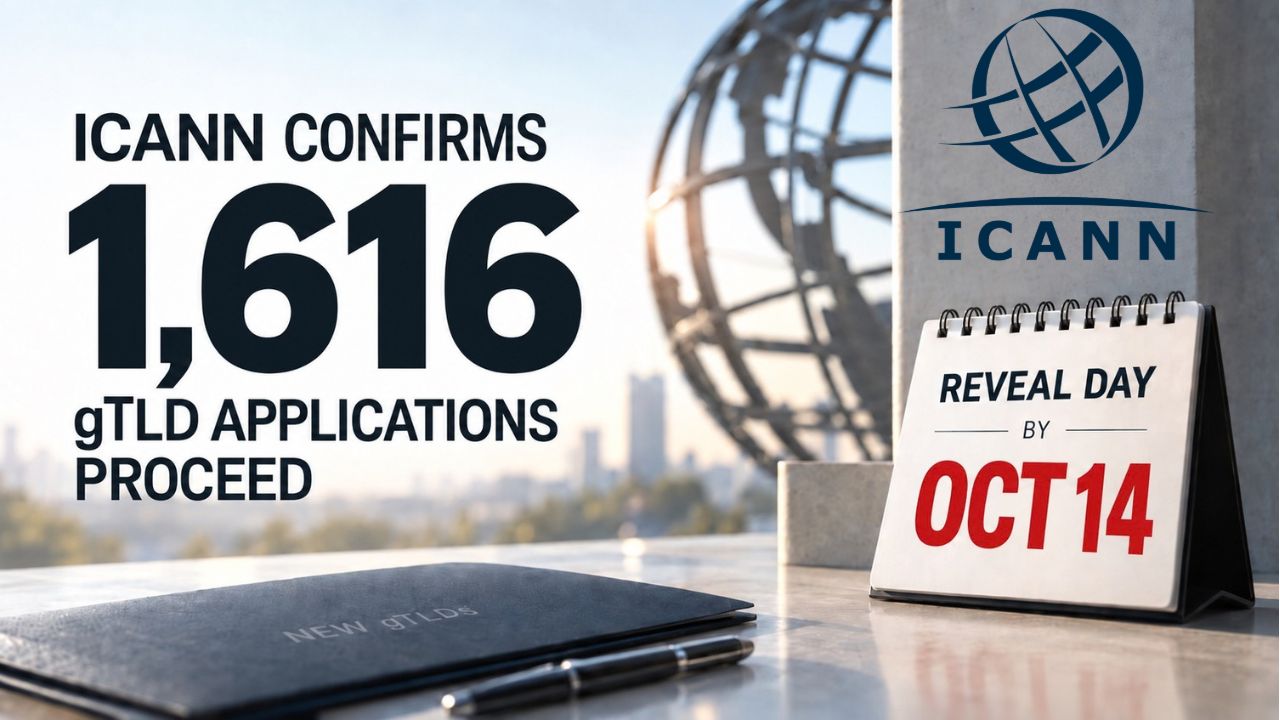
ICANN has put a firm number on the 2026 new gTLD round. In an announcement on September 22, the organization said that 1,616 applications, out of 1,663 submitted, will proceed after payment confirmation. The submission window closed on August 12. The difference of 47 is ours to calculate: ICANN gives the two totals and does not say how many were withdrawn and how many missed the payment deadline. Reveal Day, when the public portions of every application go online, is expected no later than October 14 absent extraordinary circumstances. ICANN expects to announce the date itself, along with the timeline for what follows, “early next week.”
For the hosting and registrar groups that have already disclosed their portfolios, the number matters twice. It sets the size of the field their strings compete in, and it fixes the outer date by which every competing application, including the ones nobody has talked about, becomes public. Until then, ICANN’s advice is blunt: “ICANN is the only source for complete and verified 2026 Round application information, including what entities have applied and for what string(s).”
Key facts
- The count: 1,616 applications proceed after payment confirmation, out of 1,663 submitted before the window closed on August 12.
- The date: Reveal Day falls no later than October 14, the nine-week outer limit the Applicant Guidebook sets. ICANN expects to name the exact date in the week of September 28.
- The money: at ICANN’s standard fee of USD 227,000 per application, 1,616 applications come to about USD 367 million at list price, before support discounts and refunds.
- The comparison: 2012 revealed 1,930 applications to this round’s expected 1,616, and only 16 of its 234 contention sets went to an ICANN auction.
What 1,616 Counts, and What It Does Not
ICANN’s number is a count of applications that passed the payment step, not a count of strings. Each application in the 2026 round names a primary string and may name one replacement string. The Applicant Guidebook gives eligible applicants that designated one a 14-day window after Reveal Day to elect it, whether or not the primary has landed in contention, and the election cannot be undone. The August 13 announcement said more than 1,100 of the primary applications carried such a replacement. The September 22 figure does not restate that, so the number of distinct strings that could end up applied for remains open until String Confirmation Day.
The Administrative Check that precedes Reveal Day does three things, according to ICANN’s pre-evaluation page: it verifies the fee, reviews applications for administrative completeness, and “groups them into a list of initial contention sets in preparation for Reveal Day.” The September 22 announcement confirms the first. The other two must still be completed before Reveal Day.
Payment confirmation is the filter behind the 1,616, and the fee is what had to clear. ICANN’s fee FAQ sets it at “USD 227,000 per application,” covering up to four allocatable variant strings, and the payment deadline was the later of August 19 or seven days after the invoice. The same page sets three refund windows, the first running from payment to ten days after String Confirmation Day and returning USD 147,500 on a withdrawal, plus a possible volume refund “if ICANN receives more than 1,000 gTLD applications and the program’s implementation costs have been recovered.” The first condition is now met with room to spare. The second is ICANN’s to declare.
Nine Weeks, and a Schedule That Slipped Past Mid-September
Reveal Day by October 14 is not new. The Applicant Guidebook already reads that “absent extraordinary circumstances,” ICANN expects to publish the list of applications that passed the Administrative Check “no later than nine weeks following the close of the application submission period,” and August 12 plus nine weeks is October 14. Both announcements repeat the phrase, hedge included.
What has moved is the schedule announcement itself. In August, ICANN said it would announce the Reveal Day date and subsequent milestones in “mid-September 2026.” On September 22 it said it “expects to announce the date for Reveal Day and subsequent 2026 milestones early next week,” covering the String Replacement Period, String Confirmation Day and the Community Input and Objections Period.
Domain Name Wire reported the resulting impatience on September 21, a day before the announcement came. Jeffrey Neuman of JNJ Solutions, who represents applicants, wrote to ICANN asking it to pin down the Reveal Day date, the replacement window and the prioritization draw. His argument was practical: the replacement election has to be made within 14 days of Reveal Day, and “That decision is irreversible. A notice issued too late to allow applicants to put compliance protocols and decision-makers in place serves no one.” Applicants, he added, “are awaiting an announcement of the Reveal Day date before deciding whether to attend ICANN 87 in Bali, which begins October 17.”
The sequence after Reveal Day is set out on ICANN’s pre-evaluation page. The day publishes every applied-for string, including variants and replacements, the public portions of each application, and the initial contention sets. Then comes the 14-day String Replacement Period, and the bar for using a replacement is stricter than it looks. The Guidebook blocks the switch outright if the replacement is identical to any other applicant’s original or replacement string, and it stays blocked “even if those other applicants decide not to use them.” Applicants are also barred from discussing their replacement decisions with one another, under the same prohibition that ended private contention deals.
String Confirmation Day, which ICANN projects for November 2026, publishes the final strings, the updated contention sets and opens the Application Comment Forum. The September 22 announcement also names where to look on the day: a separate Application Publication and Statistics site that pulls public data out of the application system and carries program statistics alongside it.
Smaller Than 2012, and Under Different Rules
ICANN’s 2012 Reveal Day announcement recorded that “A total of 1,930 new gTLD applications were received during the application period.” The 2026 round comes in at 1,616, about 16 percent fewer, after fourteen years in which the first-round registries have been through consolidation, delegation, and in some cases termination.
The rules around contention have changed as well, and that is where the count will bite. The 2012 round produced 234 contention sets, and ICANN’s own program statistics record that just 16 of them went to an ICANN auction. Another 217 cleared by other routes, among them withdrawals, Community Priority Evaluation, and private auctions run by the applicants themselves, in which the winner paid the losers to step aside. One set is still unresolved, fourteen years on.
ICANN banned that last route for 2026, as we reported in August. A set now resolves, in the program’s own words, “through Community Priority Evaluation (CPE), or an ICANN Auction,” with the proceeds going to ICANN rather than to the losing applicants. In 2012 an applicant could lose a contest profitably. In 2026 a losing applicant recovers only what its refund window allows, which is what makes the replacement election, for those eligible to make one, worth deciding before the auction stage is reached.
The hosting industry’s exposure is already partly on the record, though not always by choice. Namecheap’s registry arm, Starlight, accounts for 40 applications, a list Domain Name Wire broke in August rather than one the company announced, and by our count seventeen of those strings now sit on a rival’s published list. Two of them were added when Aruba disclosed its own set in September. Aruba, the Italian host that runs .cloud, has disclosed 39 strings, primaries and replacements together, and we noted on September 10 that the private auction which won it .cloud in 2012 is now the banned route. INWX has announced .crew.
One string shows what the contention list will look like when it lands. Three applicants have put their hands up for .easy: easyGroup, Link Freedom Group and Aruba. easyGroup demanded that Link Freedom Group withdraw its application by September 9. Link Freedom Group instead sued in federal court on September 21, asking for a declaratory judgment that the dispute belongs in ICANN’s own process. None of the three applications is public yet. ICANN’s warning to “remain wary of any information that doesn’t come directly from ICANN” applies to all of these disclosures as much as it does to rumor.
A hosting company that is not an applicant still has a date to watch. Many of the strings that survive will become product lines for registrars, premium names for resale and new entries in the TLD list that shared hosting customers see at checkout. Others never will. The Guidebook keeps a separate .Brand track, and a namespace run for one company’s own use does not reach a registrar’s price list. Nor does everything revealed survive: of the 1,930 applications from 2012, ICANN’s statistics record 1,241 delegated and 653 withdrawn. The number revealed in October will be the high-water mark rather than the count of new extensions.
About the Data
The 1,663 and 1,616 counts and the October 14 outer date come from ICANN’s September 22 announcement. The 47 not proceeding is our subtraction. The nine-week rule, the replacement-string conditions and the .Brand track are from the 2026 Applicant Guidebook, the mid-September expectation from the August 13 announcement, the fee and refund windows from the evaluation fee FAQ, and the 2012 counts from ICANN’s program statistics of August 31. Neuman’s letter, Namecheap’s 40 applications and the .easy dispute come from Domain Name Wire. The USD 367 million and the seventeen overlaps, counted against the portfolios published so far, are ours.

Sources
- ICANN Confirms Number of Applications Proceeding in the 2026 Round - ICANN
- ICANN 2026 Round Closes with More Than 1,600 New gTLD Applications - ICANN
- Pre-Evaluation, 2026 Round Applicant Journey - ICANN New gTLD Program
- 2026 Round Applicant Journey - ICANN New gTLD Program
- gTLD Evaluation Fee Frequently Asked Questions - ICANN New gTLD Program
- New TLD applicants impatiently wait for timeline - Domain Name Wire
- German domain registrar applies for .crew top level domain - Domain Name Wire
- TLD fight: easyGroup threatens .easy applicant, LFG files lawsuit - Domain Name Wire
- Exclusive: Namecheap Applies for 40 Top Level Domains - Domain Name Wire
- New gTLD Program Statistics - ICANN (2012 round)
- New gTLD Reveal Day, Applied-for Strings - ICANN
- New gTLD Program: 2026 Round Applicant Guidebook - ICANN