
Exchange Online, the Microsoft 365 email service behind Outlook, went down on Thursday, November 12, and stayed disrupted in parts of the world through Friday. Microsoft traced the incident to “an issue during an earlier network capacity upgrade that surfaced following a recent network change.” Early on Saturday, November 14, the company announced that services had been fully restored. Among the 25 mail providers our data recognizes, Microsoft ranks second only to Google and handles incoming mail for 15.7 million domains.
Outage reports “reached 74 countries and territories in about an hour,” according to Downdetector figures cited by CNN. Many users could not send or receive email or see their calendars. The disruption also reached Teams, Copilot and other Microsoft 365 services, where features that depend on Exchange Online could fail, from calendar scheduling in Teams to loading Copilot Chat. Anderson Economic Group, a Michigan think tank, estimated that lost productivity could approach $7 billion. Its president expects the cost to rise beyond this initial estimate.
Key facts
- Preliminary cause: a latent bug, exposed by network maintenance, left servers unable to accept new connections.
- Delayed mail: Microsoft extended its email timeout window to 48 hours.
- Senders: resend only messages that bounced because of the outage, not whole campaigns, Postbox Services advises.
- Service credits: for CSP purchases, the provider must file the request within one month from the end of the incident’s billing month.
Failed Health Checks, a Latent Bug and a Network Rollback
Microsoft’s first post about the problem on X came at 17:54 UTC on November 12 and covered access to Exchange Online mailboxes in the Americas. A warning that the disruption could be global followed 13 minutes later. The early updates described servers failing automated health checks and becoming unavailable, which left the remaining infrastructure to carry the load.
The preliminary root cause, which the company published in the Microsoft 365 admin center while its analysis continues, points to “a failure in the systems responsible for establishing connections to the Exchange Online service.” Traffic shifts during standard network maintenance and upgrades exposed a latent bug, a flaw that had stayed dormant until then. It caused a rapidly growing number of requests to queue for processing. As the queue grew, the affected servers “exhausted their available processing capacity and could no longer accept new connections.” Overall traffic had not increased, according to an earlier update.
Engineers restarted affected servers and rolled back a recent network configuration change that coincided with the start of the disruption. At 04:36 UTC on Friday, the company reported “partial recovery” in some regions. By 13:32 UTC it saw “broader improvements” in North America, “sustained improvements” across much of Europe and “encouraging recovery signals” in Asia Pacific. At 14:17 UTC, email queues were “significantly reduced and approaching normal levels.”
Microsoft’s Friday statement described the incident as “a technical issue not related to cyber or AI / agents” and included an apology: “We are deeply sorry for the disruption this incident has caused our customers and partners.” The company has committed to a full post-incident report “with root cause and defense-in-depth actions.”
Who Handles Incoming Mail, by Our Count
Our Market Insights dataset, in its snapshot dated October 24, 2026, attributes 66.2 million domains to one of 25 mail providers it recognizes. Google leads with 22.7 million and Microsoft follows with 15.7 million, or nearly a quarter of that group. Three of the five largest are hosting companies: GoDaddy with 9.8 million, Hostinger with 4.4 million and OVHcloud with 3.4 million.
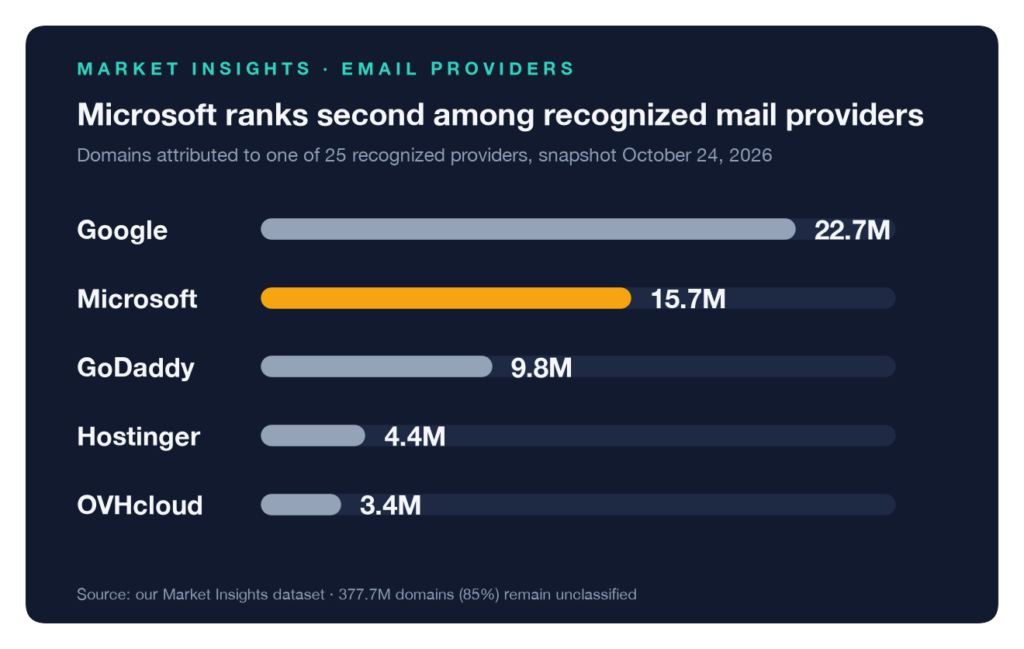
The five largest of the 25 mail providers our data recognizes, by number of domains. Source: our Market Insights dataset, snapshot October 24, 2026.
The other 377.7 million domains in the dataset, 85% of the total, are unclassified, so these figures describe the recognized providers rather than the whole email market. The count also measures domains, not mailboxes or users. In January, Microsoft reported more than 450 million paid commercial seats, meaning paid users on business subscriptions. A domain whose mail first passes through a filtering service such as Mimecast is counted under that service, even if its mailboxes run on Microsoft 365.
Delayed Mail and the Retry Window
During recovery, Microsoft made reducing its email queues and backlogs a priority and extended its email timeout window to 48 hours, “to help protect delayed messages.” CNBC describes the window as the period in which delayed emails continue to attempt delivery.
Mail that Microsoft’s servers could not accept is a separate case: it waits in the sender’s own queue. RFC 5321, the SMTP standard, requires such mail to be retried and notes that “the give-up time generally needs to be at least 4-5 days,” longer than this outage lasted. Exim and Postfix match that by default. Exim bounces a message after four days of temporary failure, counted from the first failure for the domain, and Postfix keeps undelivered mail queued for up to five days.
In a guide for email senders, Postbox Services notes that many email platforms give up sooner, in which case the messages show as bounces. Its advice is to resend only those messages, not whole campaigns. The guide also advises against letting bounce rules remove Microsoft 365 recipients after bounces or deferrals on November 12 and 13, which it calls not a sign of bad addresses.
Service Credits Run Through CSP Providers
Microsoft 365 also reaches customers through hosting companies. GoDaddy and IONOS both sell Microsoft 365 plans. On its own status page, GoDaddy logged an incident for its Professional Email with Microsoft 365 service at 18:17 UTC on November 12, covering problems with new account setup and logins to webmail and email apps in all regions. Its next update, at 18:53 UTC, referred customers to Microsoft’s status page and added: “Our phone representatives do not have additional information on this issue and we are unable to take phone calls at this time.” GoDaddy marked the incident resolved at 06:23 UTC on November 14.
OVHcloud takes part in Microsoft’s Cloud Solution Provider (CSP) program in its two-tier form, which lets its partners resell Microsoft 365, including under their own brand. Where a customer bought through CSP, the position in that chain decides who can file for service credits. Microsoft accepts credit requests only from CSP direct and indirect providers, not from indirect resellers, and approved credits appear on the provider’s next invoice.
SLA credits cover only the services that were affected and are prorated by the duration of the outage. A request needs the customer’s tenant ID and the incident ID from the Service Health Dashboard. It also needs evidence that the customer was affected and requested a credit, including an email from the affected tenant’s domain. Microsoft classifies EX1550543, the Exchange Online case, as an incident. Advisories are typically not eligible for SLA credits, and an incident listing indicates only that a tenant might be affected. For services other than Azure, requests must arrive within one month from the end of the billing month in which the incident occurred.

Sources
- Microsoft says email service is 'approaching normal levels' following widespread global outage - CNN Business
- Microsoft says it is 'deeply sorry' for global outage after almost 24 hours of disruption - BBC News
- Microsoft says services fully restored after day-long global outage - BBC News
- Why is Microsoft's outage lasting so long and will emails be lost? - BBC News
- Microsoft 365 Outage Disrupts Outlook, Exchange Online and Teams - SecurityWeek
- MO1550821: Users may be unable to connect to multiple Microsoft 365 services - Cloud Admin Hub (Microsoft 365 service health)
- Microsoft works to restore Outlook and other 365 services - CNBC
- Microsoft outage live: Outlook and Teams returning to 'normal levels' - TechRadar
- A global Microsoft 365 outage has hit millions: what happened and when will it be fixed? - The Guardian
- Microsoft Fiscal Year 2026 Second Quarter Earnings Conference Call - Microsoft Investor Relations
- Microsoft 365 and Exchange Online Outage (12 November 2026): What It Means for Email Senders - Postbox Services
- RFC 5321: Simple Mail Transfer Protocol - RFC Editor (IETF standard)
- The default configuration file - Exim Specification
- Retry configuration - Exim Specification
- Postfix Configuration Parameters - Postfix
- Microsoft Office 365 - GoDaddy
- Microsoft Office 365 Email Degraded - GoDaddy Status
- Microsoft 365 Business: Hosted Office Packages with Expert Support - IONOS
- Become a Microsoft 365 Reseller - OVHcloud
- Request a credit from Microsoft - Microsoft Learn (Partner Center)