

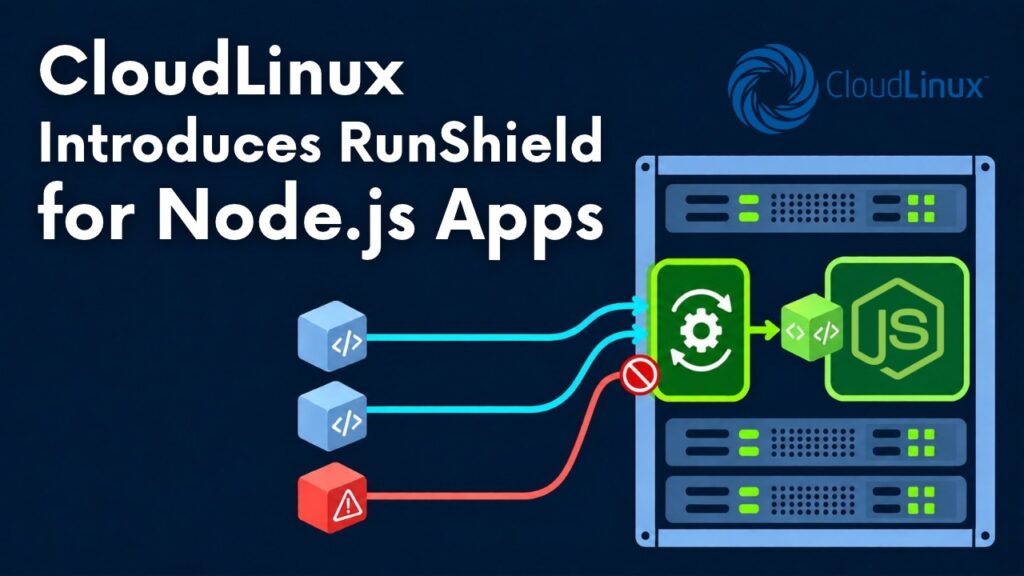
CloudLinux’s October data shows at least one npm package with a known vulnerability on 84% of servers running Node.js apps, and one with a critical-rated flaw on 73%. The host can see the problem, but the code belongs to the customer. RunShield, announced on November 10 ahead of CloudFest Americas, is built for that situation.
The company sees vibe coding as one source of these apps. An AI tool can write an app from a plain-language description, often in Node.js, and select the packages it relies on. Without maintenance, those packages can become outdated. The vendor’s March 2026 data shows Node.js apps on its customers’ servers grew 51% in a year, to more than 200,000 across over 16,000 servers.
RunShield runs inside each Node.js app, protecting it without changing its code or files, so the host does not have to wait for the app’s owner. It is in early access, with a free mode that reports what it finds and a paid mode that acts on it.
What RunShield Patches, Refuses and Blocks
RunShield sits between an app’s code and Node.js and checks every package the app loads, dependencies included. In the paid mode, when an app loads a release with a known flaw that RunShield has a fix for, RunShield hands Node.js a corrected copy of the code. CloudLinux calls this virtual patching. Its public feed, updated on November 17, lists 7,978 known vulnerabilities, almost all in npm packages, and has virtual patches for 886 of them, about 11%. For nearly all the others, RunShield reports the vulnerable version when an app loads it.
According to the RunShield site, each patch ships only after a working exploit fails against it, and a patch that breaks an app switches itself off for that account. The site adds that if RunShield itself fails, the app keeps running.
It also checks every package against lists of known malicious releases on npm, the public registry Node.js packages come from. The company points to September 2025, when attackers phished an npm maintainer and published malicious versions of chalk and debug, two of the most downloaded packages, with code written to steal cryptocurrency. The paid mode blocks these releases and the free mode flags them. Clean releases of the same package keep working.
A second layer watches for attacks on flaws that have no patch yet, including flaws in the app’s own code. The free mode reports them. The paid mode blocks attempts to manipulate database queries through an app’s input, known as SQL and NoSQL injection.
Who Switches It On and What It Costs
The server administrator chooses the mode and decides whether customers may switch it for their own apps. Customers can follow their apps’ events in a dashboard. On servers with Imunify360 or ImunifyAV, the free mode is included, and the RunShield site notes that Imunify installs it there.
No price for the paid mode appears in the announcement or on the RunShield site. Hosting providers that join early access get it free for two months. RunShield needs an x86-64 Linux server with systemd, and its site lists Node.js 16, 18, 20, 22 and 24. It supports apps launched from control panels, by systemd or the PM2 process manager, and apps running in containers.
Final Thoughts
RunShield moves part of app security to the host, which can act on customer Node.js apps without waiting for their owners. For most vulnerabilities in its public feed, though, it offers visibility rather than a fix: about one in nine has a virtual patch, and nearly all the rest are reported. Hosts running Imunify get that visibility free, but pricing for the paid mode has not been published.
Sources
