

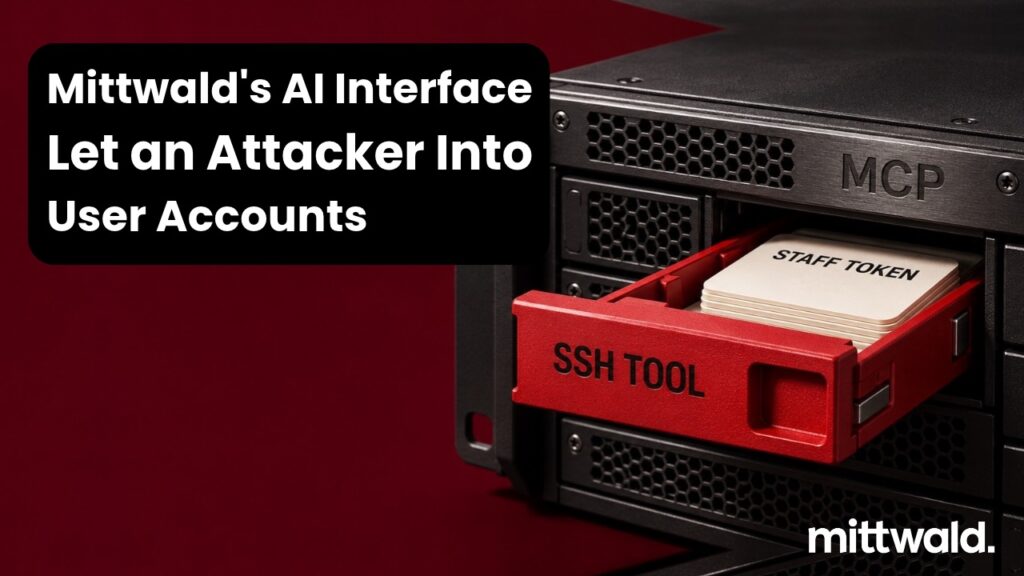
German web host Mittwald offered an MCP server so that customers could manage their hosting through AI assistants. In early November, it disclosed that an attacker had broken in through that server. Its postmortem, published three weeks after the attack was detected, traces the breach to a tool for creating SSH keys that deleted each private key straight after generating it, leaving keys no one could use.
According to Mittwald, that code served no useful purpose. The damage spread because the server held the access tokens of every active MCP user, including staff. The postmortem also describes a second break-in, through a previously unknown flaw in the Neos CMS.
One Tool Exposed Every MCP User’s Tokens
To act for customers in mStudio, Mittwald’s control panel, the server used their access tokens. Text entered in two of the SSH key tool’s fields went straight into a command line, so an attacker could slip in commands of their own.
On October 27, the attacker exploited it to gain command access to the server’s container and read the stored tokens. By early November, the stolen tokens numbered several thousand, including tokens of Mittwald staff, whose accounts had access to many of the company’s production projects. Most had expired by the time the attacker tried them, but several hundred were still valid. Mittwald revoked all tokens on November 4.
Mittwald built the server largely with AI coding agents, a deliberate choice to gain early experience working with agents. In its own assessment, AI contributed to the faulty code reaching production: review practice for agent-written code was less developed at the time, and the project had no automated code check set up to flag this kind of mistake. Mittwald adds that people make the same mistake and that a thorough review should have caught it. Agent-written code now falls under binding review rules.
Mittwald’s Own Projects Were the Main Target
The attacker went after Mittwald itself, looking for staff accounts and for projects the company runs. On October 28, short-lived containers started by the attacker collected configuration files, keys, database dumps and credentials from neighboring containers in the same projects. Most of these were Mittwald’s own projects, such as databases, backups and automations of internal tools, and customer projects were hit only in isolated cases.
Mittwald counts as affected everyone who used the MCP server and every project their accounts could reach, even where the owners never used the server, a wider circle than its early-November FAQ described. Mittwald found evidence of attacker activity in 56 of those projects, which it classifies as compromised. The attacker took credentials from Mittwald’s own projects in its container hosting but, according to Mittwald, did not get into its internal infrastructure with them.
The Second Phase Ran Through Hosting Accounts and Neos
From November 9, the attacker also worked from several hosting accounts in the Kundencenter, the panel for Mittwald’s agency server, CMS and shop hosting. Those accounts had been compromised in other ways, some as early as late October, including through a 2023 vulnerability in a WordPress plugin and with passwords that, according to Mittwald, did not come from its systems. Mittwald’s November 7 update had described the Kundencenter as unaffected by the incident.
On the night of November 11 to 12, the attacker turned to mittwald.de, which runs on Neos. Through a vulnerability in the CMS that was not yet publicly known, the attacker uploaded a script for running commands on the web server. From there, the site’s configuration and database were read, including the Neos backend accounts with their password hashes. Mittwald took the site offline, reported the flaw to Neos the same night and restricted logins to mStudio and the Kundencenter, as well as SSH access, until the morning of November 13.
Since November 18, the attacker has made new attempts and occasionally reached individual hosting accounts, partly through outdated software that customers run, such as a WordPress booking plugin and a very old phpMyAdmin version.
The Neos Flaw Affects Every Unpatched Neos Site
The vulnerability sits in Flow, the PHP framework under Neos, so every Neos site on an affected Flow version is exposed. A single request without logging in can place a file in the site’s public resources folder, and whether that leads to code execution depends on the web server. Neos, which credits Mittwald with reporting it, rated the flaw critical (CVSS 9.8) and on November 13 released Flow 8.3.22, 8.4.7, 9.0.10, 9.1.5 and 9.2.3.
Updating does not remove files that were already uploaded, so Neos lists checks for them. Flow 8.2 and older get no fix. For those versions, the only protection is to stop the web server from running scripts below Web/_Resources, which closes the path to code execution. Neos recommends the setting in any case.
The MCP Server Will Return Only in a New Design
The MCP server stays offline, with no date for its return. When it comes back, it will have a read-only file system, no outbound traffic except to the Mittwald API, a clear separation between tools and sessions, narrower and shorter-lived tokens and a connection to central logging.
Since November 13, logins to mStudio and the Kundencenter have required a captcha and, for accounts without another second factor, an email confirmation. A team has reviewed security alerts around the clock since November 14, and Mittwald is building tools to switch off single projects or functions during an incident instead of the whole platform.
Sources
