
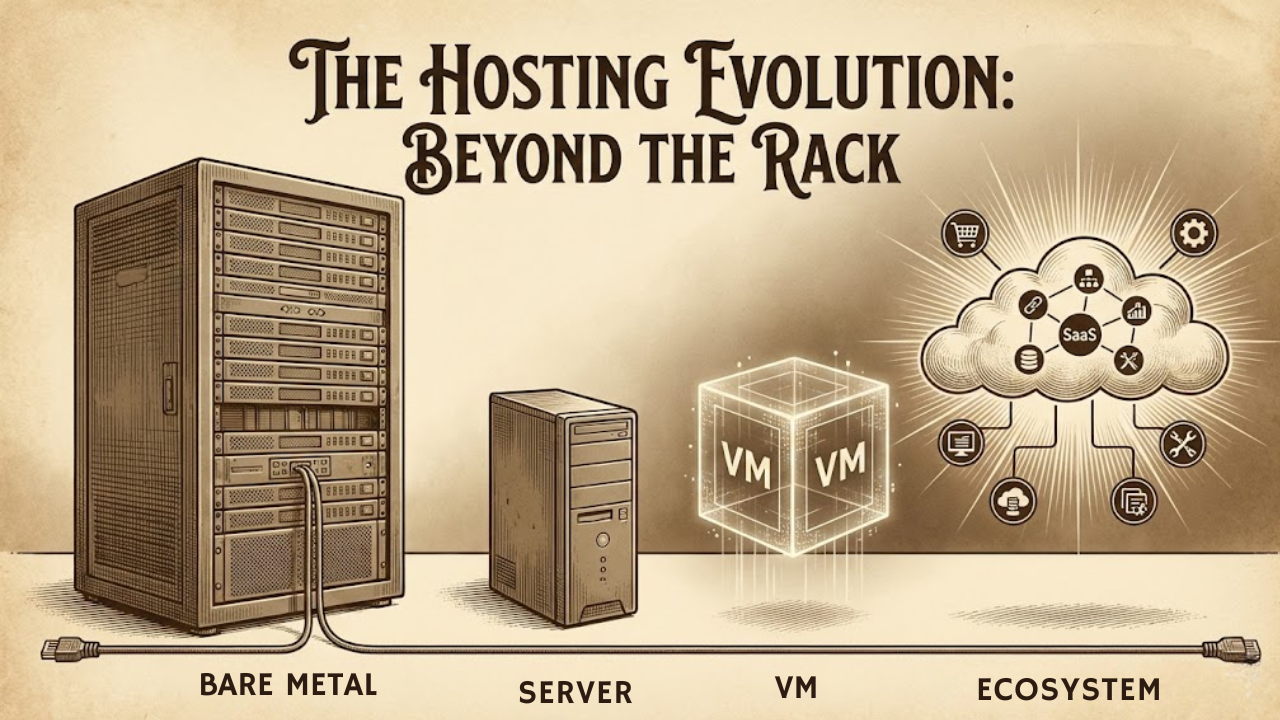
For years, the value proposition was simple: rent space on the internet, keep it online, keep it fast, keep it safe. And that still matters – immensely. But it’s no longer where most of the value is captured. In 2026, the most ambitious hosting companies are no longer competing primarily on CPUs, storage, or even performance benchmarks. They’re competing on something much messier and far more powerful: the customer’s workflow.
That shift explains almost everything we’re watching right now – why acquisitions look less like “scale plays” and more like shopping sprees across social marketing, site creation, commerce platforms, and even agencies. It’s not random. It’s gravity: value migrates up the stack.
Hosting became a commodity because customers don’t buy hosting — they buy outcomes.
Outcomes > features.
Most customers do not wake up thinking, “I need a better hosting plan.” They wake up thinking: “I need more bookings.” “I need my store to convert.” “I need my site to look credible.” “I need my newsletter to land in inboxes.” “I need to publish faster.” “I need leads.”
Hosting is necessary, but rarely sufficient. And once a market becomes “necessary but not sufficient,” it gets brutal. Price pressure intensifies because the buyer believes they’re purchasing a utility. Switching costs fall because the buyer assumes alternatives are interchangeable. Marketing becomes more expensive because everyone is bidding on the same generic intent. Meanwhile, churn becomes structural because a meaningful portion of customers aren’t churning from you – they’re churning from the internet, from entrepreneurship, from the small-business lifecycle.
This is the uncomfortable truth: the quality of your infrastructure might be excellent, and your business might still be fragile – because the customer relationship is thin.
The antidote is not “add more features.” The antidote is to become the place where the customer runs the business outcome. That is what ecosystems really are: not a pile of tools, but ownership of a journey.
Ecosystems aren’t a trend – they’re a unit-economics hack
A hosting company that stays “hosting-only” is fighting three compounding forces at once: rising acquisition costs, shallow differentiation, and limited monetization that relies too heavily on price increases. An ecosystem strategy changes the math because it changes what you can legitimately charge for – and what customers fear losing.
When your product is just hosting, you sell capacity and promise reliability. When your product becomes a workflow, you sell time, simplicity, and results. That is a fundamentally different kind of value. It expands what you can charge, but more importantly it expands the number of reasons a customer stays.
A website builder, a booking layer, social publishing, reputation management, newsletter tooling, commerce, payments – these aren’t just “upsells.” In the customer’s mind, they’re the difference between “a website that exists” and “a business that works.” Once those tools are embedded into day-to-day operations, the friction of leaving spikes. Not because you trapped the customer, but because you became part of how they operate.
In other words: the ecosystem doesn’t win because it has more SKUs. It wins because it becomes harder to replace without creating chaos.
The “supermarket” trap: why most hosting upsells fail
Most hosting companies have tried “adding products.” Most have been disappointed.
And it’s not because customers don’t want more. It’s because many bundles are designed like a supermarket. The customer shows up for pasta; you try to sell ice cream. They might buy it once. They almost never build a habit around it.
The failure mode is predictable: a new tool is added to the catalog, a newsletter announces it, and adoption barely moves. The company concludes customers “don’t care about add-ons,” when the real issue is that the company didn’t build a coherent meal.
The winning approach is less about breadth and more about adjacency. A product attaches when it naturally follows what the customer is already doing. It fits into a moment of need. It removes a pain they are already feeling. And it appears in the interface at the exact moment that pain is present – not as marketing, but as help.
Integration is not a technical detail – it is the product
This is where the conversation gets unglamorous. Everyone loves to talk about “platform.” Few want to talk about identity, billing, permissions, support workflows, analytics, packaging, and the UI seams between modules.
But those seams are the difference between a coherent ecosystem and a Frankenstack.
Customers don’t experience your org chart. They experience how many logins they need, whether invoices make sense, whether the tools share data, whether support feels coordinated, and whether the journey feels like one product or five companies pretending.
If you’re dependent on external layers you don’t control, that problem gets worse. The more of your product experience is dictated by third parties, the harder it becomes to craft a unified workflow. And without a unified workflow, your “ecosystem” is just a list of apps – exactly what customers already have.
Why hosting companies are buying SaaS: distribution beats invention
SaaS acquisitions are a shortcut to relevance
If you’re a hosting group with millions of customers, distribution is your superpower. You can put a new capability in front of an enormous installed base. But building a credible SaaS product from scratch – one that competes with specialized vendors – is slow, expensive, and full of organizational risk. M&A is the shortcut: buy a product that already works, then attach it to your distribution engine.
That’s why you see deals that look, at first glance, unrelated to hosting.
For example, group.one moved to acquire SocialPilot, explicitly framing it as expanding its SaaS offering for SMBs and agencies. The logic is obvious once you view hosting as only one layer of “digital presence.” If customers are trying to grow, managing social output is closer to revenue than upgrading RAM.
This isn’t hosting companies “chasing shiny objects.” This is hosting companies buying their way into the workflows where customers live.
The “vibe coding” land grab is about owning creation, not code
Nowhere is this clearer than the rush into AI-powered creation tooling. team.blue acquired Macaly, positioning it as an AI platform that lets users build web applications via natural language.
The strategic meaning is bigger than “AI.” It’s about controlling the entry point to the internet. If you can help someone go from “idea” to “live online” inside your ecosystem, you don’t just sell them hosting – you become their digital starting line. And once you own the starting line, you have first right of refusal on everything that follows: domains, email, security, marketing, commerce, analytics, and support.
AI creation tools aren’t just features. They’re funnels.
Why e-commerce is the most tempting adjacent layer
E-commerce is particularly attractive because it sits at the intersection of money and operational complexity. Once a customer is selling online, the stakes change. Downtime is no longer annoying; it’s lost revenue. Performance is no longer vanity; it’s conversion rate. Security is no longer abstract; it’s fraud and chargebacks. Support isn’t a ticket queue; it’s business continuity.
That environment increases willingness to pay, but it also increases willingness to consolidate vendors – because commerce operators hate fragmentation. They want fewer dashboards, fewer bills, fewer integration points that can break at 2 a.m.
So when a hosting group pushes into e-commerce platforms, it’s often an attempt to move from “we keep you online” to “we help you sell.”
The podcast discussion highlights this logic through the lens of Cyber_Folks and its move deeper into e-commerce tooling, including the acquisition of PrestaShop. The interesting part isn’t the deal headline; it’s the strategic bet: e-commerce becomes a way to escape hosting’s commoditization by anchoring customers in a higher-value workflow.
The ecosystem play is rarely “replace Shopify”
The smarter version of this strategy isn’t to compete head-on with dominant SaaS commerce platforms. It’s to own the segment where customers want flexibility, customization, and control – or where agencies build tailored solutions for clients. That’s where hosting groups can combine infrastructure, managed services, and tooling into a compelling “full stack” offer, especially in regional market
Agencies aren’t being bought for billable hours—they’re being bought for product DNA
There’s another acquisition pattern that looks strange until you understand ecosystems: hosting companies buying agencies.
On the surface it’s odd. Agencies are people-heavy. Margins can be messy. Scaling is harder. But agencies possess something deeply valuable: a living map of customer problems, in the order they occur, with all the ugly context included.
That’s why WP Engine acquired Big Bite and stated that the agency business would be wound down as the team transitions into engineering to help build publishing products.
Read that carefully. The goal isn’t to become a services shop. The goal is to absorb expertise from the front lines – then turn it into product.
This is ecosystems thinking at its most mature: services are not the destination; they are a research lab with revenue.
The hard part: ecosystems collapse without coherence
There’s a dark side to ecosystem ambition: it’s easy to build a mess. And the mess often looks successful from inside because revenue grows while complexity quietly compounds.
The most common failure isn’t that the acquired products are bad. It’s that the ecosystem never becomes a single experience. Customers get trapped in integration purgatory: multiple logins, inconsistent UX, unclear packaging, support ping-pong, and pricing that feels like a penalty for loyalty.
At that point, “ecosystem” stops being a moat and becomes a churn driver – because the customer’s frustration is no longer with one product; it’s with the entire relationship.
The only sustainable ecosystem is one that reduces cognitive load
A real ecosystem should feel like gravity, not clutter. Fewer decisions. Cleaner defaults. Smooth upgrades. Context-aware guidance. One story.
The ecosystem wins when the customer thinks: “This is where I run my online business,” not “This is where I buy hosting, plus a bunch of other stuff.”
That’s why the winners obsess over onboarding flows, product-led upsell triggered by actual behavior, and tight integration that makes the second product easier to adopt than the first. If the next module feels like extra work, you’ve already lost.
Where this goes next: ecosystems become the new battleground for hosting
The industry is converging on a blunt reality: infrastructure differentiation is becoming less meaningful to the buyer, while workflow ownership is becoming more meaningful to retention, monetization, and brand.
That’s why hosting groups are expanding into SaaS, e-commerce, and creation tooling. That’s why “AI builder” acquisitions keep appearing. That’s why social marketing software makes strategic sense in a hosting portfolio. That’s why agencies are being absorbed into engineering teams.
And that’s why the next era of hosting won’t be won by whoever has the cheapest VPS or the fastest benchmark. It will be won by whoever makes the customer feel like the internet is simpler – because the platform understands what they’re trying to do.
Hosting isn’t going away. It’s being repositioned: from the product you sell to the foundation you stand on.

Kamil Kołosowski
Author of this post.