
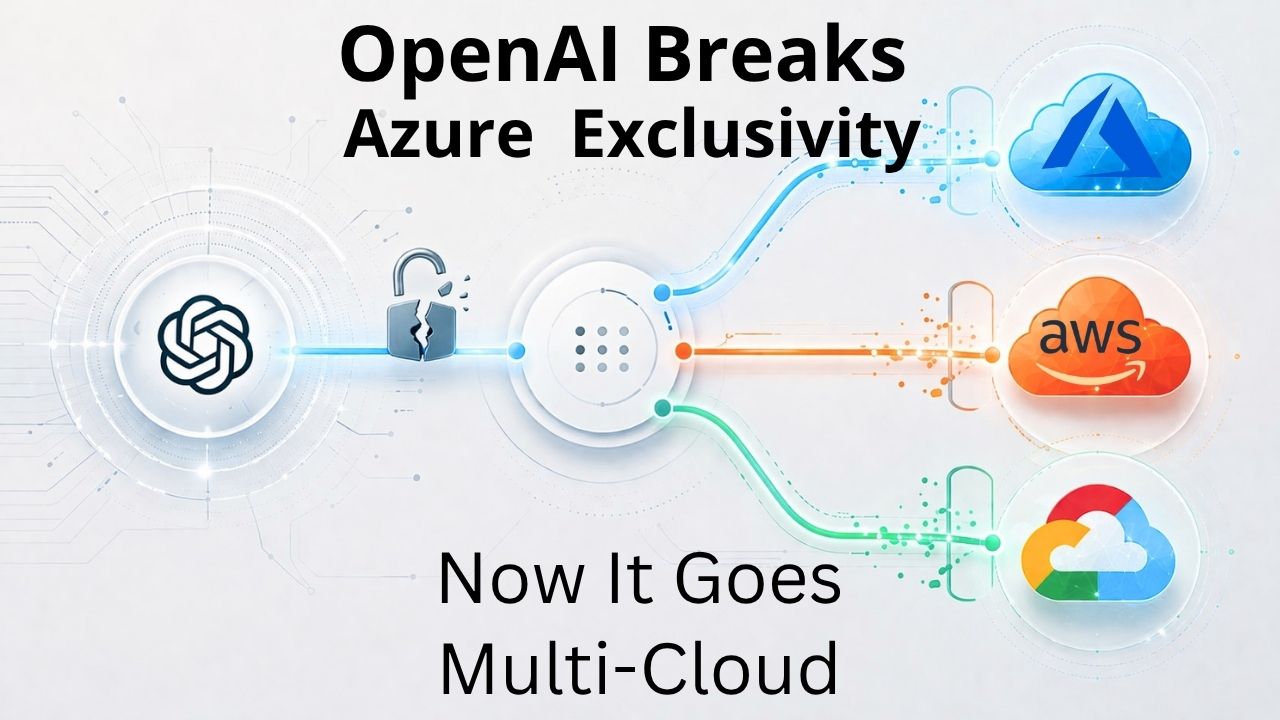
Microsoft and OpenAI announced a restructured partnership on April 27, ending the cloud exclusivity arrangement that had defined their relationship since 2019. Azure remains OpenAI’s primary cloud provider and OpenAI products continue to launch on Azure first. But the exclusivity clause is gone. OpenAI can now distribute all of its products across any cloud provider including AWS and Google Cloud. Sam Altman, OpenAI CEO, stated the change directly: “Microsoft will remain our primary cloud partner, but we are now able to make our products and services available across all clouds.”
What the Deal Actually Changed
The financial terms shifted significantly. Microsoft no longer pays revenue share to OpenAI. OpenAI continues paying Microsoft a revenue share through 2030, now subject to a defined cap. Crucially, the revenue share is decoupled from AI milestones, including AGI, removing a structural financial incentive that had been embedded in the original agreement. Microsoft retains approximately 27 percent of OpenAI’s for-profit entity and continues to benefit from OpenAI’s commercial success regardless of which cloud runs the workload.
The IP license, previously exclusive and open-ended, extends through 2032 but becomes non-exclusive. Microsoft had previously stated in February that “Azure remains the exclusive cloud provider of stateless OpenAI APIs.” That position is now superseded. The new arrangement allows OpenAI to serve all products on any cloud, with Azure retaining first-launch rights and the primary partner designation.
The Amazon Context
The restructuring did not happen in isolation. In November 2025, OpenAI signed an AWS cloud contract worth $38 billion. Amazon followed with an investment of up to $50 billion in OpenAI, structured as a $15 billion initial commitment and up to $35 billion conditional. The original Microsoft exclusivity agreement created a direct legal conflict with those arrangements. The April 27 restructuring resolves that conflict, specifically including AWS exclusive rights to OpenAI’s “Frontier” agent-making tool.
Amazon CEO Andy Jassy responded to the deal’s announcement: “We’re excited to make OpenAI’s models available directly to customers on Bedrock in the coming weeks.” The signal is clear: AWS will move quickly to build OpenAI-native offerings now that the contractual barrier is removed.
For Microsoft, the mathematics of the restructuring are defensible. Microsoft reported $7.5 billion in quarterly revenue from its OpenAI investment in its most recent results. Stopping revenue share payments to OpenAI while retaining a 27 percent equity stake means Microsoft participates in OpenAI’s growth without the cost structure of an exclusive distribution agreement. The company had already committed $250 billion in cloud services to OpenAI in October 2025. That relationship continues regardless of where OpenAI’s models run for other customers.
Regulatory Dimension
The restructuring also has a regulatory dimension. The exclusive arrangement between Microsoft and OpenAI had drawn scrutiny from competition regulators in the US, UK, and Europe, who were examining whether the exclusivity created barriers in cloud and AI markets. Gil Luria, analyst at D.A. Davidson, framed the commercial significance: “The new deal with Microsoft was essential for OpenAI to be successful in the enterprise market.” Enterprise IT teams that preferred AWS or Google Cloud had been structurally limited in their ability to adopt OpenAI models without routing workloads through Azure. That limitation is now removed.
For Hosting Providers, the Binary Choice Is Gone
The immediate effect on the managed hosting and cloud reseller market is an expansion of viable AI product stacks. A managed cloud provider on AWS can now build OpenAI-powered products without routing customers through Azure. A Google Cloud partner can offer GPT-4o or o3 integrations in the same environment as their existing GCP workloads.
The fragmentation of AI model access by cloud provider, which has driven significant enterprise infrastructure decisions for three years, begins to dissolve. Enterprise procurement teams evaluating AI infrastructure no longer face a binary choice between OpenAI on Azure or Anthropic and others on their preferred cloud. The competitive pressure this creates across all three major hyperscalers will shape pricing and terms for managed AI hosting products throughout 2026 and beyond.
For hosting providers who built OpenAI differentiation on Azure specifically, the exclusivity argument is gone. The question now is what their Azure partnership delivers that AWS or Google Cloud cannot, and whether the answer is strong enough to retain customers who now have genuine alternatives.
