
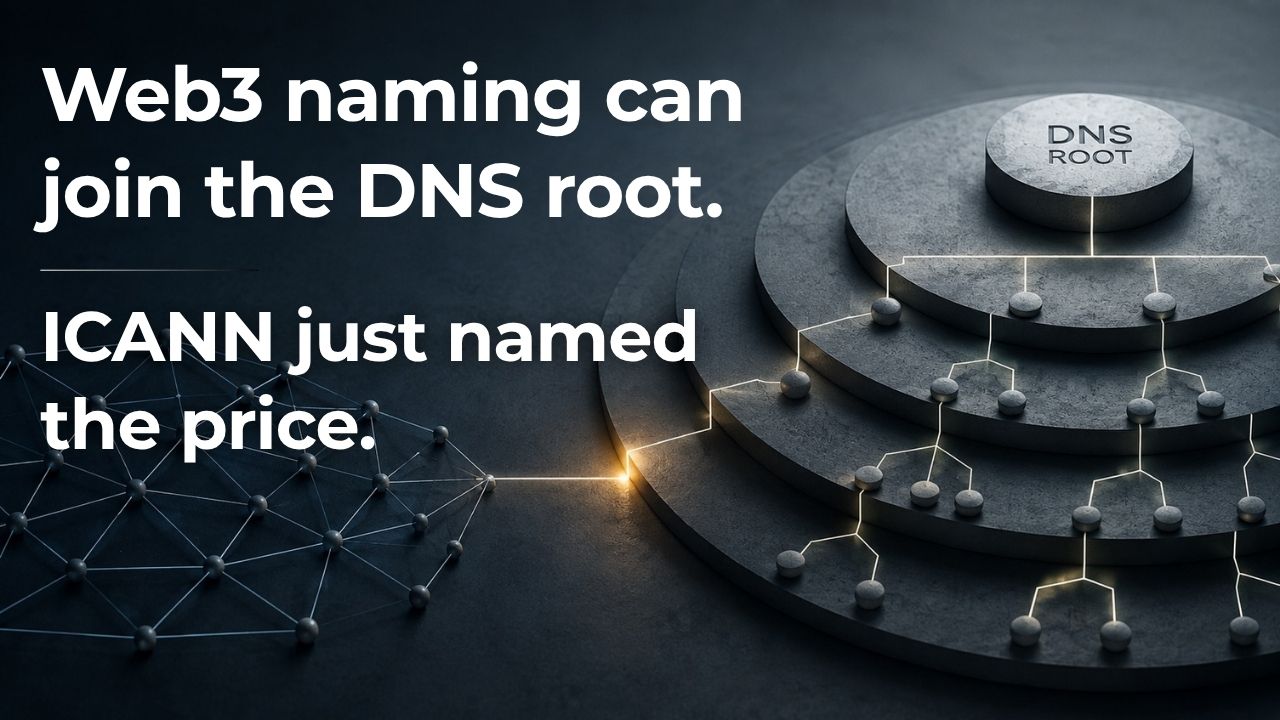
The organization that governs the internet’s address book spent the summer on a question it had put off for years. Can a blockchain naming system share a name with the real Domain Name System, and should ICANN let it happen? A first answer arrived on August 10 as a draft technical report, opened for public comment a day later. The application window then closed at 23:59 UTC on August 12, on ICANN’s first new top-level domain round since 2012. The sequence was not accidental. Several Web3 naming projects have run their own address systems outside the DNS for years, and the 2026 round is where some of them try to come inside.
The short version
- The finding. ICANN’s Technical Study Group concluded that a domain can be integrated with a matching name in an alternative system. The condition is demanding: the same string of letters, always controlled by the same party, in both systems at once.
- The catch. The hardest case is an existing Web3 registry that has already sold names, because every name would then have to be reserved for, or matched to, the same owner in the DNS.
- The move. Days before the deadline, Ethereum Name Service reorganized into a foundation so it could apply to ICANN at all. It is going after .ens as a closed brand domain, not trying to reconcile its existing .eth namespace.
- The clock. The report is a draft, the round’s evaluations run through ICANN’s registry-service review, and the earliest any of these strings could go live is 2028.
The First New-Domain Round Since 2012
ICANN opened the 2026 application window on April 30 and closed it on August 12, the first time it has invited new generic top-level domains since the 2012 round that produced more than 1,200 new endings. The base evaluation fee this time is expected to be USD 227,000 per string, with the fee itself due a week after the application deadline. The earliest a successful string could go live in the root is 2028. This is a slow, expensive process by design, and it is the sanctioned path into the root that the whole internet resolves, for a string that is not already there.
Pressure to open that route has been building on ICANN’s side, not just from applicants. The study group’s own report notes that since 2022, multiple current and prospective registry operators have approached ICANN asking to integrate the global DNS with other naming systems. In June, ICANN’s chief executive convened a small group to decide whether that could be done safely, and the group delivered its draft for public comment in the second week of August, days before applications were due.
What the Study Group Actually Concluded
The headline is more permissive than early coverage suggested. The group’s preliminary determination is that this can be done safely, if the two systems use the same string, those names stay under the same party’s control, and the report’s other requirements are met. In the report’s terms, the systems are integrated only if a name made of the same string is always either controlled by the same party or held back for that party’s exclusive control. Those criteria, it says, must always be satisfied.
That rule carries real weight. The report attaches several conditions to it:
- Every name in the alternative system must also be at least a candidate name in the DNS.
- The registry operator has to hold effective control over the matching name in the other system, a matter it calls at least as much contractual as technical.
- A suspension has to apply to all of the linked naming systems at once.
It also flags a gap. Where a name exists only in the alternative system, with no registrant contact data on file, it is not obvious how established dispute and takedown policies would even function.
What the report does not say is that any of this is hopeless. It uses the word insurmountable exactly once, and in the negative. The compliance challenge need not be insurmountable, it writes, but it is an issue any prospective operator would have to face. If the burden looks too high, the report adds, that domain may simply not be a good candidate. The document is a draft from a technical rather than legal group, written as advice to the ICANN organization, and any approval would still run through ICANN’s registry-service evaluation and potentially a technical review panel.
Why an Existing Web3 Registry Has the Hardest Path
The same-owner rule is straightforward for a brand starting fresh and awkward for a namespace that already exists. A Web3 registry that has sold thousands of names to pseudonymous holders cannot simply mirror them into the DNS, because each matching DNS name would have to be reserved for, or handed to, that same holder. Names whose owners do not want, or cannot establish, the DNS counterpart get withheld. The registry also inherits an ongoing duty to keep the two systems locked together, suspending in both at once and proving continuous control. For a going concern with a live book of names, that is the expensive part, and it is exactly the situation the largest Web3 naming projects are in.
ENS Picks the Pragmatic Door
Ethereum Name Service, whose names end in .eth, is taking a different route into the root. On August 11, ENS tokenholders approved a proposal that turns the project’s foundation into a fully operational body with a full-time executive director, staff, and a five-member board, and the change was executed on-chain. The stated reason is blunt: a decentralized organization on its own cannot pursue recognition of a top-level domain at ICANN, and a foundation can. Governance of the protocol itself did not move, and the proposal states plainly that protocol control remains exclusively with ENS tokenholders.
The domain ENS is chasing is .ens, not .eth, and the reason is a rule that predates the crypto era. The string eth is the three-letter ISO country code for Ethiopia, and ICANN’s guidebook treats any such code as a country name that is not available as a generic top-level domain. So ENS is pursuing a fresh string, as a closed brand domain rather than a public registry. In its own framing the goal is not revenue but brand protection and a more formal role in the ICANN ecosystem, a domain that would stay closed to public registration while still supporting names like wallet.ens. ENS and Unstoppable Domains each had a representative on the study group, which ICANN says served as peers rather than constituency delegates, alongside Verisign, Public Interest Registry, and Identity Digital.
Put together, the two developments describe an industry trying to move from the edge of the internet’s naming system toward its center, on terms the incumbent has now written down. ICANN’s message is that the door is open and narrow. The pragmatic response, at least from ENS, is not to drag an existing namespace through it, but to incorporate, pursue a clean brand string, and wait out a process whose payoff is years away.
About the Data
The requirements and the feasibility finding come from ICANN’s draft Technical Study Group report of August 10, 2026, and from the ICANN blog posts that announced the group and opened it for comment. Round mechanics, the fee, and the country-code rule come from ICANN’s 2026 application announcements and program materials. The ENS details come from the project’s official announcement and the executable governance proposal its tokenholders passed. The report is a draft and its conclusions are preliminary. Vote tallies circulating in crypto press are not in ENS’s official record and are not quoted here.

Sources
- Report of the Technical Study Group: gTLD Integrations with Alternative Naming Systems - ICANN (initial draft report)
- Feedback Request: gTLD Integrations with Alternative Naming Systems TSG Report - ICANN (blog, Theresa Swinehart)
- gTLD Integrations with Alternative Naming Systems Technical Study Group Underway - ICANN (blog, Kurtis Lindqvist)
- Introducing the Evolved ENS Foundation - ENS (official blog)
- Next Era of ENS DAO: Empowering the ENS Foundation - ENS DAO Governance Forum (executable proposal)
- Reminder: 2026 Round New gTLD Application Window Closes 12 August - ICANN (announcement)
- New gTLD Program Next Round Evaluation Fee - ICANN (fee FAQ)
- How ENS Is Approaching ICANN's gTLD Expansion Program - ENS (official blog)