
Vibe coding tools have moved from niche trend to category force. Lovable has passed $400 million in ARR with 8 million registered users. Bolt has 5 million users. Replit has 50 million. A first-party report from Lovable, The Build Economy, surveyed 14,300+ users and tracked 50 million total projects to map who is building and why. These tools produce React and Node.js by default, and the platforms capturing their deployment volume are not traditional shared hosts.
50 Million Projects, 1 Million a Week: Who Is Actually Building With Vibe Coding Tools
The leading platforms have each passed scale milestones that would have seemed implausible two years ago:
| Platform | Key figures |
|---|---|
| Lovable | $400M ARR · 8M users · 1M+ projects/week · 50M total · $6.6B valuation (2025–2026) |
| Bolt (StackBlitz) | 5M+ users (2025) |
| Replit | 50M users · $9B valuation (March 2026) |
| Vercel | $340M ARR · 30% of deployments from AI agents (April 2026) |
The Build Economy report fills in the demographic picture. The builders behind these numbers are not students experimenting with tech:
- 4 in 5 describe themselves as non-technical
- 55% have more than 11 years of professional experience
- 2 in 3 come from outside the tech industry
- 3 in 5 plan to monetize what they build
- 1 in 2 are actively building a business
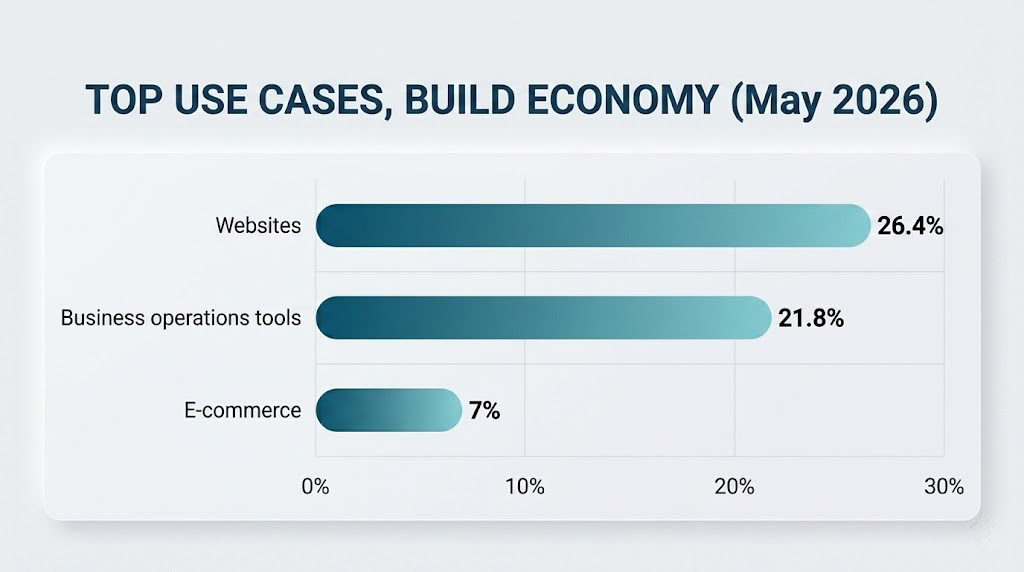
These are experienced professionals building work-critical tools on infrastructure that traditional hosting providers are not structured to capture.
The Stack Problem for Traditional Hosting
Traditional shared hosting was built around a stack defined in the early 2000s: PHP, MySQL, Apache or Nginx, and cPanel or Plesk. This stack powers WordPress and the long tail of legacy PHP applications, and remains the operational foundation of nearly every general-purpose shared hosting provider.
Vibe coding tools produce something categorically different:
| Vibe coding output | Traditional shared hosting |
|---|---|
| React, Next.js | PHP |
| Node.js, TypeScript | MySQL / MariaDB |
| Python, serverless functions | Apache / Nginx |
| Deploy via Git / CLI | cPanel / Plesk |
None of these outputs run natively on a standard PHP shared hosting environment without significant additional configuration that the tools themselves do not provide.
The practical consequence is immediate. A user who builds with Lovable and attempts to deploy to a cPanel host encounters a barrier with no guidance on how to resolve it. The path of least resistance is to click “Deploy” within the tool, which routes to Vercel, or to follow the platform’s deployment guide, which routes to Cloudflare Workers or Netlify. Both have free tiers. Neither requires a monthly subscription decision.
Where Vibe-Coded Projects Actually Deploy
The stack mismatch has a clear beneficiary. Three platforms capture the majority of vibe coding deployment volume, all charging on usage rather than a fixed monthly subscription, with free tiers sufficient for most projects at launch volume.
| Platform | Stack | Free tier |
|---|---|---|
| Cloudflare Workers | JS, TS, Python, Rust | 100,000 req/day, no credit card required |
| Vercel | React, Next.js, Node.js | Hobby tier, no monthly cost |
| Netlify | Static sites, JAMstack | Free plan available |
Cloudflare’s Q4 2025 earnings call cited 4.5 million active developers on the platform. CEO Matthew Prince stated that most vibe coding platforms are either built on Workers or have Cloudflare as their preferred deployment target. Cloudflare Containers reached general availability on April 13, 2026, extending the platform to persistent workloads beyond the Workers execution model.
Vercel’s position is reinforced by its default relationship with Lovable: deployments route to Vercel unless the user explicitly redirects them. A vibe coding user who launches 10 small projects over a year may pay nothing across any of these platforms. The same usage pattern on shared hosting generates 12 monthly subscription payments.
Hostinger Horizons and What the Exception Reveals
Among established hosting providers, Hostinger is the only one that has built a product structurally aligned with the vibe coding workflow. Horizons, launched in late 2024, generates a complete web presence from a natural language description and bundles hosting, domain registration, and email into a single product. Horizons reached one million users, with 93% to 95% having no prior paid web presence and a median time-to-launch of 0.8 days.
The distinction between Horizons and Lovable is worth stating clearly. Horizons generates informational and small business sites: company pages, portfolios, local service listings. Lovable and Bolt generate functional software with custom backend logic, databases, and APIs. The two products are not competing for the same builder.
But Horizons demonstrates the approach that works: own the creation experience, and the hosting decision becomes a consequence of product choice rather than a separate evaluation. Hostinger entered the creation layer and captured the deployment as a built-in outcome. The rest of the industry has not followed.
These Builders Were Never in Your Funnel
The demographic data from the Build Economy report points to something more fundamental than a technology mismatch. The builders using Lovable and Bolt are not former shared hosting customers who switched platforms. 4 in 5 describe themselves as non-technical. 55% have more than 11 years of professional experience. 2 in 3 come from outside the tech industry. These are people who, five years ago, would not have built a web application at all. They did not evaluate cPanel plans and choose Vercel instead. Vercel was the only option they ever considered.
Hostinger is the only traditional provider to have built a product that intersects with this workflow. Horizons reached one million users with 93% to 95% having no prior paid web presence. The figure confirms the pattern: the new builder segment is reachable, but only if the entry point is creation, not infrastructure.
Lovable signed a multi-year agreement with Google Cloud on June 3, 2026, expanding its AI infrastructure fivefold and entering Google’s enterprise agent marketplace. Bolt formalized a partnership with Microsoft Azure in May 2026, with Azure-native deployment and Microsoft 365 integration. Both platforms are now anchored to hyperscalers. The structural question for traditional providers is not how to add AI to existing plans. It is whether they have a product that intersects with the creation moment at all, before a builder defaults to Vercel or Cloudflare Workers and never evaluates anything else.

Sources
- The Build Economy - Lovable.app (platform data, Jan 2025–May 2026)
- Lovable says it added $100M in revenue last month alone - TechCrunch
- Vibe coding startup Lovable raises $330M at $6.6B valuation - TechCrunch
- Replit raises $400 million - Replit Blog
- Agentic infrastructure - Vercel Blog
- Vercel CEO signals IPO readiness as AI agents fuel revenue surge - TechCrunch
- Cloudflare Q4 2025 earnings call transcript - The Motley Fool
- Deploy your own AI vibe coding platform - Cloudflare Blog
- Cloudflare Workers pricing - Cloudflare Developers
- Cloudflare Containers and Sandboxes now generally available - Cloudflare Changelog
- Horizons turns one: one million users - Hostinger Blog
- AI website builder statistics 2026 - Hostinger Blog
- Lovable signs multi-year deal with Google Cloud to up usage 5x - TechCrunch
- Agentic building across the enterprise with Bolt.new on Microsoft Azure and Microsoft 365 - Bolt Blog