
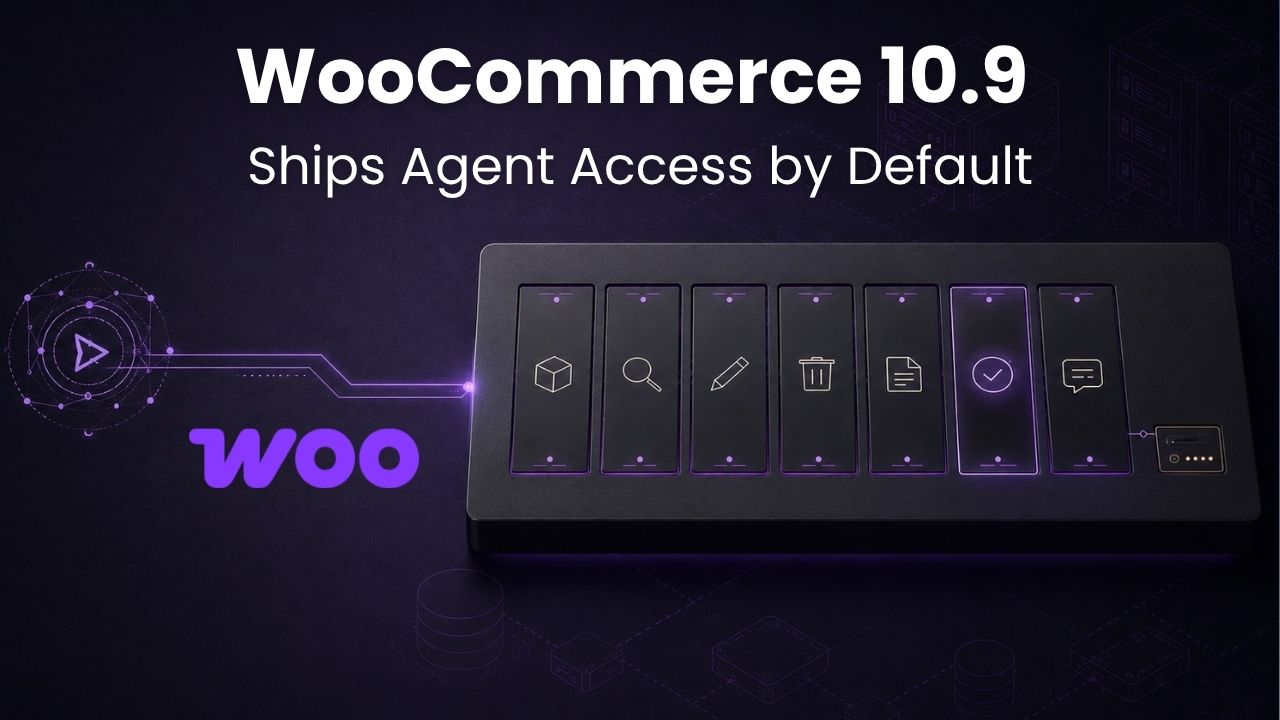
When WooCommerce announced in May that it would make its store operations addressable by AI agents, this publication wrote that the concept was sound and the hard part would belong to the hosts. That hard part arrived yesterday, when WooCommerce 10.9 reached stable on June 23, carrying the first set of canonical “abilities” into core: seven schema-defined operations for products and orders that any agent, automation, or command-line tool can call through the WordPress Abilities API and the WordPress Model Context Protocol endpoint. In May, agent-addressable commerce was a developer proposal. It shipped, by default, into the upgrade path of one of the most widely deployed e-commerce platforms on the web, and over the normal WooCommerce upgrade cycle it will reach the installed base whether or not any given merchant has thought about what it means.
Key facts, WooCommerce 10.9 (developer.woocommerce.com; stable June 23, 2026)
- Seven canonical abilities in core for products and orders:
woocommerce/products-query,woocommerce/product-create,woocommerce/product-update,woocommerce/product-delete,woocommerce/orders-query,woocommerce/order-update-status, andwoocommerce/order-add-note - Each ability ships with strict input and output schemas, WooCommerce-aware enums, permission callbacks, and metadata, and is exposed as a transport-neutral contract through the WordPress Abilities API, WordPress MCP, admin tools, the CLI, automation systems, and future agent surfaces
- Five of the seven are write operations:
woocommerce/product-create,woocommerce/product-update,woocommerce/product-delete,woocommerce/order-update-status, andwoocommerce/order-add-note; the surface is not read-only - Read-only abilities are landing across extensions too, spanning gift cards, add-ons, subscriptions, payments, shipping, automation, and marketing data
- A performance change hosts will feel: the Store API no longer creates a persisted draft order during fresh-session GET and PATCH requests, cutting unnecessary database writes on storefronts, alongside product-filter SQL optimizations
- Also in the release: transactional email logging built into core (visible under WooCommerce, Status, Logs), and experimental dual Code API plus autogenerated GraphQL for PHP 8.1 and above; the block-based Product Editor beta is deprecated for removal in 11.0
What Actually Shipped, and Why “Canonical” Matters
The word doing the work in this release is “canonical.” Before 10.9, an AI agent or automation that wanted to act on a WooCommerce store could do so through the REST API, but every integration interpreted the store’s operations slightly differently, and there was no single authoritative definition of what “create a product” or “update an order status” meant in WooCommerce’s own terms. The abilities layer makes that definition official: each operation is described once, with a strict schema, WooCommerce-aware enumerations, and a permission callback that decides whether a given caller is allowed to invoke it. The same contract is what a human reaches through the admin, a script through the CLI, and an AI agent through MCP. That collapses a sprawl of inconsistent integrations into one governed interface, and it makes the agent surface a first-class, default-present part of the platform, which is exactly why it is a hosting concern and not just a developer convenience.
Five of the seven abilities write. An agent with the right permissions can create, update, and delete products, change order status, and add order notes, not merely read. That is the line that separates a helpful catalog-lookup feature from a privileged operational interface, and it is the line at which the permission callback stops being an implementation detail and becomes the security boundary of the store. The read-only abilities now landing across extensions, exposing subscription, payment, shipping, and marketing data through the same mechanism, widen the surface further: more of the store’s state becomes machine-addressable through one consistent contract, which is convenient for legitimate automation and equally convenient for anything that reaches the interface without authorization.
The Surface Hosts Now Have to Reason About
Security research presented at Infosecurity Europe in mid-June established the uncomfortable foundation of agent-facing surfaces: prompt injection, the technique by which an agent is manipulated through the content it reads, is increasingly regarded as a structural property of how language models work rather than a bug that will be patched. OWASP maps it to six of the ten categories in its 2026 Top 10 for Agentic Applications. WooCommerce 10.9 sits exactly at the intersection of those threads. It gives agents a clean, governed way to act on a store, and the same research says those agents can be steered by the content they ingest. The store’s defense is the permission callback on each ability and the configuration of the MCP endpoint that exposes them, which means the security of an agent-addressable WooCommerce store is now only as good as the host’s and merchant’s understanding of who can call those seven operations and under what authority.
WooCommerce 10.9 moves the addressable surface from bolt-on integrations into the platform core. The feature is well designed and brings real governance to what was previously a free-for-all of REST integrations. The consequence is that a managed WooCommerce host can no longer treat “is the MCP endpoint exposed, to whom, and with what write permissions” as an exotic edge case: after the 10.9 upgrade cycle, it is a default-present property of every store it runs.
The Quiet Win, and the Practical Checklist
Not all of 10.9’s hosting impact is risk. The performance change is a genuine and immediate benefit: by no longer creating a persisted draft order during fresh-session Store API GET and PATCH requests, WooCommerce eliminates a class of unnecessary database writes that has long inflated load on busy storefronts, where bot and casual-browse traffic generated throwaway draft orders by the thousand. Combined with the product-filter SQL optimizations, this reduces database pressure on exactly the high-traffic stores that cost hosts the most to run, and it is the kind of change that quietly improves the economics of managed WooCommerce hosting without any merchant action. The new in-core email logging, surfacing send outcomes under Status and Logs, also cuts a recurring support category, the “did my order email actually send” ticket, by making the answer visible without a plugin.
The practical checklist for operators, worth running before the upgrade reaches the bulk of customer stores:
- MCP endpoint: know whether WordPress MCP is or will be exposed on your managed WooCommerce stack, and treat it as an authenticated, monitored, privileged interface rather than a developer toy
- Write permissions: understand the default permission-callback behavior for the five write abilities and confirm it matches the authority you actually want agents and automations to have
- Logging: add the MCP endpoint and abilities calls to whatever anomaly detection you run; a write ability invoked by the wrong caller is the event you will wish you had recorded
- Upgrade promptly: take the performance change as a reason to upgrade rather than defer; the draft-order reduction pays for itself on busy stores
The version that turns WooCommerce into an agent-addressable platform is here and stable. The platform did the engineering; the part that determines whether it is safe in production is the host’s.

Sources
- WooCommerce 10.9: What's coming for developers (June 9, 2026) - WooCommerce Developer Blog (official)
- Introducing canonical WooCommerce abilities for products and orders - WooCommerce Developer Blog (official)
- Expanding abilities across WooCommerce extensions - WooCommerce Developer Blog (official)
- Model Context Protocol (MCP) integration - WooCommerce developer documentation (official)
- OWASP on prompt injection as a structural problem (Infosecurity Europe, June 2026) - Help Net Security