
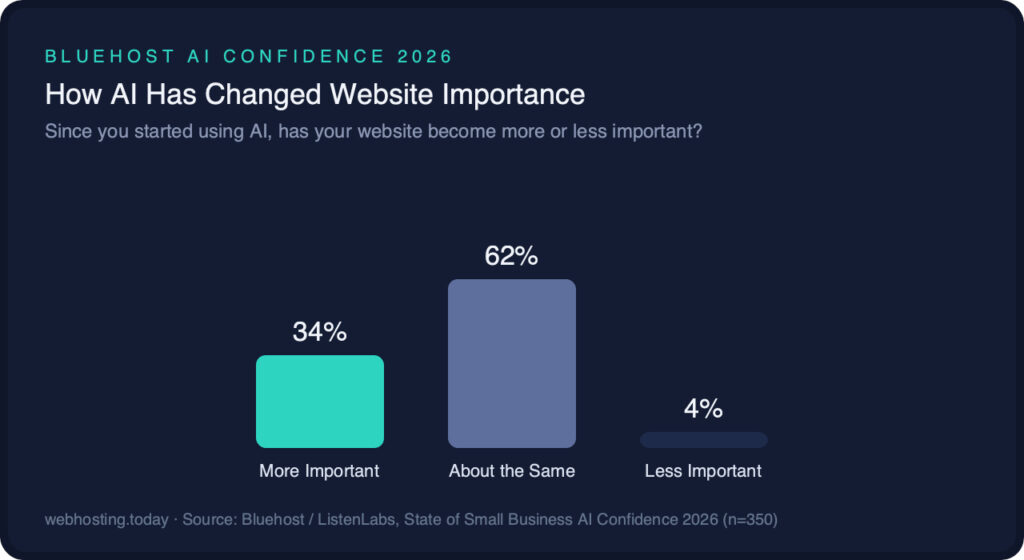
The recurring prediction is that AI will make business websites irrelevant. Customers will talk to chatbots, get answers from AI search, and never visit a URL again. Bluehost just published data that contradicts that story directly. In its first State of Small Business AI Confidence report, based on a survey of 350 U.S. small business owners conducted in May 2026, the company found that 34% of respondents say their website has become more important since they started using AI. Only 4% say it has become less important. The remaining 62% say it stayed the same. The website is not dying. For a significant share of small businesses, AI is actually making it matter more.
The Bluehost survey covers 350 U.S.-based businesses with 1 to 50 employees – a focused sample that captures the SMB segment well, though limited to the U.S. market. The broader trend it identifies is consistent with larger studies. Intuit’s 2026 AI Impact Report, drawing on responses from more than 34,000 businesses and anonymized data from 5.3 million QuickBooks accounts across four countries, found that 77% of U.S. businesses now use AI regularly and 43% say AI has increased their revenue. The Intuit data does not address website relevance directly, but it confirms the same underlying trend: AI adoption among small businesses is broad, accelerating, and increasingly tied to revenue. The Bluehost report adds a layer that larger studies have not yet examined – how that adoption is reshaping the role of the website itself.
The reason is structural. To be recommended by an AI model, a business needs a data-rich, well-structured website that AI can read and reference. The website is becoming the source of truth that feeds AI-powered discovery. Businesses that understand this early are already seeing measurable results.
Key Findings
- 34% of small businesses say their website has become more important since they started using AI. Only 4% say less important.
- 87% use at least one AI tool, but ChatGPT is used by 73% of them. Specialized AI tools remain rare.
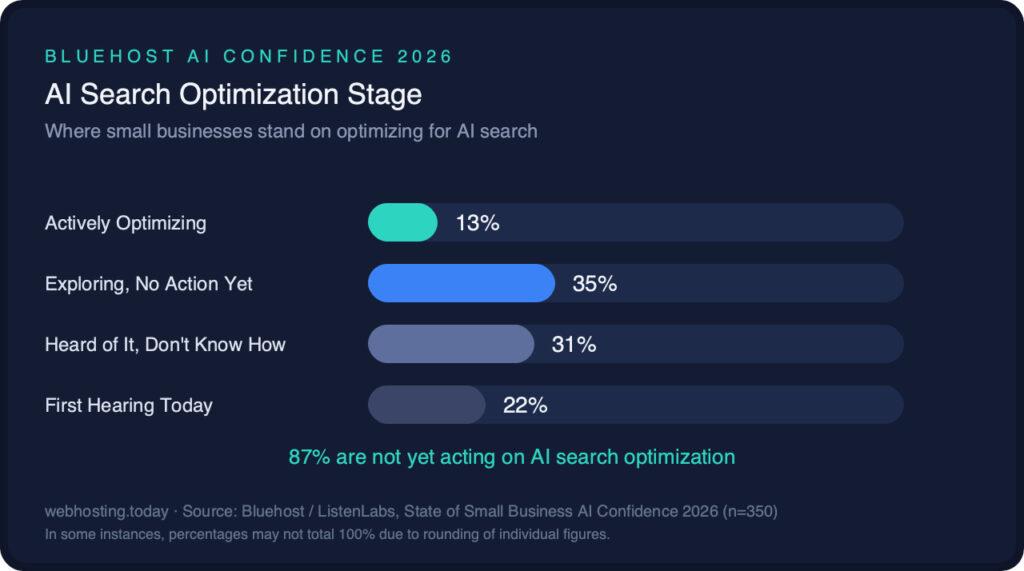
- Only 13% actively optimize for AI search visibility.
- 47% of owners would treat a competitor appearing first in AI search as a top priority.
- Businesses at peak AI confidence are nearly 3x as likely to see positive revenue impact as low-confidence peers.
- Paying for AI subscriptions does not close the confidence gap: 76% of paid users still are not highly confident.
87% Use AI, but the Website Remains the Hub
87% of small businesses now use at least one AI tool, 56% use it every day, and a majority pay for at least one subscription. But the shape of the AI stack tells its own story. ChatGPT appears in 73% of small businesses, more than five times the share of any specialized tool. The general-purpose chatbots dominate. Purpose-built AI for marketing, SEO, sales, and customer service each appears in fewer than 12% of businesses.
The owner is the integration layer. They prompt a general-purpose chatbot, then copy the output into their website, their email campaigns, their listings, their proposals. The specialized AI applications that would live inside the business workflow are still largely missing. The website remains the destination where AI-generated content lands, gets published, and reaches customers.
Only 13% Optimize for AI Search
AI search optimization is where the gap between what small businesses know and what they will need to know is widest. Only 13% of small businesses are actively optimizing for AI search visibility. Another 35% have heard of it but have not taken action. 31% know it exists and do not know where to start. 22% encountered the concept for the first time in the survey itself.
But the early movers are already pulling ahead. Even imperfect, early attempts at making a website more readable for AI appear to correlate with measurable business growth. And the urgency is building: when asked how they would respond if a competitor appeared first in AI search results, 47% of owners said they would treat it as a top priority. 13% already report that more customers have found them through AI tools.
What does “optimizing for AI search” actually look like in practice? The starting point is structured data. Google recommends schema markup in JSON-LD format as the preferred way to help machines interpret page content, and AI platforms like Bing, Google AI Overviews, and ChatGPT Search use it to identify entities, attribute content, and understand relationships between pages. The most relevant schema types for a small business are Organization (brand identity), Article (content attribution), and Product or Service (commercial information). For most small businesses, implementing this is relatively straightforward technical work on an existing website, not a platform migration or a new product category.
Paying for AI Does Not Close the Confidence Gap. Practice Does.
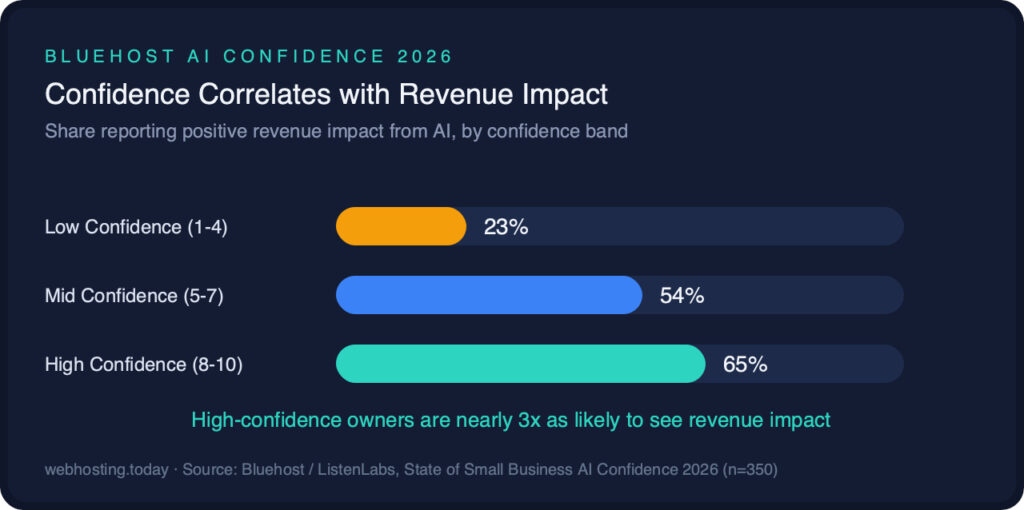
The report’s broadest finding ties directly back to the website story. Only 20% of small business owners rate themselves highly confident in their effective use of AI, and 76% of those paying for AI subscriptions still are not highly confident in how they use those tools. But confidence correlates directly with revenue: businesses that reach peak AI confidence are nearly 3x as likely to see positive revenue impact as low-confidence peers using the exact same tools. What closes the gap is not spending more but practicing more. Businesses using AI for more than two yearsreport roughly 2x higher revenue growth than newcomers.
87% Are Waiting. The Question Is for What.
The 87% of small businesses not yet optimizing for AI search is not a sign of indifference. The Bluehost data shows that awareness is high and intent is real – nearly half of owners say they would act the moment a competitor showed up ahead of them. What is missing is a clear, accessible starting point. Most owners know AI search exists. Most do not know what to do about it.
That gap is where the next round of competition in web services will play out. The tools, the knowledge, and the technical work required to make a website AI-readable already exist. Schema markup is not new. Structured data is not experimental. What is new is that it now has a direct, measurable connection to how businesses get found. The website is not the relic of a pre-AI era. It is the asset that makes AI discovery possible.
