

The domain a company picks is treated as a design decision: .io reads as developer-native, .ai signals the moment, .co when the .com is taken. What almost nobody prices is that most of these fashionable extensions are not neutral internet real estate. They are the country codes of specific territories, delegated by IANA to whoever manages them, and the founding rulebook of the system is blunt about what that means. RFC 1591, the 1994 document that still governs domain delegation, states that top-level-domain managers are “trustees for the delegated domain” and that “concerns about ‘rights’ and ‘ownership’ of domains are inappropriate.” You do not own a country-code domain. You rent continuity that depends on the diplomatic and political status of a place you have no control over, and in the past three years that status has changed, been seized, been repriced, and been switched off often enough that the risk is no longer theoretical. The .io saga of the last year is the loudest example, but it is not the scariest one, and it is not the only one.
Hosting M&A Consultation
Get one-on-one advice on maximizing your hosting company’s valuation and navigating the sale process.
Key facts (ccTLD sovereign risk, verified June 2026)
- A ccTLD is not property. RFC 1591 defines the manager as a “trustee” with a “duty to serve the community” and calls ownership concerns “inappropriate.” A registrant is a tenant of a tenant.
- The retirement mechanism is real and automatic: when a territory’s code leaves the ISO 3166-1 standard, IANA retires the ccTLD, by default after five years, extendable to a maximum of ten. It has happened to .yu (Yugoslavia), .tp (East Timor), .zr (Zaire), .an (Netherlands Antilles), and others.
- .io is a reprieve, not a resolution. The UK-Mauritius Chagos treaty was signed May 22, 2025, which raised the question of whether the “IO” code survives; the deal was then shelved in early 2026 after the US withdrew consent and ratification stalled. ICANN’s position: nothing changes for .io unless “IO” leaves ISO 3166-1, at which point the retirement clock starts. As of now it has not, but the dispute is unresolved.
- .io runs deep into the software supply chain, not just branding: github.io, kubernetes.io, registry.k8s.io, docker.io, and crates.io are hardcoded into millions of downstream systems; the Kubernetes project opened a tracking issue on the impact of losing .io.
- .ai now funds a country. Anguilla’s .ai revenue went from about $2.9M in 2018 to roughly $32M in 2023 (about 20 percent of government revenue, per the IMF) to an estimated $85M in 2025 (about half). .ai passed 1,000,000 registrations on January 2, 2026, and 28 percent of 2025 Y Combinator and Techstars startups use it.
- Governments have switched ccTLDs off before: Gabon reclaimed .ga and roughly 7 million domains were deleted (2023); the EU suspended 80,000-plus UK-held .eu domains after Brexit (2021); the Taliban-controlled ministry shut down .af domains, killing the queer.af service (2024); Libya seized vb.ly (2010).
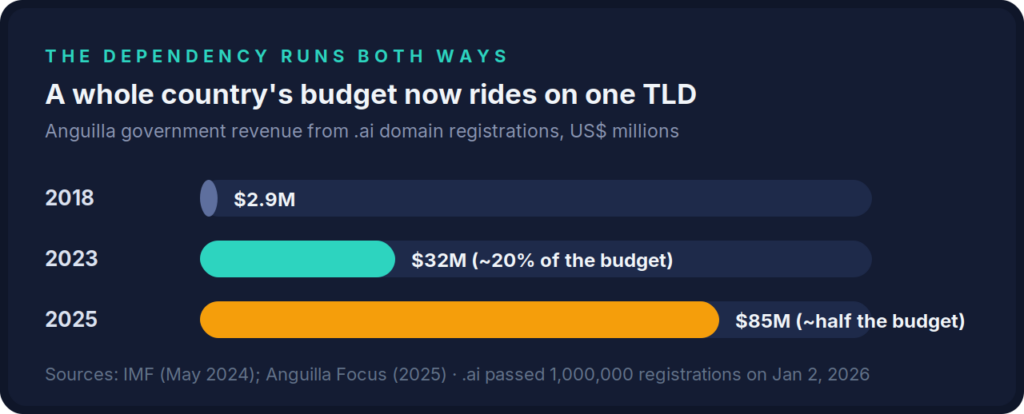
Anguilla now funds roughly half its government from .ai. The flip side: more than a million brands, including major AI-infrastructure companies, now depend on the stability and goodwill of a Caribbean territory of about 15,000 people. Sources: IMF (2024); Anguilla Focus (2025).
A ccTLD Is Not Property, and the Rulebook Says So
The conceptual mistake sits at the root, so it is worth stating plainly. A generic top-level domain like .com is operated under an ICANN contract designed for global commercial use with the continuity that implies. A country-code domain is different in kind. It exists because a two-letter code appears in ISO 3166-1, the standard list of country and territory codes, and IANA delegates the running of that code to a manager who, in the words of RFC 1591, holds it in trust for a community. The registrant who buys a name under it is a tenant of that trustee, and the trustee’s authority itself depends on a standards-body list it does not control. There is no ownership anywhere in the chain, and no guarantee of continuity written into it. That is not a loophole; it is the explicit design, and the design includes an exit. When a territory’s code is removed from ISO 3166-1, IANA’s published policy retires the ccTLD after five years by default, extendable to a hard maximum of ten. The precedents are concrete: .yu vanished with Yugoslavia, .tp with East Timor’s transition to .tl, .zr with Zaire’s renaming, .an with the dissolution of the Netherlands Antilles. Each one was somebody’s address, and each one went away because the geopolitics under it changed. The difference in 2026 is that the most fashionable startup extensions are country codes of exactly the kinds of places, small territories and contested jurisdictions, whose status is least stable.
The .io Case Is a Reprieve, Not a Resolution
The .io story is the one the industry noticed, and it is instructive precisely because the alarming version turned out to be wrong, which does not make the risk go away. .io is the code for the British Indian Ocean Territory. When the United Kingdom and Mauritius signed a treaty on May 22, 2025 to transfer sovereignty over the Chagos Archipelago, it raised a direct question: if BIOT ceases to exist as a distinct territory, does the “IO” code eventually leave ISO 3166-1 and start the retirement clock on a domain that carries more than a million registrations. ICANN addressed it directly, saying nothing changes for .io unless and until “IO” is removed from the standard, at which point the normal retirement process applies. Then the politics moved again: the deal was shelved in early 2026 after the United States withdrew its consent and the ratifying legislation stalled, leaving the UK in control for now and Mauritius signaling it would pursue other routes. So .io is not on a retirement clock today. It is a reprieve, not a resolution, and the honest reading is that a domain used by a large share of the developer world spent a year with its long-term existence hostage to a treaty negotiation it had no part in.
What makes .io the sharpest cautionary tale is not the branding exposure but the infrastructure exposure. .io is not only where startups put their marketing sites; it is wired into the plumbing of modern software. github.io hosts millions of pages, docker.io is the default registry namespace baked into every Docker installation, registry.k8s.io serves container images to effectively every Kubernetes cluster on earth, and crates.io is where the Rust ecosystem pulls its packages. These are not domains a company can change with a redirect; they are hardcoded into build pipelines, deployment manifests, and installed software across the industry. That is why the Kubernetes project opened a formal tracking issue on the possible impact of losing .io, an artifact that shows what it actually means when critical infrastructure discovers its canonical address belongs to a contested territory. A brand can be migrated, painfully. A default container registry that half the world’s clusters pull from cannot be moved without a coordinated global dependency change, which is a categorically harder problem than a marketing rebrand.
This Is Not Hypothetical: The Ledger of ccTLD Disruptions
The reason to take the abstract risk seriously is that the concrete version keeps happening, to real companies, with no recourse. In June 2023, Gabon reclaimed control of .ga and the mass of free domains issued under the previous operator was wiped out, roughly seven million names deleted by a single change of registry control. On January 1, 2021, the day the Brexit transition ended, EURid suspended more than 80,000 .eu domains held by UK registrants because they no longer met the eligibility rules; websites and email went dark overnight, purely because of a change in who was allowed to hold the name. In February 2024, the Taliban-controlled ministry that governs .af shut down domains including queer.af, killing a live service about two months before its renewal was even due, with no appeal. Back in 2010, Libya seized vb.ly for violating Libyan morality law and then warned every holder of a short .ly domain that they were exposed. And in 2017, during a routine backend transition, a security researcher was able to register four of the seven authoritative nameserver domains for .io itself, briefly gaining potential DNS control over every .io domain then in existence. None of these were exotic edge cases. They were governments and registries exercising exactly the authority that RFC 1591 describes, over registrants who had assumed, wrongly, that they owned something.
The Money Runs the Wrong Way Too
Sovereign risk is the dramatic failure mode, but there is a quieter one that hits every ccTLD tenant: pricing power. Once a company has built its brand and its links and its email reputation on an extension, the cost of leaving is high enough that the operator can raise prices with little resistance, and the operators have. Identity Digital, which runs .io along with a large portfolio, has pushed near-annual portfolio-wide increases and a .io-specific rise in early 2026. Anguilla’s .ai wholesale fee rose from $70 to $80 a year effective March 5, 2026, and with the mandatory two-year minimum that lifts the floor to $160 per term. These are not huge sums per domain, but they are the predictable behavior of a landlord whose tenants cannot easily move, and they compound the strategic point: a ccTLD gives the holder of the code both the continuity risk and the pricing leverage.
The Anguilla numbers also expose a second-order risk that cuts the other way. .ai has become so lucrative that it now funds roughly half of the government of a territory of about 15,000 people, up from a fifth just two years earlier. That is a windfall for Anguilla and, on its face, an argument for stability, because no government kills the goose. But a single revenue line that large is also a distortion: it makes the territory’s finances, and by extension the domain’s governance, hostage to the AI hype cycle that inflated it, and it concentrates the fate of more than a million brands, including AI-infrastructure companies whose entire identity is a .ai domain, in the political and fiscal stability of one very small place. The dependency runs both directions, and neither direction is priced into a domain that a founder chose because it looked good on a pitch deck.
What It Costs to Leave, and What to Do
The instinct on reading this is to ask whether it matters, given that migrating a domain is possible. It is possible, and it is brutal. Domain migrations lose organic search traffic as a rule; SEO practice plans for a dip measured in months, not weeks, and recovery is neither quick nor guaranteed. The cautionary case is WooCommerce, which moved to woo.com in late 2023, watched organic traffic fall steeply over the following months, and publicly reversed the change back to woocommerce.com in April 2024, naming the domain move as a contributing factor in the decline. For an infrastructure company the direct search loss is the smallest part: API base URLs, SDK defaults, OAuth callback URLs, container-image registries, and hard-won email deliverability reputation all have to be rebuilt, and much of it is hardcoded in customers’ systems beyond the company’s reach. There is no credible single dollar figure for what a full primary-domain migration costs a business, because the cost is spread across brand, search, engineering, and third-party dependencies, but the honest summary is that it is expensive enough that almost nobody does it voluntarily, which is exactly why the sovereign risk sits unaddressed until an external event forces the issue.
The practical response is not to declare ccTLDs unusable; .io and .ai are useful, and Google treats both as generic for search purposes, so there is no ranking penalty. The response is to price the risk that was previously invisible. Know which of your properties sit on a country code and which country. Hold the matching .com defensively even if you lead with the ccTLD, so a forced migration is a switch rather than a scramble. For anything in the software supply chain, a registry, an API endpoint, a package host, do not let a single ccTLD be the only canonical address, because that is the exposure that cannot be fixed with a redirect. And treat the extension as what RFC 1591 says it is: not a possession, but a trust arrangement with a government you do not control, whose politics are now a line item in your continuity plan whether you wrote it down or not. The founders who picked .io because it read as native, and the AI companies who picked .ai because it read as inevitable, made a branding decision that was quietly also a geopolitical one. The bill for that, when it comes, does not arrive as a renewal notice. It arrives as a policy change in a capital you have never visited.
How We Verified This
The trusteeship language is quoted directly from RFC 1591 (J. Postel, 1994), and the retirement mechanism (ISO 3166-1 removal, five-year default, ten-year maximum, IANA decides) from IANA’s published ccTLD retirement policy, both retrieved and verified June 26, 2026. The .io/Chagos status is drawn from the UK Parliament’s record of the May 22, 2025 treaty, ICANN’s November 14, 2024 statement that nothing changes for .io absent an ISO 3166-1 removal, and reporting that the deal was shelved in early 2026; we present .io as under an unresolved dispute, not on an active retirement clock, and label it a reprieve rather than a resolution. The Anguilla revenue figures are from the IMF (2018 to 2023, including the roughly 20 percent of government revenue) and Anguilla Focus for the 2025 estimate (EC$230 million, about US$85 million, with the government expecting .ai to fund nearly half of revenue); the one-million-registration milestone and the 28 percent accelerator-startup share are from Domain Name Wire; the .ai wholesale increase is from registry-price reporting. The disruption precedents (.ga, .eu, .af, .ly, and the 2017 .io nameserver incident) are from contemporaneous reporting and registry statements. The .io registration total is given as a range because the registry does not publish an official count. Migration-cost evidence rests on the WooCommerce woo.com reversal, documented in the company’s own April 2024 announcement, not on a single audited dollar estimate, which does not exist.

Sources
- RFC 1591: Domain Name System Structure and Delegation (J. Postel, 1994) - IETF/RFC Editor (the "trustee" and "ownership is inappropriate" language)
- Retiring ccTLDs: the ISO 3166-1 removal trigger and the five-to-ten-year timeline - IANA (official)
- The Chagos Archipelago and the .io domain (November 14, 2024) - ICANN (official)
- The UK-Mauritius agreement on the Chagos Archipelago - House of Commons Library
- An AI-Powered Boost to Anguilla's Revenues (May 15, 2024) - International Monetary Fund
- .ai domain surge brings EC$230m (US$85.3m) windfall to Anguilla in 2025 - Anguilla Focus
- .AI namespace hits 1 million domain names (January 2026) - Domain Name Wire
- New data: 28% of Y Combinator and Techstars startups using .ai domains (August 5, 2025) - Domain Name Wire
- Possible impact of losing .io domains and alternatives (issue #127966) - Kubernetes / GitHub
- Taliban shuts down queer.af domain (February 2024) - 404 Media
- Brexit and .eu eligibility: suspension of UK-held domains - EURid (official)
- Millions of domains to be deleted as Freenom loses its first TLD (.ga returns to Gabon, 2023) - Domain Incite
- The .ly domain space to be considered unsafe (vb.ly seizure, October 2010) - Ben Metcalfe (co-owner's first-hand account)
- Researcher takes over .io nameserver domains during backend transition (July 2017) - The Register
- .ai domain wholesale price rising to $80 (effective March 5, 2026) - Domain Name Wire
- Identity Digital is hiking domain prices (October 2025) - Domain Name Wire
- Price increases for .info, .io, and .pro effective January 19, 2026 - NicSRS
- Woo.com migrating back to WooCommerce.com (April 2024) - WooCommerce (official)