
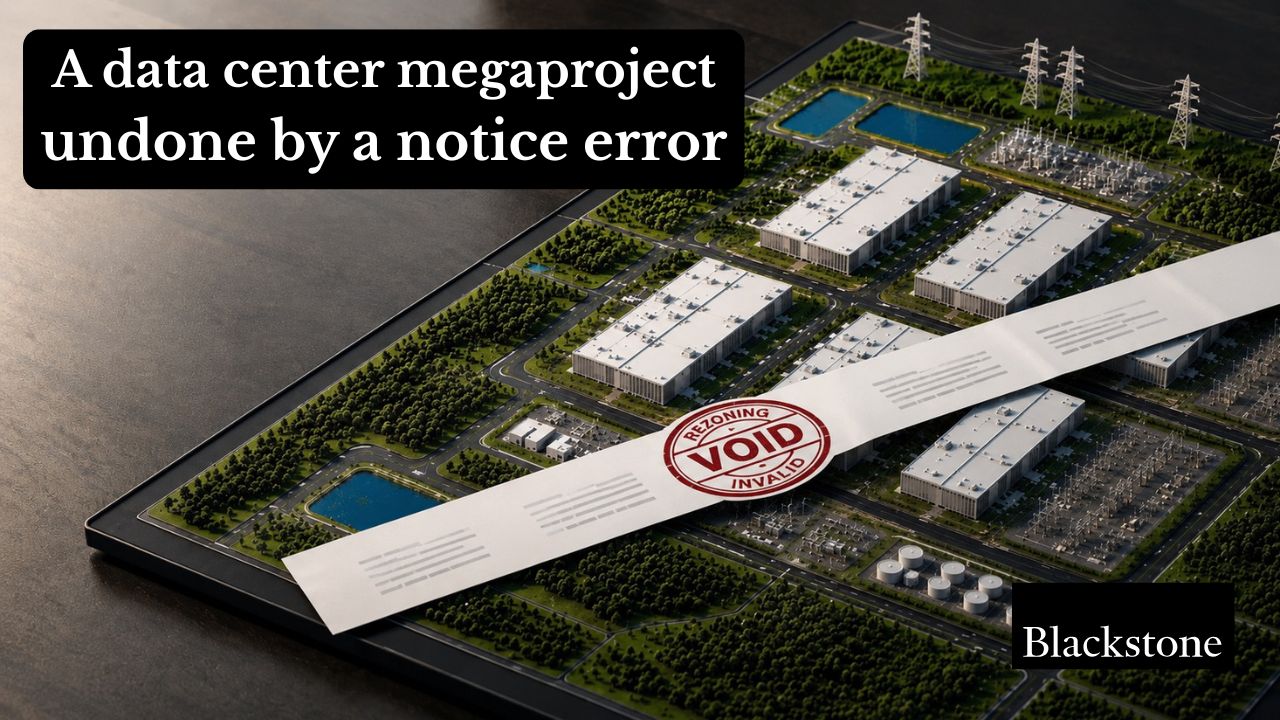
One of the biggest data center projects ever proposed has collapsed, and not because the market turned or the opposition won on the merits. On July 2, QTS, the data center operator that Blackstone took private in 2021, filed notice withdrawing its last appeal to the Virginia Supreme Court and said it would wind down the Prince William Digital Gateway. The roughly 2,100-acre, multi-gigawatt campus in Northern Virginia is now dead, undone by a defect in how the county advertised a zoning hearing years earlier.
What Blackstone Walked Away From
The Digital Gateway was not an ordinary project. Planned along Pageland Lane near Manassas National Battlefield Park, it grew from an 800-acre proposal floated in 2021 into something far larger:
- Roughly 2,133 acres of the county’s rural land rezoned for data centers
- About 11.3 million gross square feet planned by QTS and up to 11.55 million by co-developer Compass Datacenters
- More than 20 million square feet across roughly 37 buildings at full build-out
- A multi-gigawatt power draw, making it one of the first gigawatt-scale campuses proposed in the United States
It was also one of the first data center projects to draw national coverage of the backlash against it. For a firm that has bet heavily on data centers as an AI-era asset class, this was a flagship, and it is now gone.
The Defect That Undid Years of Approvals
The project had cleared the political process. Prince William’s Board of County Supervisors began laying the groundwork in 2021, adopted the enabling comprehensive plan amendment on November 1, 2022, and approved the specific rezonings in December 2023 after a marathon hearing that ran roughly 27 hours. What it did not clear was the paperwork. The Oak Valley Homeowners Association, a 254-member group, together with area residents, sued on the ground that the county’s required newspaper advertisements for the rezoning hearing did not run on the schedule that state code and the county’s own ordinance demand. In August 2025, Prince William Circuit Court Judge Kimberly A. Irving agreed and voided the rezonings, writing that the advertised notice did not comply with either the state or county code and that the defects were caused solely by the county, not the newspaper. On March 31, 2026, the Virginia Court of Appeals unanimously affirmed.
How the Appeals Collapsed
After the appellate ruling, the coalition behind the project came apart. The Board of Supervisors and Compass Datacenters both dropped out of the appeals in April 2026, leaving QTS to carry the fight to the state Supreme Court alone. It did, until it did not. QTS said that after careful consideration it had decided to terminate the project and proceed with a responsible wind-down, noting the investment, tax revenue, and jobs the campus would have brought. The withdrawal leaves the more than 100 landowners who had signed on to sell in limbo and returns the land to the zoning it held before the process began. A separate challenge from the American Battlefield Trust, focused on the site’s proximity to Civil War ground, had run in parallel throughout.
Why This Lands Beyond Prince William
Northern Virginia is the largest data center market in the world, and the Digital Gateway was meant to be its next frontier. Its death is a reminder that the constraint on the AI build-out is not only power and chips but land and the local process that governs it. A gigawatt-scale campus with board approval, a private-equity balance sheet, and an American-AI rationale was stopped by a procedural notice error that had nothing to do with whether data centers belong there. The politics are hardening around it too. During Virginia’s 2026 legislative session, Senate Democrats led by Finance Chair Louise Lucas pushed to phase out the state’s data center sales-and-use tax exemption, a break estimated to cost nearly $2 billion a year, arguing it mostly benefits large operators while raising costs for ratepayers. For an industry racing to site the next generation of AI capacity, the lesson is that approval is not the finish line, and the local rulebook can undo years of work in a single ruling.
