
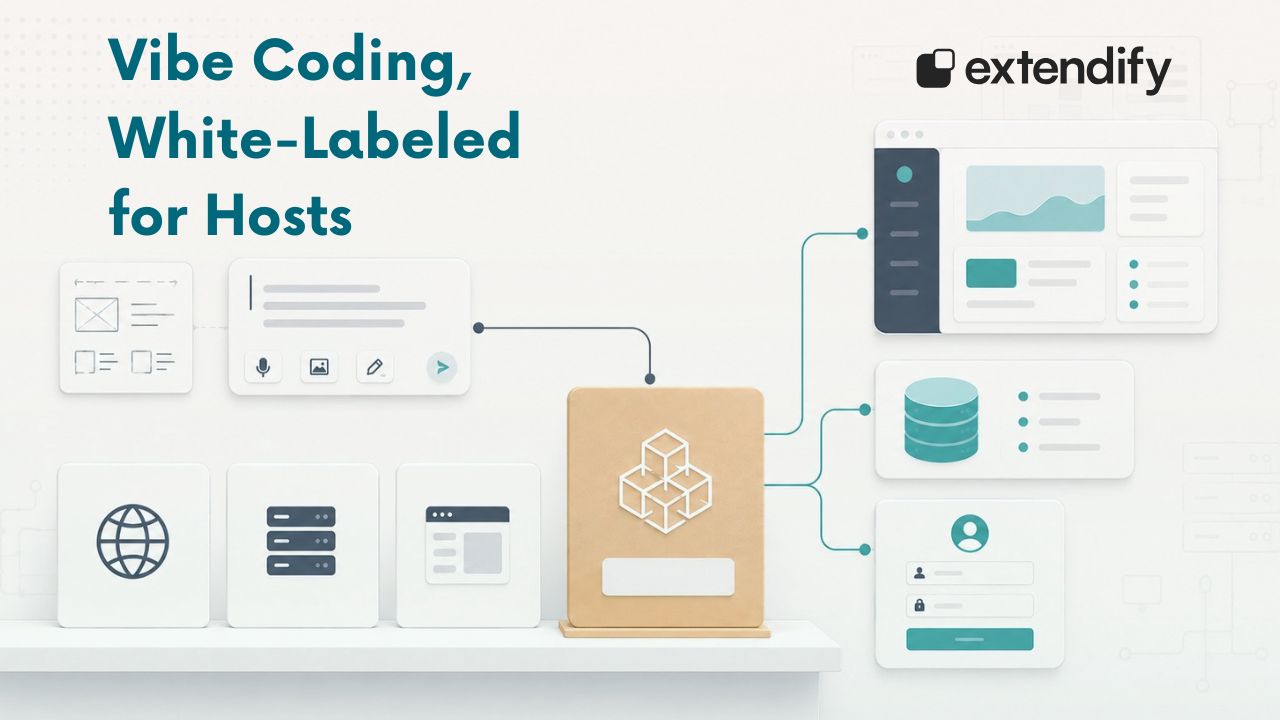
One of the fastest-growing product categories in web creation is coming to the hosting industry as a white-label. Extendify, the company whose AI onboarding and site-building tools already sit inside the signup flows of many hosting brands, has launched Extendify Code, which it describes as an “agentic AI web app builder for hosting companies.” The pitch is direct: customers are drifting toward vibe-coding tools to turn ideas into working software, and Code lets a hosting provider sell that capability under its own brand instead of watching the demand leave. For an industry whose entry product has been “a website” for decades, this is the moment the shelf product starts becoming “an app.”
What Extendify Code Is
According to the product’s launch page, Code turns a plain-language description, typed or spoken, into a working web application. The feature set goes well beyond a site builder:
- Prompt-based app creation through text or speech, with files, images, or a sketch on a built-in Canvas as additional input
- Full applications, not pages: data, logic and workflows built in, from internal tools and dashboards to booking forms, with a product database out of the box and authentication added, Extendify says, with a single prompt
- Developer escape hatches: an integrated development environment and file browser, plus usage analytics
- Host-side packaging: fully white-labeled, localized, deployable through WHMCS or an API, with plans the company says are designed for usage-based upsells
The last bullet is the strategic one. WHMCS deployment aims the product squarely at the long tail of hosting providers, the thousands of cPanel-and-WHMCS shops that could never build an AI app platform themselves but can resell one in an afternoon.
Why Hosts Want an Answer to Vibe Coding
The demand Extendify is pointing at is real and visible. Consumer vibe-coding tools such as Lovable, Replit and Bolt have turned “describe an app, get an app” into one of the fastest-growing habits among non-developers, and every small business that builds its booking tool on one of those platforms is a customer a hosting provider did not win. The largest hosts have already responded by building their own: Hostinger’s Horizons, an in-house AI web-app builder launched in early 2025, attracted more than 800,000 customers by the end of its first year. What has been missing is an option for everyone else. Extendify’s bet, consistent with its existing business of white-labeling onboarding for hosting brands, is that app creation will follow the same path website builders did a decade ago: pioneered as standalone products, then absorbed into the hosting bundle. Its own framing of the revenue case is that full apps open “revenue from customers a basic site builder can’t reach.”
The Open Questions for Hosts
What hosts will want to ask next is mostly practical. Pricing, reference partners and usage data are not yet public, so early adopters will be evaluating the product on its promise, “from prompt to published in minutes” included, ahead of measured results. The bigger evaluation points are operational: an AI-generated application with a database, logins and workflows is a heavier thing to run and support than a brochure site, so front-line teams will need preparation beyond the usual hosting tickets. Security deserves the closest look. AI-assembled applications can accumulate dependencies faster than teams are able to review them, which is exactly why the industry is wiring scanners into the stack, and a host selling app-building under its own brand takes on responsibility for what its customers generate. None of that is unique to Extendify; it is the price of entry for the whole category. White-labeling the upside also means planning for the operations that come with it.
The Hosting Product Is Quietly Being Redefined
Step back and the launch fits a pattern this publication has tracked all year: AI agents reaching hosting control panels, AI builders becoming part of provisioning, and now agentic app creation packaged for resale. Each step moves the hosting product up the stack, from serving files to building what gets served. For hosts, the calculus is the same as it was with website builders: carry it and defend the customer relationship, or skip it and compete with the platforms that do. The difference this time is that the product being commoditized is not the website. It is software itself, and hosting providers are about to find out what it takes to sell it at scale.
