
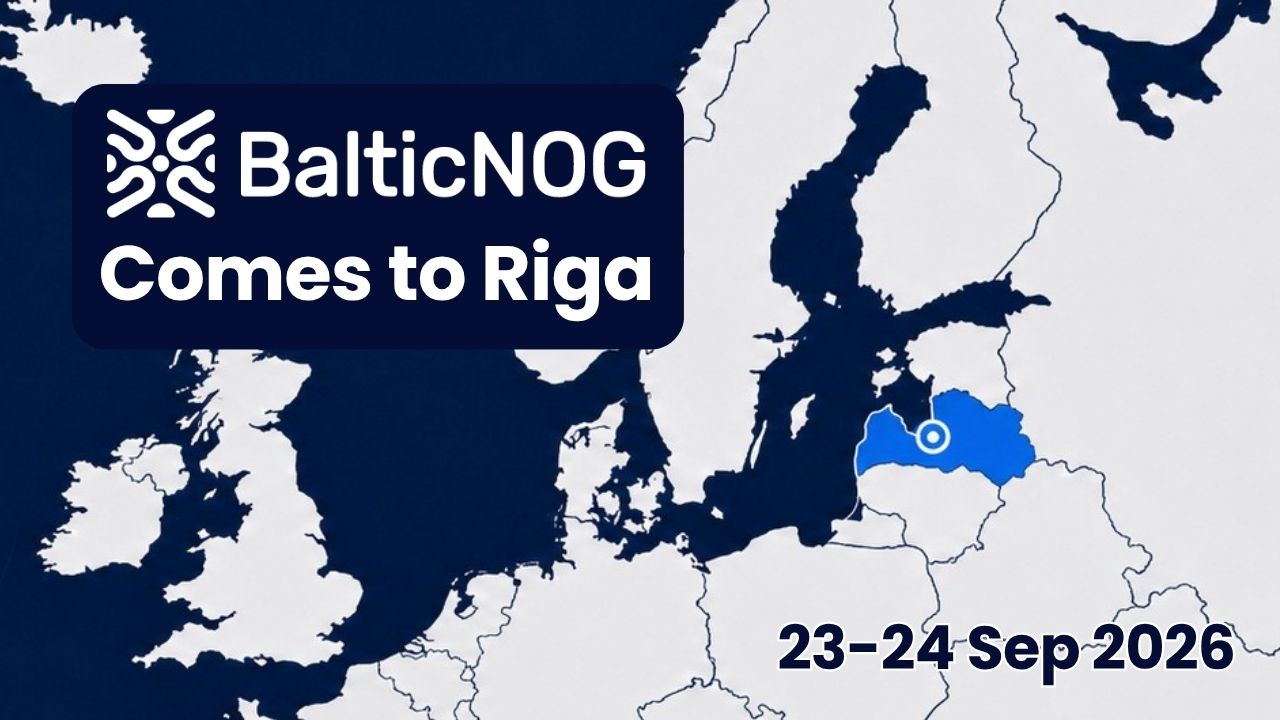
The Baltic Network Operators Group is a non-profit initiative for collaboration, knowledge sharing and technical discussion among network professionals in the Baltic region and beyond, a hub where operators, engineers and researchers exchange insight on internet infrastructure, security and best practices. Network operator groups are where the people who run the internet’s plumbing compare notes, and this one is explicit about who it wants in the room. Its mission commits it to strengthening collaboration between ISPs, data centers, cloud providers and enterprises, and its pitch to attendees lists data centers and cloud providers among the industries represented.
It moves from Vilnius to Riga for its second edition. On paper it is a networking conference. Read the sponsor list and the topics and it is a hosting infrastructure event: the principal organizer runs an IPv4 leasing marketplace, a silver sponsor serves more than four million customers, and the topic list reads like the ways a hosting business breaks.
Key information
- Date: September 23 and 24, 2026
- Location: Radisson Blu Latvija Conference and Spa Hotel, Riga, Latvia
- Tickets: 320.65 euros standard and 50 euros student
- Call for papers: closes August 28, 2026
- Sponsorship: four tiers from 3,000 to 12,000 euros, plus add-ons from 1,000
- Organizer: IPXO, an IPv4 leasing marketplace, listed as principal organizer and coordinator
From Vilnius to Riga in Twelve Months
The group was officially established on December 19, 2024 and held its first meeting nine months later, on September 24 and 25, 2025, at LITEXPO in Vilnius. For something this new it sets a direct target: becoming one of the largest NOGs in Europe, bridging the Baltic region with the broader global networking community.
The first edition put 45 speakers from 29 countries on stage across two days. Moving the second edition to Riga rather than repeating in Vilnius is the clearest signal that the organizers mean the Baltic part of the name rather than the Lithuanian part.
The principal organizer and coordinator is IPXO. Vincentas Grinius is president and co-founder of the group, Donatas Abraitis co-founder, and Paulius Judickas chairman of the board.
Key Topics from the Call for Papers
The call for papers lists the topics the program committee is looking for, and it is the best available guide to what will be discussed in Riga. It closes on August 28, which leaves a narrow window for anyone who wants to speak rather than simply attend.
- BGP security, hijacks and route leaks, covering vulnerabilities in the protocol and mitigation strategies
- DDoS mitigation and cybersecurity trends, including how attack tactics are evolving
- IPv6 deployment and transition strategies, from addressing architecture to adoption obstacles
- Internet routing and interconnection, inter-AS relationships and peering optimization
- IP leasing, RPKI and resource management, where address scarcity meets routing security
- Peering, IXPs and regional connectivity, the economics of how traffic moves between networks
- Policy and regulation, plus network resilience in conflict zones
- Network automation, AI in networking, and data center and cloud networking
Who Is Speaking in Riga
The speaker list includes Mikael Holmberg, a distinguished engineer in the CTO office at Extreme Networks; Thomas Graf, network analytics architect at Swisscom; Dmytro Shypovalov, founder of Vegvisir Systems; Zachary Smith, chief executive of Datum; Scott Fisher, senior principal engineer at Team Cymru; and Marco Schmidt, who manages registration services at the RIPE NCC.
An August post on the event’s site names Shypovalov’s talk, on auto-bandwidth for segment routing. Schmidt’s presence carries the most direct consequence for anyone running address space in Europe, because registration services is the function that decides how addresses are allocated, transferred and documented.
Third, one speaker makes the overlap explicit. Zachary Smith and his brother Jacob founded Packet, the bare metal provider acquired by Equinix in 2020. His current company, Datum, is described by one of its investors as building a virtual meet-me room for the internet, a programmable interconnection layer aimed at organizations running multi-cloud architectures. That is a hosting career and an interconnection product for the cloud ecosystem, presented at a networking conference.
Three Reasons Hosting Professionals Should Attend BalticNOG 2026
First, the sponsor list is a hosting list. The principal organizer runs a marketplace for leasing IPv4 addresses, a business that exists because the free pool ran out and hosting providers still need addresses. Hostinger, a silver sponsor, was founded in Kaunas as Hosting Media and now serves over four million clients. Cherry Servers, a bronze sponsor, sells API-driven bare metal and runs data centers in Lithuania among other locations. DE-CIX, also silver, operates some of the largest internet exchanges in Europe. The RIPE NCC, the registry that allocates address space to essentially every European host, is listed among supporters. Set aside the equipment vendors and Team Cymru’s threat intelligence business, and the rest of the paying list is the address, interconnection and hosting layer.
Second, the topics are a list of ways a hosting business breaks. BGP hijacks and route leaks are how a provider’s customers vanish from the internet without anyone touching the servers. DDoS mitigation is a line on every host’s cost sheet. IPv6 transition is the question of what happens when a host can no longer get IPv4 for new customers. Peering and exchanges determine what a provider pays for transit and how fast its customers’ sites feel. Every hosting company above a certain size runs its own autonomous system and announces its own prefixes, and depends on other people honoring them.
Third, one speaker makes the overlap explicit. Zachary Smith and his brother Jacob founded Packet, the bare metal provider acquired by Equinix in 2020. His current company, Datum, is described by one of its investors as building a virtual meet-me room for the internet, a programmable interconnection layer aimed at organizations running multi-cloud architectures. That is a hosting career and an interconnection product for the cloud ecosystem, presented at a networking conference.
Put together, that is why BalticNOG matters for the infrastructure side of this industry, and why the second edition is the right moment to be there: two days in one room with the people who allocate address space, move traffic between networks and keep hosting platforms online. Anyone running hosting infrastructure in Europe should be in Riga on September 23 and 24.

Sources
- BalticNOG 2026 - BalticNOG (event site)
- About BalticNOG - BalticNOG
- 2026 Speakers - BalticNOG
- Sponsorship - BalticNOG (rate card)
- IPXO Launches Fully Automated Platform for IPv4 Address Leasing and Monetization - CircleID
- The Internet's Missing Layer and Our Investment in Datum - Amplify Partners (investor note)
- About Hostinger - Hostinger (company)
- Cherry Servers - Cherry Servers (company)