
The story the industry tells about itself is consolidation: a handful of global platforms absorbing everyone else, market by market. Our own data says something more complicated. We pulled the full Market Insights dataset covering 115 countries and territories and the eight largest providers in each, and counted who actually comes first. This measures who answers a domain’s DNS rather than who runs the server behind it, a distinction the next section sets out and one that has to travel with every number here. On that measure Cloudflare appears in the top eight of every single one of the 115, a footprint no other company comes close to matching. And in 69 of those 115 markets it does not lead. In 43 of them, first place belongs to a company that exists, by our count, in four countries or fewer. The global layer is genuinely global. It just does not lead most of the places it has reached.
Key facts, DNS-attributed provider share across 115 countries and territories, read August 18, 2026
- Universal presence, partial leadership: Cloudflare is in the top eight in 115 of 115 markets and leads 46 of them, 40.0 percent. GoDaddy appears in 49 markets and leads 17.
- Narrow-footprint companies hold a third of the map: in 43 of 115 markets, 37.4 percent, the leading provider appears in four countries or fewer, which is the test we use throughout for a provider that is not a global platform.
- The field is enormous and shallow: 375 distinct providers appear across the 115 top-eight lists, and 284 of them, 76 percent, appear in exactly one country.
- Forty-seven different companies lead somewhere. Leadership is far less concentrated than worldwide totals suggest.
- An independent survey reverses the top two: W3Techs puts Cloudflare first and GoDaddy second. Our data has it the other way round, and the reason is which domains each survey counts.
This Counts Who Answers DNS, Not Who Runs the Server
Our method, stated on the tool itself, is that Market Insights is built from publicly observable data: domains seen across the internet and the DNS servers that answer for them. That is a real signal, and it is not hosting. Cloudflare’s business is a DNS and proxy layer customers put in front of hosting they bought elsewhere, so a site on a German dedicated server or a French cloud instance can count as Cloudflare here. That is why it appears in all 115 markets.
The reverse distortion is just as real, and our own documentation says so: a provider’s real footprint can be higher or lower than shown, especially when it does not use its own DNS servers to host customer domains, for example when those domains sit on a registrar’s, reseller’s or third-party cloud DNS. The national companies below are visible precisely because they run their own DNS for their own hosting customers, and some competitors are invisible for the opposite reason. This is a map of who answers the query. Treat it as that.
Forty-Six First Places Out of a Hundred and Fifteen
Cloudflare’s reach is the least ambiguous number in the set. It is in the top eight in every market we cover, with no exception. The next widest footprints are GoDaddy at 49 markets, Hostinger at 48, and AWS Route 53 at 42. Nothing else reaches a third of the map.
Leadership is a different picture. Cloudflare comes first in 46 markets, GoDaddy in 17, and the remaining 52 markets are led by 45 other companies. Its share is also wildly uneven: a median of 15.5 percent but a range running from 2.7 percent to 73.9 percent. Its highest readings are the Central African Republic at 73.9 percent, Equatorial Guinea at 71.5 percent, Nepal at 53.1 percent and Indonesia at 44.2 percent. Its lowest are in markets with an entrenched national incumbent, which is the pattern the next section sets out.
Japan, Germany, France and Italy Are Led by Their Own Companies
Cloudflare’s four weakest large markets are Japan, Germany, France and Italy, which rank first, second, ninth and twelfth from the bottom of all 115 on its share. In each the pattern is identical: a national provider running its own DNS at scale, with the global layer pushed far down the list.
In Japan, Xserver leads at 30.2 percent with GMO Internet second at 20.2 percent, and Cloudflare ranks seventh at 2.7 percent, its lowest reading anywhere. In Germany, IONOS leads at 18.9 percent and Strato follows at 14.5 percent, with Cloudflare again seventh at 3.1 percent, behind GoDaddy, All-Inkl, InternetX and Sedo. In France, OVH holds 36.0 percent against Cloudflare’s 5.8 percent. In Italy, Aruba holds 35.6 percent against 6.2 percent, and the scale behind that reading is not in dispute: Aruba says of itself that it serves 16 million users and 2.7 million registered and managed domains, across seven data centers it owns plus partner sites in Europe.
The strongest national positions in the entire dataset are in smaller markets, and several are commanding. Hoster.by leads Belarus at 49.6 percent, SuperHosting.bg leads Bulgaria at 47.5 percent, Websupport leads Slovakia at 44.4 percent, Domeneshop leads Norway at 42.9 percent, and Zone.eu leads Estonia at 41.3 percent.
In most of these markets Cloudflare is not even the closest challenger. Across the thirteen charted below it is the runner-up in five and ranks third to seventh in the other eight, which means the company the leader actually competes with is usually another local or regional name: ActiveCloud in Belarus, Veebimajutus in Estonia, Beget in Russia, Register.it in Italy and GMO Internet in Japan.
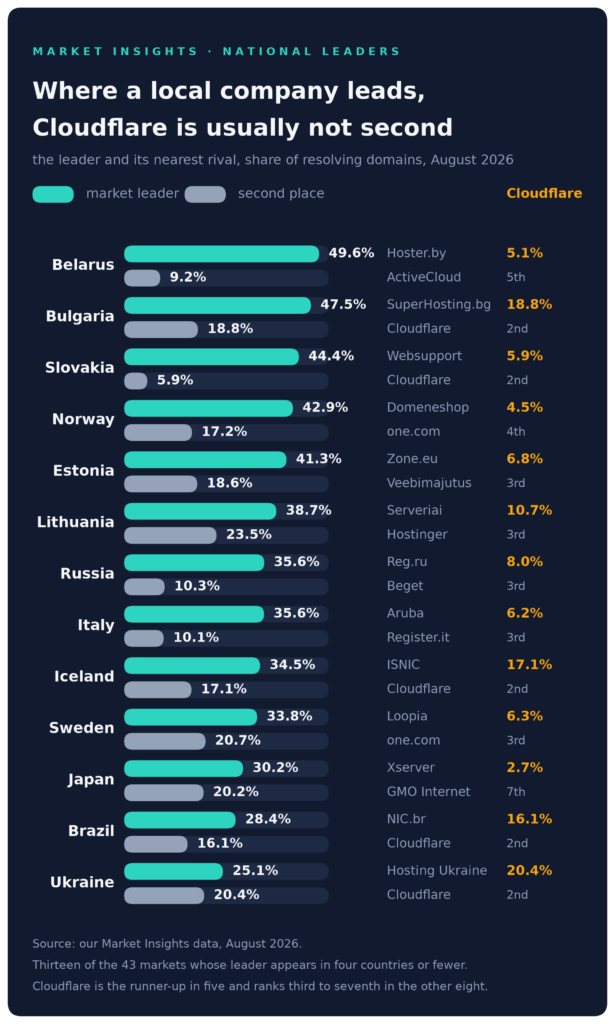
The leader and the company actually in second place, share of resolving domains, August 2026, with Cloudflare’s share and rank shown separately on the right. Thirteen of the 43 markets whose leader appears in four countries or fewer. Cloudflare is the runner-up in five of them and ranks third to seventh in the other eight, so in most of these markets the leader’s real challenger is someone else. Niue is excluded because its ccTLD is administered from Sweden. Source: our Market Insights data.
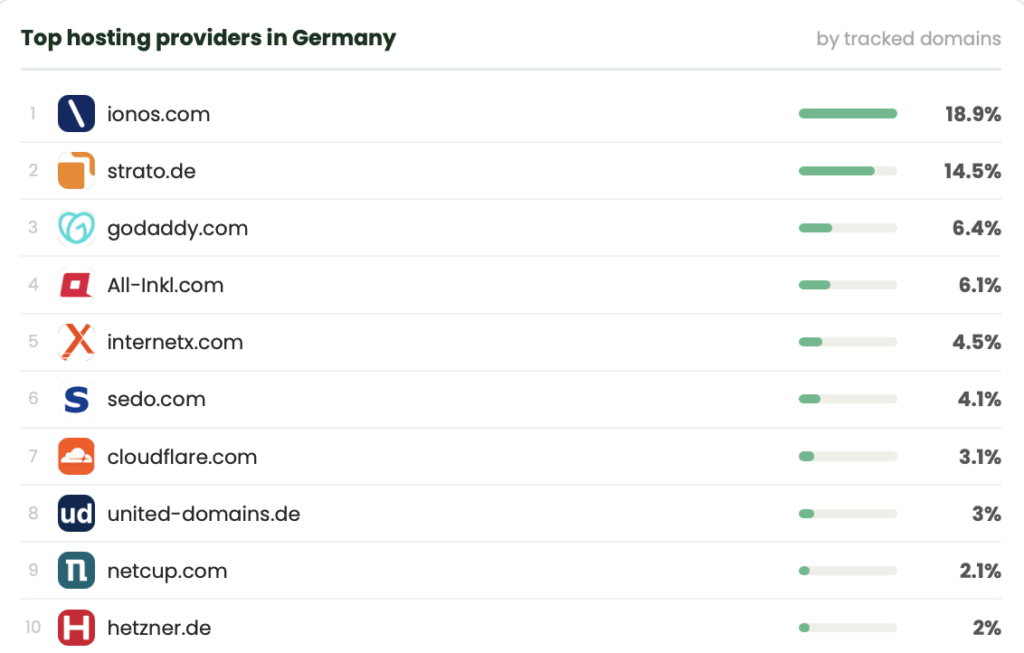
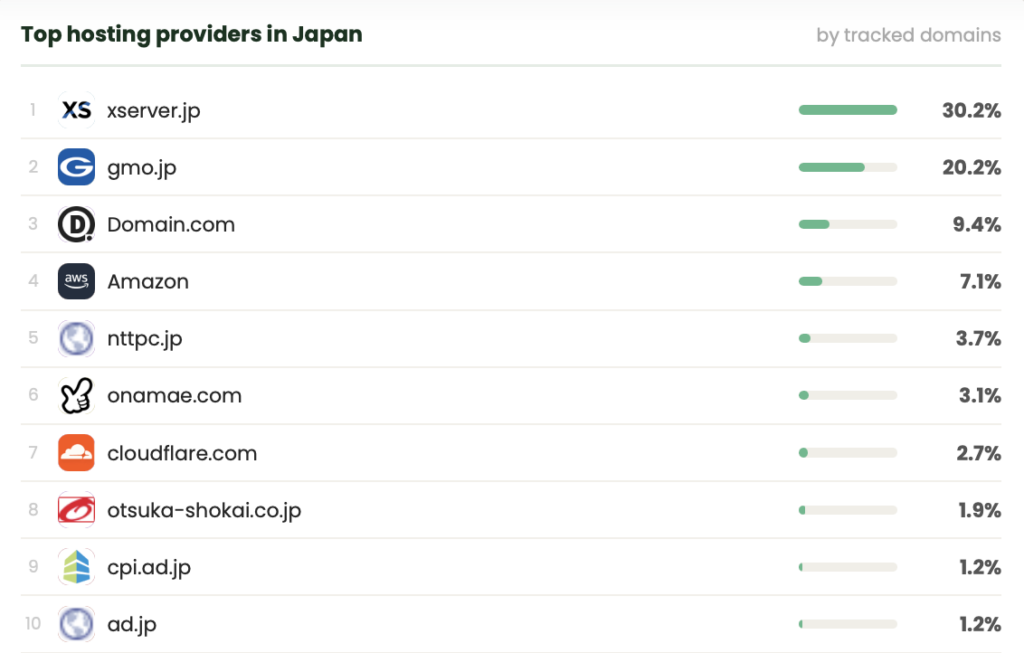
The same two markets in the tool itself, read August 18, 2026, showing the ten largest providers in each. Cloudflare ranks seventh in both, with six names ahead of it either way. Germany’s ninth and tenth places go to netcup and Hetzner. Figures move monthly, so this is a snapshot rather than a standing ranking. Source: our Market Insights data.
An Independent Survey Puts the Same Two Companies in the Opposite Order
Our worldwide totals should not be taken on trust, so we checked them against W3Techs, which measures DNS provider share independently and published its own reading on the same day we pulled ours. It puts Cloudflare first at 18.0 percent and the GoDaddy Group second at 9.9 percent. We have those two the other way round, GoDaddy at 17.83 percent ahead of Cloudflare at 11.60 percent.
The gap is not an error in either set. It is a difference in what gets counted. W3Techs surveys what it calls the relevant web, excluding sites without useful content, folding subdomains into their parent site and dropping redirected domains. Our figures cover resolving domains generally, which includes the enormous population of registered names that hold no active site. GoDaddy’s core business is selling domain registrations, and a great many registered names never carry a site at all; Cloudflare is a layer people put in front of sites that are actually running. Count active sites and Cloudflare leads. Count resolving domains and GoDaddy does. Both statements are true, and neither is a hosting market share.
Our own country data shows the same split from the other direction. GoDaddy’s mass is stacked rather than spread: in the United States it holds 43.1 percent, more than four times Cloudflare’s 9.7 percent, with similarly heavy readings in a small number of large markets including 41.1 percent in India and 28.9 percent in the United Kingdom. Outside those it is often absent from the top eight entirely, which is how a company that is larger on our own worldwide row still leads 29 fewer countries. Cloudflare is smaller in total and present everywhere, and that converts into first places rather than depth.
One further difference matters for reading the tables above: W3Techs aggregates by corporate group where we list operating brands, and says so plainly, that it groups brands owned by the same entity to show the real relevant market shares. Its fourth-placed United Internet at 3.8 percent is the group behind both IONOS and Strato, which United Internet’s own annual report places together in its Business Applications segment, and which our German table shows separately at 18.9 and 14.5 percent. For scale, Verisign’s Domain Name Industry Brief counted 401.6 million registered domains at the end of the second quarter of 2026, up 8.1 percent year over year, so the universe our tool tracks is the same order of magnitude.
Two Hundred Eighty-Four Companies Exist in Exactly One Country
The most striking number in the set is not about the leaders. Across the 115 top-eight lists, 375 distinct providers appear. Of those, 284, or 76 percent, appear in exactly one country. Another 65 appear in two to four. Only eight companies reach 15 markets or more, and only one reaches beyond 50.
That is a long tail with almost nothing in the middle. The industry has a thin global layer sitting on top of hundreds of providers that reach the top eight in a single market, and the middle tier of genuine multi-country operators is remarkably sparse. The caveat is that reaching one country’s top eight is not the same as being a one-country company: Hurricane Electric, a large American network operator, appears in our data only in Nepal. What the count measures is where a provider is big enough to be seen, not where it exists. Concentration inside each market is meanwhile high: the top eight providers account for a median of 70.2 percent of the visible DNS in a given country, running from 43.9 percent at the low end to 95.9 percent at the high end. Most countries are contested by a small field, not an open one.
Seventeen Positions Worth Buying, Fifteen That Are Ties
For anyone tracking consolidation, this map is also an inventory, and the useful work is separating the positions that are real from the ones that only look like leadership. Split the 43 narrow-footprint leaders by the share they hold and the difference is stark, because what changes is not the share but the distance to the company behind them.
In the 17 markets where the leader holds 30 percent or more, the median lead over the number two is 22.7 percentage points. These are not contests. Hoster.by is 40.4 points clear in Belarus, Websupport 38.5 points clear in Slovakia, and the pattern repeats through the Philippines, Estonia, Mongolia, Russia and Italy. A buyer acquiring one of these is buying a lead measured in tens of points rather than fractions, in markets where the visible top eight already accounts for a median of 78.2 percent of the DNS.
In the 11 markets where the leader sits between 20 and 30 percent, the median lead falls to 8.4 points. Still a lead, no longer a moat.
Then the bottom group inverts the whole idea. In the 15 markets where the leader holds under 20 percent, the median lead over the number two is 3.5 points, and in five of them it is under a single point: Morocco at 0.5, Iran at 0.6, Liechtenstein at 0.7, Kenya at 0.8 and Vietnam at 0.9. Calling those companies market leaders is an artifact of sorting a table. They are the largest of several near-equal competitors, in markets where the top eight covers a median of only 63.1 percent, so more than a third of the market sits outside the eight names we can see. In the two markets where we looked at the deeper list, Japan and Germany, ninth and tenth place were already down at one to two percent, which suggests that residue is fragmented rather than concealing a larger rival, though we cannot demonstrate that for every market.
That distinction is the whole analysis. The same word, leader, describes a company 40 points ahead of anyone else and a company half a point ahead, and only a country-by-country read separates them. Anyone using a worldwide league table to decide where a market can be entered or bought is working from the one view that hides the difference.
Hosting M&A Consultation
Get one-on-one advice on maximizing your hosting company’s valuation and navigating the sale process.
About the Data
Country figures are ours, read and computed on August 18, 2026 across the 115 country and territory rows, excluding the two aggregate rows, “Worldwide” and “European Union”, used only for the global comparison. Counts come from the dataset embedded in the tool’s overview, which carries the eight largest providers per market; the tool’s country pages list more. Calling a leader national means it appears in four countries or fewer, a proxy for a domestic operator rather than proof of one. It is a single snapshot, so nothing here is a trend claim. The W3Techs, Verisign and Aruba figures come from the sources below, read the same day.

Sources
- Usage Statistics and Market Share of DNS Server Providers - W3Techs (survey)
- Technologies Overview and Survey Methodologies - W3Techs (methodology)
- Domain Name Industry Brief, Second Quarter 2026 - Verisign Blog
- About Us - Aruba (company)
- Business Model, Group and Company Profile - United Internet (annual report)