
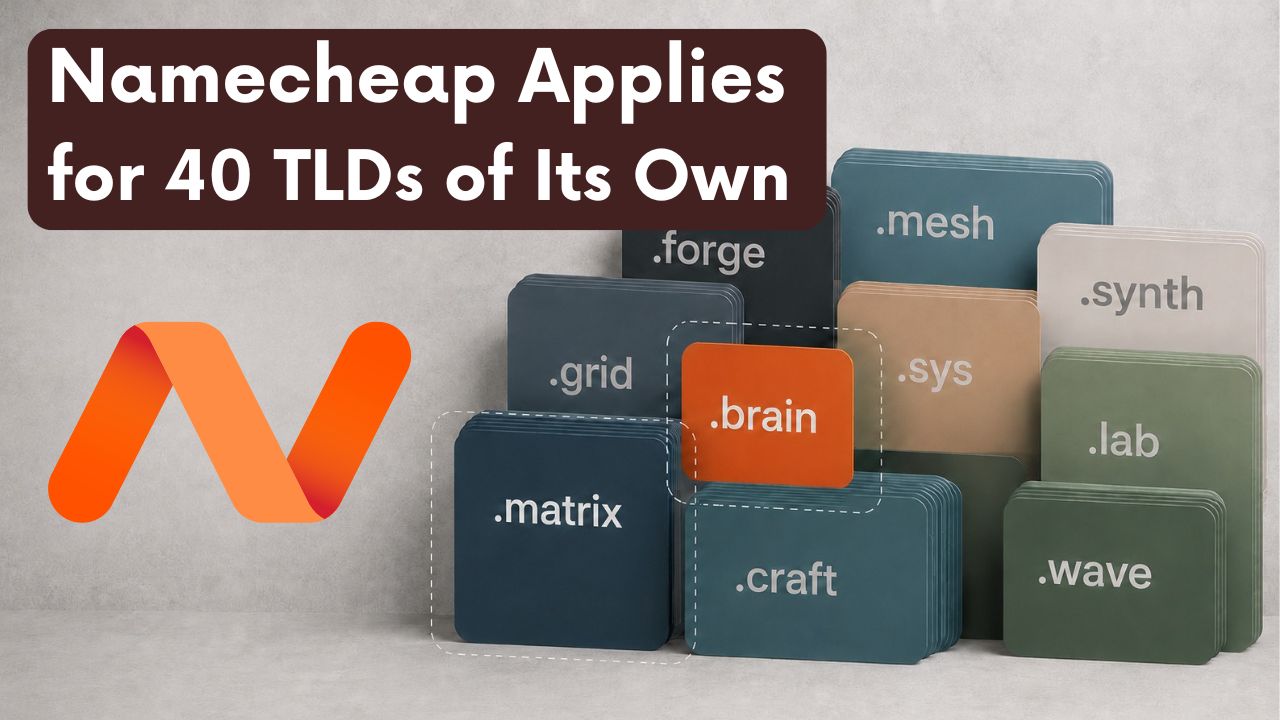
Namecheap has applied for 40 new top-level domains through a company called Starlight Registry. The registrar is moving one rung up the chain after two decades selling names inside other people’s namespaces.
Read that list against the rival portfolios published so far and fifteen of the 40 strings are already in someone else’s path. None of it is settled contention yet, and the reason for the overlap says as much about the rivals as about Namecheap.
Key facts
- What launched: Starlight Registry, owned by Namecheap, with 40 applications in ICANN’s 2026 round, running from .aid to .wave and leaning heavily technical.
- The overlap: 15 of the 40 appear on portfolios published by Link Freedom Group, Journey to the West or Endpoint Domains.
- Why that is soft: none of them separates original applied-for strings from replacement strings. Any overlap that exists only because a rival listed the string as a replacement cannot become identical-string contention with Namecheap’s original application.
- No incumbents: none of the 40 is currently delegated, based on a check against the 1,438 top-level domains in the root zone.
- The bill: at ICANN’s fee of $227,000 per string, 40 applications come to roughly $9.1 million before a single auction.
- How it was announced: not by Namecheap. There is no release in the company’s newsroom, where the most recent item dates from April. The news ran as a trade-press exclusive.
A Registrar Moving Up the Chain
Namecheap is widely described as the second-largest domain registrar, behind GoDaddy. Published estimates of how many domains it holds vary by several million depending on what is counted, so the ranking is firmer than any figure attached to it.
What is new is the direction. A registrar earns a margin selling names that someone else’s registry operates; a registry sets the wholesale price and collects on every name in its namespace, whoever sold it. Moving between the two is the domain industry’s version of a retailer deciding to manufacture.
Hillan Klein, chief executive of Namecheap and of its sister brand Spaceship, framed it as continuity rather than a new business. Moving into the registry side, he said, is “a natural extension of what we have been building”, and the company does not see the move “simply as acquiring a portfolio of registry assets”. It intends to “actively build these namespaces, put meaningful distribution and marketing behind them, and work with the broader registrar ecosystem to drive adoption”.
That last phrase carries the awkward part. A registry owned by the second-largest registrar needs broad distribution, including through competing registrars, and those registrars will have to decide whether to stock a rival’s namespaces knowing the wholesale registry fee flows to a company chasing the same customers. A new namespace lives or dies on how many registrars carry it, so winning a string at auction is only the beginning of the cost if the shelves it needs belong to competitors.
Fifteen of Forty Overlap With Rival Portfolios
ICANN has published nothing about who applied for what and will not until Reveal Day, when it publishes the applications that passed the administrative check, expected by mid-October. Until then only a fraction of the field is public, through applicant disclosures and trade reporting.
Three applicants can be checked against Namecheap. Link Freedom Group and Journey to the West publish their portfolios in full on their own sites, which is where we read them; Endpoint Domains has had its eight strings reported.
| Rival applicant | Strings published | Overlap with Namecheap |
|---|---|---|
| Link Freedom Group | 316 | .asi, .brain, .craft, .fab, .gate, .intelligence, .kit, .mart, .matrix, .scan, .ship, .sys, .view |
| Journey to the West | 323 | .foundry, .grid |
| Endpoint Domains | 8 | .fab |
That is fifteen distinct strings, since .fab appears twice, and the size of the first two portfolios is most of the explanation. Between them Link Freedom Group and Journey to the West list 639 strings, against Namecheap’s forty disclosed applications. Portfolios that broad are likely to land on a great deal of what anybody else wants, so the overlap says less about Namecheap’s choices than about how thoroughly two bidders covered the board.
None of it is confirmed contention, and one rule is the reason. Neither Link Freedom Group nor Journey to the West says which of its strings are original applied-for strings and which are replacement strings, the second choice that more than 1,100 applications in this round carry.
That distinction decides everything. ICANN does not allow an applicant to use a replacement string identical to another applicant’s original applied-for string, even if that other applicant later switches away from the original string. If .matrix sits in a rival portfolio as a replacement while Namecheap’s .matrix is an original application, that overlap can never become an identical-string contest. Every overlap count below carries that qualification.
Five of Namecheap’s strings sit close to something on a rival’s list without matching it, and three of those five, .maker, .mod and .lab, are not in the fifteen at all.
| Namecheap string | Nearest string on a rival’s list |
|---|---|
| .fab | Journey to the West lists .fabric |
| .gate | Journey to the West lists .dragongate |
| .maker | Link Freedom Group lists .make |
| .mod | Link Freedom Group lists .mode, Journey to the West lists .mold |
| .lab | Link Freedom Group lists .labs |
Different strings can still end up in the same contention set if ICANN’s String Similarity Evaluation finds them visually confusingly similar, while broader visual, aural or semantic similarity can be raised through a String Confusion Objection. The 2026 round also provides a separate singular and plural notification process, which could make .lab and .labs more consequential than the other near-matches. Two of these, .fab and .gate, have been reported elsewhere as direct overlaps with Journey to the West; its site today shows the longer strings instead.
What is not in doubt is the mechanism. Contention cannot be settled privately, the route that ended most 2012 contests, and unresolved sets go to an ICANN auction. Applicants who named an eligible replacement string can switch to it during the fourteen-day Replacement Period after Reveal Day, and Reveal Day publishes the designated replacement strings as well as the applications, so the distinction this section turns on becomes public then.
The Portfolio Is a Bet on What Comes Next
Read the list and the strategy is legible without anyone explaining it. Alongside ordinary commercial words like .mart, .craft and .maker sit .brain, .intelligence, .asi, .logic, .matrix, .synth, .clone and .droid, and then a run of infrastructure vocabulary in .grid, .mesh, .flux, .ops, .sys, .forge and .foundry.
About a third of the list is positioned around AI and infrastructure; much of the rest is broader commercial vocabulary. Namecheap has not described it in those terms, and the trade report notes only that the applications are concentrated in the tech space. None of the forty exists today, so there is no incumbent registry to displace and no registrant base to inherit. The upside and the risk are the same fact: the demand has to be created.
One string stands out for particularly obvious trademark risk. .intel is both a common abbreviation for intelligence and one of computing’s better-known trademarks, which makes it the most obvious string on the list to attract trademark scrutiny or a legal rights objection once the applications are public.
No Press Release, No Website, No Back End Disclosed
For a move of this size the announcement is unusual. There is no press release from Namecheap, the most recent item in its newsroom dates from April 6, and the story reached the industry as a trade-press exclusive with Klein quoted directly. The company publishes rarely, every two or three months on the evidence of its own archive, so an empty newsroom one day later is not by itself a decision to stay quiet. It does mean the public record of this launch rests on a single article, and that Starlight Registry has no website we could find.
The gap that matters most is technical. Running a registry means operating or contracting the back end that answers for every name in the namespace, and nothing published so far says who will do that for Starlight. Whether Namecheap is building registry infrastructure or putting its name on somebody else’s is the difference between the move Klein described and the acquisition of registry assets he said this is not.
About the Data
The list of 40 strings comes from the trade report that broke the story. The overlaps were checked against the rival applicants’ own published portfolios, read from their sites on August 20, and the check for existing extensions against IANA’s root zone file. The fee, the similarity review and the contention rules come from ICANN’s 2026 Applicant Guidebook, the application totals from its announcement of the window closing. Namecheap has not commented to us.

Sources
- Exclusive: Namecheap Applies for 40 Top Level Domains - Domain Name Wire
- Link Freedom Group portfolio - Link Freedom Group (published application list)
- Link Freedom Group Announces Unprecedented Investment in ICANN Top-Level Domain Applications - PR Newswire (company release)
- Journey to the West portfolio - Journey to the West Corporation (published application list)
- Chinese Company Applies for More Than 100 Top Level Domains - Domain Name Wire
- Root Zone Database, list of top-level domains - IANA
- New gTLD Program: 2026 Round Applicant Guidebook - ICANN
- ICANN 2026 Round Closes with More Than 1,600 New gTLD Applications - ICANN
- New gTLDs: What We Do and Don't Know About the 2026 Round - Domain Incite
- Press Releases - Namecheap (newsroom)