

NameHero has introduced HeroicGuard, an email security service that sits in front of mailboxes rather than inside them. Mail for a protected domain is delivered to HeroicGuard first, filtered there, and passed on to the existing mailbox provider, so the mailboxes themselves do not have to move. The launch comes with a first-person account from founder and chief executive Ryan Gray, who describes using it to rescue a company address that had been taking more than a thousand junk messages a day. HeroicGuard builds on email filtering that NameHero says it has offered for nearly three years, now presented as a dedicated service across four plan tiers.
Key facts
- What changes: one MX change, pointing the domain’s mail at HeroicGuard’s filtering servers. Nothing is installed and no mailboxes move.
- Scope: protection is sold per domain, with unlimited mailboxes and, the company says, no cap on messages.
- Price: four packages. Sidekick covers one domain at an advertised $2.96 a month, against a $3.95 list price; Hero covers five at $10.76, and Legend covers ten at $17.96. The plan cards state those rates reflect a three-year billing cycle and that the 25 percent discount applies to the first invoice only. The 100-domain MSP Reseller plan is custom-priced.
- Direction: inbound only, per NameHero. No outbound mail passes through the service, and the MX change is the only configuration involved.
A Founder’s Own Inbox as the Test Case
The launch post uses Gray’s own inbox as the clearest illustration of what the service does. Gray writes that he created a general catch-all address when he founded NameHero in 2015, used it for vendor signups and service notifications, and watched it decay until it was taking more than 1,000 junk messages a day. He had spam filters in place and kept adjusting them; the inbox stayed unusable, and he reached the point of asking what the use was in checking it at all.
In Gray’s account, the turning point came when a manager suggested applying NameHero’s existing inbound mail filtering to the address. Gray agreed to a test on the condition that it be reverted immediately if anything broke. The domain was set up, he added one DNS record, and a few minutes later the reply came back: “Done.” Gray says the address now receives only the mail it should, normal filters work again, and checking it takes minutes rather than hours.
Source: NameHero
A Gateway in Front of the Existing Mail Provider
Most spam filtering a hosting customer meets runs at the destination. Mail arrives at the mailbox provider, the provider’s filters sort it, and whatever they miss lands in the inbox for the user to deal with. A gateway inverts that order. Because the domain’s MX records point at the filtering service, the provider never receives a message until the gateway has decided what to do with it, so unwanted mail is stopped before it consumes mailbox storage, raises a notification or reaches a phone. The product page describes it as standing “between the internet and your inbox”, with every inbound message scanned and filtered in real time before being delivered onward.
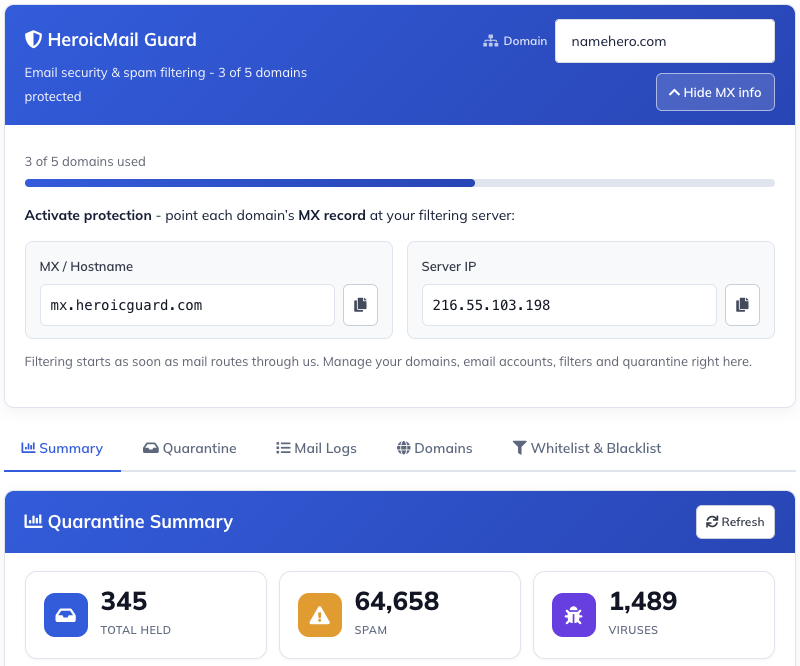
Activation follows from that. There is nothing to install and no need to move mailboxes, according to the product page: the domain’s MX records are pointed at the filtering servers shown in the customer’s client area. The dashboard pictured in the announcement shows mx.heroicguard.com as the MX destination. Protection begins within minutes of the change taking effect, the company says. For a hosting company or an agency, that is the commercially interesting property, because email security can be added to a client’s current arrangement without touching the addresses, the mail clients or the calendar integrations. Only the road the incoming mail takes changes.
What It Filters
The company lists what the service is built to catch:
- Spam and bulk mail, filtered through what it calls multiple layers of analysis before delivery.
- Phishing and impersonation, with links, attachments and message intent inspected on the way through.
- Viruses and ransomware, quarantined rather than passed on.
The service handles inbound mail only. No outbound mail passes through HeroicGuard, according to the company, and no SMTP relay or server-side configuration is involved; the MX change is the whole setup.
Around the filtering sit the administrative parts, included rather than sold separately: a self-service quarantine, allow and block lists, and live mail logs, with support for setup and filter tuning also advertised.
Plans Are Counted in Domains, Not Seats
The pricing model is the second structural decision worth understanding, because mailbox security is commonly sold per seat. HeroicGuard charges per domain and leaves the mailbox count open, so a domain with three addresses and a domain with sixty cost the same. The model is particularly well suited to organizations managing many addresses under each domain.
The three standard tiers currently show a 25 percent discount, and all three carry a 30-day money-back period. The reseller plan is quoted individually and is built for a different job, adding multi-domain management and priority support for providers covering many client domains.
| Plan | Domains | Price per month | List price |
|---|---|---|---|
| Sidekick | 1 | $2.96 | $3.95 |
| Hero | 5 | $10.76 | $14.35 |
| Legend | 10 | $17.96 | $23.95 |
| MSP Reseller | 100 | Custom | Not stated |
Mailboxes are unlimited on every tier. The advertised monthly rates reflect a three-year billing cycle, and the 25 percent discount applies only to the first invoice, according to the note beneath the plan cards. The list price column shows the rates from which those discounts are calculated.
Google Workspace Compatibility
HeroicGuard can sit in front of mailboxes hosted by Google, Microsoft or another provider, according to the product page. The service operates at the domain level wherever the customer can update the domain’s MX records, including a full Google Workspace domain. It is not designed for standalone Gmail addresses, whose users do not control Google’s MX records.
About the Data
Prices are those displayed at the time of writing. The supported Google Workspace configurations and the inbound-only scope come from NameHero’s written answers to our questions, received on September 3, 2026.
