
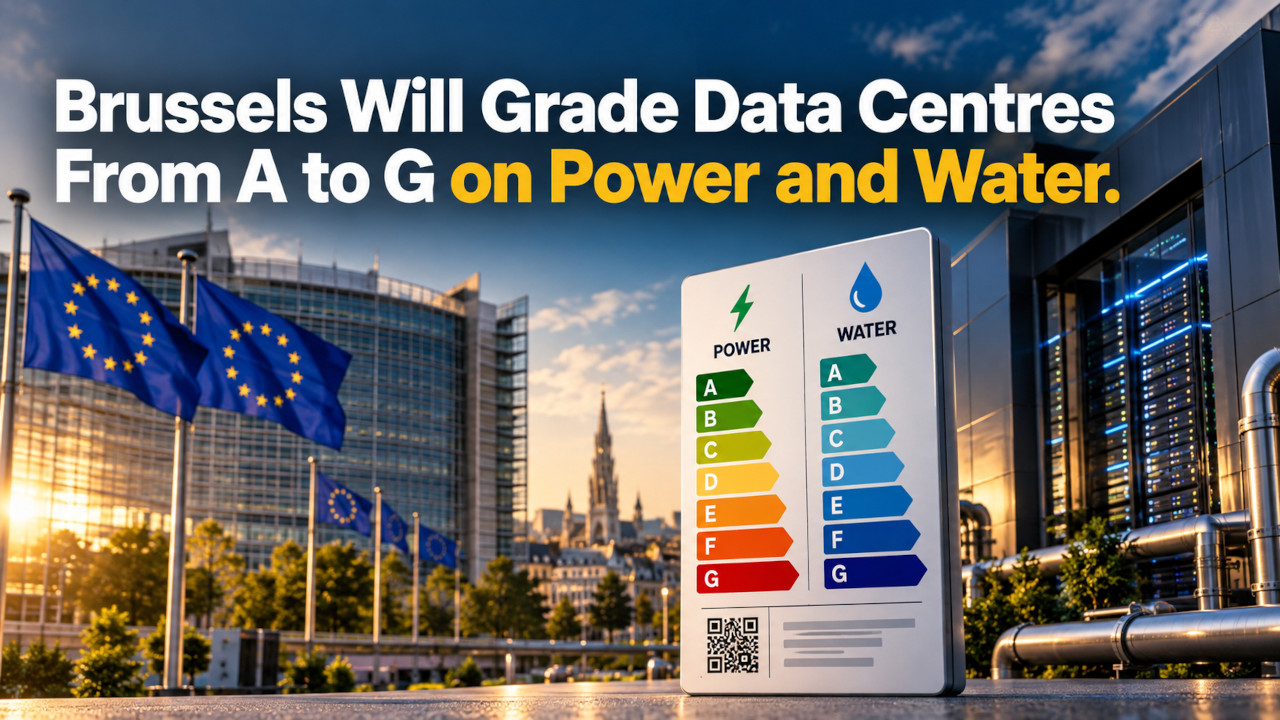
The European Commission adopted a delegated regulation on September 21 that turns the data the EU has been collecting from data centres since 2024 into a public label. Every facility with an installed IT power demand of at least 500 kW that reports to the European database on data centres will receive an electronic label, generated automatically, that grades its Power Usage Effectiveness and its Water Usage Effectiveness on an A to G scale, breaks down where its electricity came from, and states whether it offers flexibility to the grid and whether it is ready to hand its waste heat to someone else. The first labels are due by August 15, 2027. The act is now with the European Parliament and the Council, which have two months to object; they cannot amend it.
For a hosting company the label is not an abstraction. It names the operator, the type of data centre and the NUTS3 region, and it is public. A provider with racks in a colocation hall will see its landlord’s PUE class published next year, and the landlord’s existing right under the 2024 reporting regulation to gather IT energy figures from tenants now carries a public grade behind it. The Commission’s own numbers show why it wants the pressure: in the first reporting round only 770 data centres reported, about 36 percent of those it believes are obliged to, and their average PUE of 1.36 is a D on the new scale.
Key facts
- The act: Commission Delegated Regulation C(2026) 3472 of September 21, 2026, supplementing the recast Energy Efficiency Directive (EU) 2023/1791 and amending Delegated Regulation (EU) 2024/1364, which set up the reporting scheme and the European database in 2024.
- The grades: PUE class A is 1.15 or below, G is above 1.9. WUE class A is 0.1 or below, G is above 1.0. Both scales run in seven steps and both are printed on the label.
- The timing: labels are generated by August 15, 2027 and every year after, valid for twelve months, for every data centre that has reported. Member States must confirm by August 15 each year that reporting on their territory is complete; the act writes that clause from 2026, a date already overtaken by the scrutiny period.
- What is not in it: no cap on energy or water use, no minimum PUE. A separate consultation on minimum performance standards runs until December 14, 2026, and the preparatory study behind it is scheduled to run about 24 months from January 2026.
- The baseline: 770 facilities reported in the first period, around 36 percent of the estimated total. Average reported PUE 1.36, average WUE 0.58, and only 67 data centres reported any waste heat reuse.
Seven Classes for Power, Seven for Water, and a QR Code
The label’s two grades come straight from the two ratios operators already report. Annex I of the act sets the energy classes: A for a PUE of 1.15 or less, B up to 1.25, C up to 1.35, D up to 1.5, E up to 1.7, F up to 1.9, and G above that. The water classes run from A at a WUE of 0.1 or less through B at 0.2, C at 0.4, D at 0.6, E at 0.8, F at 1.0, and G above 1.0. PUE keeps the method fixed in the 2024 regulation, while Annex III restates WUE on freshwater rather than potable water, and the Commission says the thresholds “have been set based on analysis of the data submitted by data centre operators during the first reporting period and assessment of existing legislation, initiatives, benchmarks and standards.”
Annex II lists what else appears on the label: the data centre’s name, type, operator, location, size category and year of entry into operation, a QR code linking to the public part of the European database, cooling degree days, whether the facility provides flexibility functions to the grid, whether it is “waste heat reuse ready,” and a breakdown of its electricity into on-site renewables, renewable and nuclear power purchase agreements, guarantees of origin, and energy “the source of which the data centre has not identified in the reporting.” Nuclear sits beside renewables on that breakdown, which Agence Europe singled out.
The scheme runs on data that already exists: “The label will be created automatically by the reporting platform at the end of each reporting period for all reporting data centres.” Article 4 adds two obligations for operators: make the label available to “any physical or legal person requesting it,” and do not “produce or display labels mimicking” the official one.
A Colocation Landlord’s Right to Poll Its Tenants Now Has a Grade Behind It
The part that reaches hosting providers sits in Article 5, which amends the 2024 reporting regulation. The tenant mechanism itself is not new: the 2024 regulation already let colocation operators gather tenants’ indicators through an anonymous internal reporting mechanism. The rewritten paragraph reads: “If a colocation data centre operator cannot monitor and gather the necessary data to sufficiently calculate the key performance indicators referred to in points 2(a) and 2(b) of Annex II for the whole data centre computer room floor area, it shall estimate and indicate the percentage of the data centre computer room floor area that the information communicated to the European database covers.” The next sentence restates that right: “Colocation data centre operators may set up an internal reporting mechanism, if necessary, on an anonymous basis, to gather the key performance indicators set out in Annex II from their colocation customers.”
The Commission’s companion report explains the problem this addresses. Colocation facilities, it says, “often struggle to access complete operational KPIs due to client-controlled IT equipment,” and reporting requirements “should consider the feasibility of data centres to receive data from their customers.” A landlord whose label carries a floor-area coverage figure wants that figure high, and the tenant’s IT energy consumption is the number that makes it so. A hosting company that leases cages should expect the request in the next reporting cycle, framed as anonymous but not optional.
Two further amendments widen the door. Operators of data centres below 500 kW “may voluntarily participate” in the scheme by reporting on the same deadlines, and operators of facilities “that have not yet entered into operation” may report the indicators a site “is designed or expected to achieve after two calendar years of operation” and receive a label on that basis, then report actual figures from the first year of operation. A hosting provider building its own facility can carry a design-stage grade into its sales material before the doors open. Facilities serving “exclusively” the defence and civil protection of a Member State are exempt.
The confidentiality clause is rewritten as well. Individual reports stay confidential “with the exception of the information that is part of the label.” The Corporate Europe Observatory’s Bram Vranken told Euronews the clause survived in rewritten form and called that “hugely problematic.” Everything not on the label stays out of public view.
Only 36 Percent Reported, and Half of Those Miss a PUE or WUE Baseline
The report the Commission published alongside the act, COM(2026) 500, is the first public assessment of what the 2024 reporting scheme collected. Its headline is coverage: “770 data centres reported their data in the first reporting period, representing around 36% of the estimated total of data centres in the EU falling under the reporting requirement.” Six Member States reported none. The Commission says it received preliminary data from “at least 30% more data centres” in the second round and “will accelerate enforcement.”
The averages are what the label will now expose facility by facility. In 2024 “the average reported PUE of data centres in the EU stood at 1.36,” with national averages spanning 1.15 to 1.66. Facilities of 500 to 1,000 kW, the size band where many regional hosting companies run their own halls, “report an average PUE of 1.64, considerably above the average.” The average WUE was 0.58, and “most data centres fell short” of the Climate Neutral Data Centre Pact target of 0.4. Waste heat is the weakest indicator: 67 data centres reported any reuse, about 1.8 percent of the heat generated. The report concludes that “roughly half of reporting data centres in Europe exceed a recommended PUE baseline of 1.5 and/or a recommended WUE baseline of 0.4,” which is the sentence that sets up the next act.
That next act is the one with teeth, and it has a consultation but not a text. The call for evidence on minimum performance standards closes on December 14, 2026; the preparatory study began in late January 2026 with a duration of about 24 months; Agence Europe reported a Q2 2027 target for the regulation. Reuters put the label’s limits plainly: the scheme “would not impose limits on their energy and water use or require data centres to disclose their total power use.” The label ranks. The standards, when they arrive, will exclude.
Hosting M&A Consultation
Get one-on-one advice on maximizing your hosting company’s valuation and navigating the sale process.
Triple the Capacity, Grade Every Hall
The press release says “the EU wants to triple its data centre capacity over the next five to seven years,” and Executive Vice-President Teresa Ribera’s line carries the argument: “Tripling our data centre capacity cannot mean tripling the pressure on our grids, our water and our energy bills. That starts with transparency, rating large data centres depending on their impact on our energy system.” The numbers behind it: EU data centres consumed 68 TWh in 2024 and are expected to reach 114 TWh by 2030, both IEA figures, which the memorandum puts at 3.2 percent of the Union’s electricity demand using Eurelectric demand data.
The grade will travel. The memorandum says the rating “will be used to assess the sustainability of data centres in other EU legislation, including in the Cloud and AI Development Act,” and was considered in the review of the Taxonomy delegated acts. A hosting provider bidding for public sector work will be asked for it.
National schemes stay. The report notes that Germany’s reporting threshold is 300 kW, so a German host with a 400 kW hall reports nationally today and can now opt into the EU label. The Commission will review the scheme by December 31, 2028 and every three years after, and Article 6 lists what it may add: an aggregate sustainability score, indicators for ICT equipment energy use, and “(partial) certification or auditing of the reported data.”
About the Data
The classes, label contents, obligations, amendments and review clauses are quoted from delegated regulation C(2026) 3472, its annexes and its explanatory memorandum as published by the Directorate-General for Energy on September 21, 2026. The coverage, PUE, WUE and waste heat figures are from the Commission’s report COM(2026) 500 of the same date, which covers the first reporting period of May to September 2024 and describes its figures as weighted averages of data judged reliable. The electricity figures are the IEA’s as cited by the Commission. The scrutiny period, the December 14 deadline and the Ribera quote are from press release IP/26/1667. The Q2 2027 target is Agence Europe’s report, not a Commission statement. The act’s Official Journal number is not yet assigned; it refers to itself provisionally as Delegated Regulation (EU) 2026/7000.

Sources
- Commission enhances energy efficiency and sustainability of data centres in the EU - European Commission
- Making data centres energy efficient thanks to a new EU rating system - European Commission
- Commission Delegated Regulation establishing a common Union rating scheme for data centres and annexes - European Commission, Directorate-General for Energy
- C(2026) 3472 final, delegated regulation text with explanatory memorandum (PDF) - European Commission
- C(2026) 3472 final, Annexes 1 to 3 (PDF) - European Commission
- Report on the energy efficiency of data centres in the EU - European Commission, Directorate-General for Energy
- COM(2026) 500 final, Report on the energy efficiency of data centres in the EU (PDF) - European Commission
- Minimum performance standards for EU data centres - European Commission, Directorate-General for Energy