
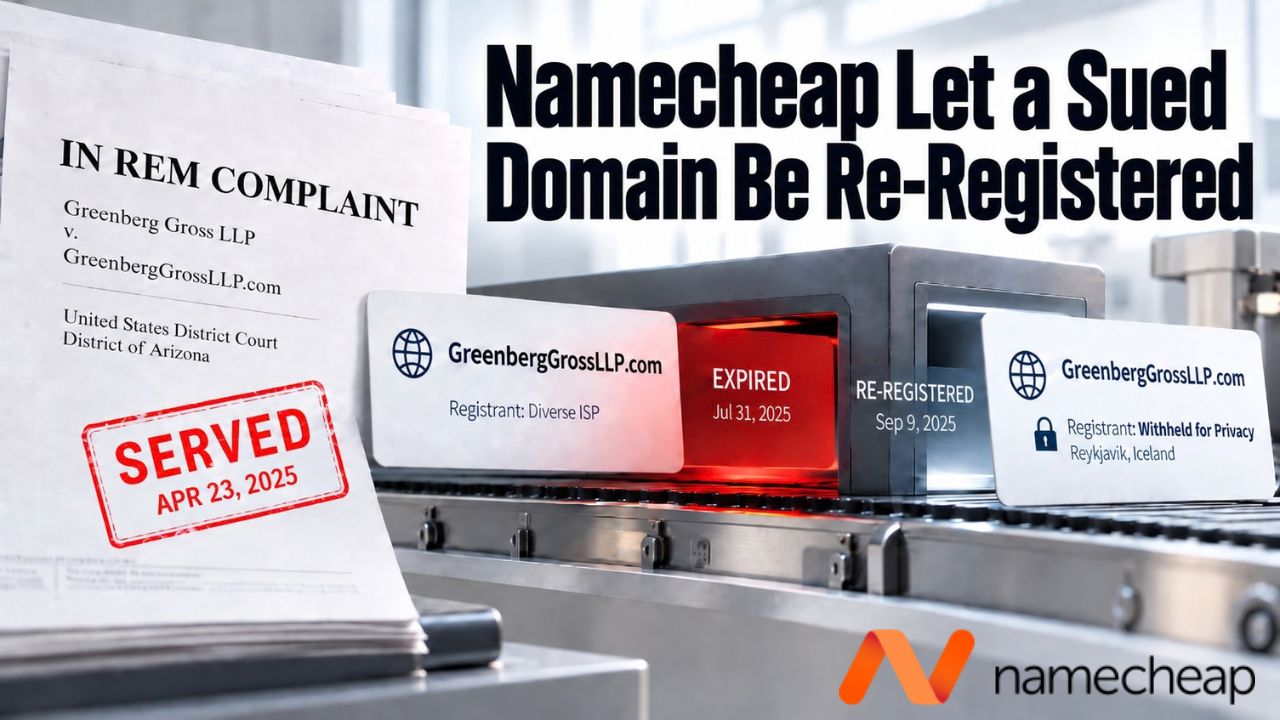
On September 28, Judge Michael T. Liburdi of the US District Court for the District of Arizona ordered Namecheap, a non-party to a cybersquatting case, to explain in writing by October 12 why it should not reimburse the plaintiff’s legal costs. The court granted the request on the ground that the law firm “has presented ample evidence that Namecheap violated its obligations under the ACPA.”
The accusation against Namecheap is not cybersquatting. It is that the registrar let a domain under an in rem action lapse and be registered to someone else. Once a registrar receives written notification of a filed, stamped copy of an in rem complaint, the statute requires it not to “transfer, suspend, or otherwise modify the domain name during the pendency of the action, except upon order of the court.”
Key facts
- The case: Greenberg Gross LLP v. GreenbergGrossLLP.com, District of Arizona, an in rem ACPA action over a domain that copied a California law firm’s website.
- The gap: Namecheap was served in April 2025. The registration lapsed in July and the name was re-registered to a different customer in September, behind a privacy service.
- The money: the firm claims at least $50,385.55 in extra costs and fees incurred from October 21, 2025 onward.
- The clock: Namecheap must answer in no more than 10 pages by October 12, and the plaintiff replies by October 19.
Served in April, Lapsed in July, Re-Registered in September
Greenberg Gross, a litigation firm in California, found in spring 2025 that GreenbergGrossLLP.com was serving a copy of its own site with the contact details swapped. The registrant was listed as Diverse ISP, with an address in Accra, Ghana, so the firm used the route the ACPA provides when a registrant is beyond reach: it sued the domain itself, in the district where the registrar sits.
| Date | Event |
|---|---|
| April 8, 2025 | In rem complaint filed against the domain |
| April 23, 2025 | Amended complaint served on Namecheap |
| May 22, 2025 | Clerk enters default |
| July 31, 2025 | The registration of Diverse ISP lapses |
| September 8, 2025 | Court sets the default aside, because the registrant had not been served |
| September 9, 2025 | Namecheap registers the name to Belvana Sela |
| October 21 to 22, 2025 | Plaintiff asks who the new registrant is. Namecheap declines without a court order or subpoena |
| December 8, 2025 | Namecheap complies with a subpoena and names the registrant |
| February 12, 2026 | Default entered against the domain |
| April 14, 2026 | Domain transferred to the plaintiff, a year after filing |
The order sets out the heart of it in one sentence: “When this action was filed, the Domain Name’s registrant was Diverse ISP; on July 31, 2025, that registration lapsed; and on September 9, 2025, Namecheap registered the Domain Name to Belvana Sela.” The new registration carried the contact details of Withheld for Privacy in Reykjavik, Namecheap’s privacy partner.
Namecheap’s Position, and the Plaintiff’s Answer
The registrar’s explanations, as the plaintiff’s motion reproduces them, came in three stages. The motion answers each by pointing to a different rule.
- March 9, 2026: no obligation to restrict the domain, because Namecheap “did not confirm receipt of a court order requiring the restriction of the subject domain [or] any direct requests by your firm for the subject domain to be placed on a litigation hold.” The motion’s answer: the statute is triggered by a filed complaint, not a court order.
- March 20, 2026: the original registration had expired and a different customer registered the name, so Namecheap “did not facilitate a transfer of the domain from the original account to the second.” The motion’s answer: the statute bars any modification, not only transfers.
- March 27, 2026: through Eugene Rome of Rome LLP, that there is no duty to monitor a domain under the UDRP and no registrar liability absent a “bad faith intent to profit.” The motion’s answer: the UDRP is “an entirely separate process established by ICANN” and does not address the ACPA obligation at issue, while the profit standard concerns the cybersquatting claim against a registrant rather than a registrar’s exposure.
On the registrar’s own exposure the statute withholds immunity “in the case of bad faith or reckless disregard.” The court pointed at two things on that question: Namecheap had been served with “numerous court filings over the course of several months”, and it then “permitted the second registrant to anonymize its contact information.” That, the order says, “suggests that Namecheap knew of this pending action as well as its obligations under the ACPA and chose to disregard them.”
Namecheap refused reimbursement in March, and its counsel described that decision as final.
What ICANN’s Contract Says About a Domain in Litigation
Namecheap’s counsel leaned on the Registrar Accreditation Agreement. The plaintiff’s motion answers with other clauses of the same agreement.
- 3.7.5.7, the clause counsel cited, lets a UDRP complainant renew a name that expires during a UDRP dispute. It says nothing about court cases.
- 3.7.5 makes non-renewal end in cancellation “in the absence of extenuating circumstances.”
- 3.7.5.1 defines those circumstances to include a “domain name subject to litigation in a court of competent jurisdiction.”
- 3.7.2 requires a registrar to “abide by applicable laws and governmental regulations.”
On that reading, the motion argues, a pending ACPA action is grounds for a registrar to interrupt the normal registration cycle. The agreement does not itself impose a hold. What 3.7.5.1 does is make the ordinary cancellation rule in 3.7.5 non-automatic in those circumstances, while the duty not to modify the name comes from the statute. ICANN’s Expired Registration Recovery Policy, which governs renewal reminders and the post-expiry grace period, has no provision for domains under legal dispute at all. It is written for the ordinary lifecycle, and the ordinary lifecycle is exactly what the plaintiff says should have been interrupted.
The statute’s trigger is written notification of a filed, stamped complaint. Here, the court treats service of the amended complaint on April 23 as that notice. It does not require a court order, and it does not require anyone to ask for a “litigation hold” by name. If the court accepts the plaintiff’s reading that lapse and re-registration count as a modification, the practical consequence for any registrar or reseller is that a served in rem complaint has to reach whatever system decides which names expire. Namecheap added roughly 1.9 million .com names in 2025, the largest gain of any registrar in the full-year data.
The Order Decides Nothing Yet
Judge Liburdi was explicit that the court’s power to make a non-party pay comes only from its inherent authority to sanction, citing the Ninth Circuit’s decision in Corder v. Howard Johnson, and that both sides must address whether he should use it. Namecheap has ten pages and until October 12. Greenberg Gross replies by October 19.
Whatever the outcome, the order puts the court’s preliminary reading on the public record: allowing a name to lapse and be registered to someone else during an ACPA in rem action can support a finding of prohibited modification, and allowing a new registrant’s contact details to be anonymized can support an inference of disregard.
The chronology, the quotations and the fee figure come from the order of September 28, 2026 and the plaintiff’s motion of August 14, 2026, both read in full. The court’s account of the facts is drawn from the plaintiff’s filings, and Namecheap has not yet filed a response. Namecheap’s own statements are quoted as the motion reproduces them from emails and a letter, exhibits we have not read directly.
The order names the first registrant as Diverse ISP, while Domain Name Wire’s report of April 2025 spelled it Diverse IP. The 2025 .com figure is from Domain Name Wire’s full-year registrar data, which we analyzed in April. Neither Namecheap nor Greenberg Gross was contacted for this article.

Sources
- Order granting motion for issuance of an order to show cause, Greenberg Gross LLP v. GreenbergGrossLLP.com, No. CV-25-01176-PHX-MTL - United States District Court for the District of Arizona, via GovInfo
- Greenberg Gross LLP v. GreenbergGrossLLP.com, 2:25-cv-01176, opinions and orders - GovInfo
- Plaintiff's Ex Parte Motion for Issuance of an Order to Show Cause Requiring Nonparty Namecheap, Inc. to Appear and Show Cause - court document, copy hosted by Domain Name Wire
- Namecheap ordered to explain why it shouldn't pay $50,000 in ACPA case - Domain Name Wire
- California law firm files lawsuit to take down imposter site - Domain Name Wire
- 15 U.S. Code § 1125 - Legal Information Institute, Cornell Law School
- 2013 Registrar Accreditation Agreement - ICANN
- Expired Registration Recovery Policy - ICANN