
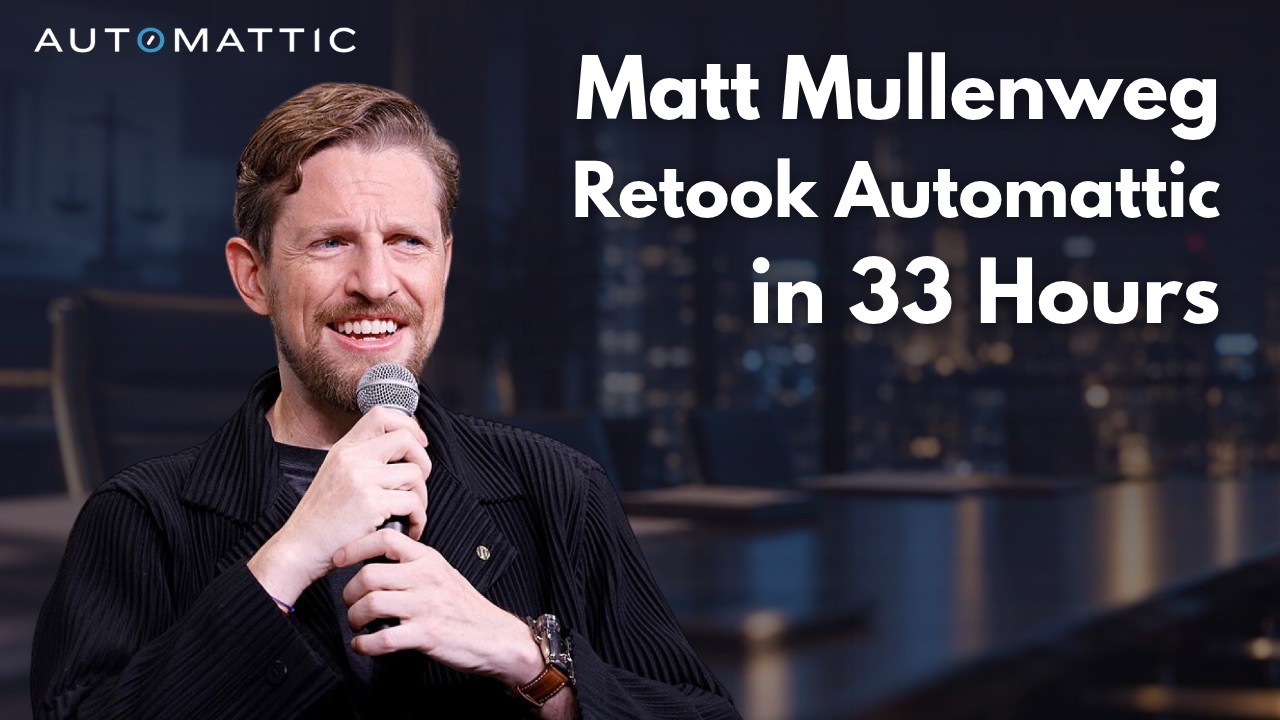
Matt Mullenweg’s paid leave from Automattic, which we reported on September 10, lasted 33 hours and 20 minutes, according to the company. He is back as chief executive, the three directors who voted to sideline him have left the board, and both the chief financial officer who briefly replaced him and the company’s chief legal officer have left the company. A reconstruction published by Fortune on October 19 points to divisions inside Automattic over the WP Engine litigation and raises the question of whether the dispute over preserved evidence played a part in the board’s decision. None of the former directors has publicly explained it.
For the WordPress ecosystem, the outcome reverses the split we described in September. At that point, Automattic had an interim chief executive while Mullenweg kept his leadership of the WordPress project. He now runs both again, and Automattic’s board consists of Mullenweg and four directors announced in late September.
Key facts
- The new board: Hugh Howey, Amy Chan, Henry Khachatryan and Krutal Desai sit alongside Mullenweg, with four special board advisors.
- Voting control: Mullenweg holds 84% of Automattic’s voting power, by his own account, and used his shares to replace the board.
- Severance: during the 33 hours, the interim chief executive and the chief legal officer signed each other’s severance deals, valued by TechCrunch at $8.15 million combined.
- The court: a written ruling on WP Engine’s spoliation sanctions motion is still pending after the October 7 hearing.
How the 33 Hours Unfolded
On September 9, the board voted to place Mullenweg on paid leave and named Mark Davies, then chief financial officer, interim chief executive. Fortune identifies Toni Schneider, Automattic’s founding chief executive, Sue Decker and Ann Dunwoody as the three directors on the special committee behind the move. In a Slack message to staff, Mullenweg accused Davies of having “conspired” with the directors behind his back.
Within two days, he informed employees in Slack that he was back in control, and on September 12 Automattic confirmed that Mullenweg had returned as chairman and chief executive, with the board’s full support.
Fortune quotes a person familiar with BlackRock’s investment in Automattic who learned of the board’s move from news reports: “I don’t understand how he basically reinstated himself and reversed the decision of the vote.” The subsequent board shakeup rested on Mullenweg’s voting control. He holds 84% of Automattic’s voting power, as he stated at TechCrunch Disrupt 2024, and TechCrunch reports that he used his shares to replace the board.
Who Left and Who Joined
Schneider and Decker resigned their board seats, Mullenweg removed Dunwoody, and Davies and chief legal officer Andy Missan were let go. During the 33 hours, Davies and Missan had each signed the other’s severance agreement, effective September 10. TechCrunch, which reviewed the documents, put the combined value of the packages at $8.15 million, covering a year of salary and accelerated equity. At the time, Automattic’s legal team was weighing whether to pay the sums or challenge the agreements’ validity.
Mullenweg announced the new board to staff on September 25. Automattic’s board page now lists five members: Mullenweg, the science fiction author Hugh Howey, the author Amy Chan, and Henry Khachatryan and Krutal Desai, who co-founded the social app IRL. Four special board advisors are listed as well: Stephen Wolfram, Jaime Waydo, Hiten Shah and Matt Van Horn. Mullenweg’s statement confirming the appointments ends: “The next six months will determine the next 20 years of Automattic.”
The finance role has turned over again since. By October 9, Jeremy Klaperman, who had stepped in as interim chief financial officer after Davies, had left after less than a month in the role.
The Question Behind the Vote
At the center of Fortune’s reconstruction is why three directors moved against a founder who controls most of the votes. As Fortune puts it, there was no mathematical way for them to overcome his voting power, and a former employee quoted in the piece suggests the move may have been meant more as a message.
Fortune points to the WP Engine case as a possible trigger. According to WP Engine’s court filings cited by Fortune, after more than a year of discovery Automattic had produced just 16 of Mullenweg’s Telegram messages, one Signal conversation and no WhatsApp messages. Fortune also reports that his phone was not fully copied until around March 2026. Automattic denies that relevant evidence was lost. In an August 12 post on the company’s website, Missan stated that WP Engine “cannot identify a single missing message about anything having to do with this case.” The board acted about four weeks before the October 7 hearing on WP Engine’s spoliation motion.
Fortune also describes a company divided over the litigation. Former employees quoted in the piece disagree about Mullenweg’s campaign against WP Engine, and 159 people, about 8.4% of the company, took the buyout he offered in October 2024 to staff who disagreed with his approach. Neither Mullenweg nor the board responded to Fortune’s requests for comment.
Where the WP Engine Case Stands
The litigation continues on two tracks, with new counsel for Automattic: the company replaced Gibson Dunn with Susman Godfrey, a change it and Mullenweg announced on September 16. On September 24, the district court revived WP Engine’s antitrust counts against Automattic, as we reported. At the October 7 hearing, Magistrate Judge Ajay Krishnan indicated he was inclined to deny WP Engine’s request for sanctions, as we reported. As of October 20, the court docket showed no written ruling on the motion.
For hosting providers, the significance lies in governance rather than in any immediate operational change. Mullenweg kept control of WordPress.org and his leadership of the WordPress project during the leave, as we reported in September, and he again runs Automattic, now with a rebuilt board. The episode showed how much influence over the WordPress ecosystem rests with one person.
Photo illustration. Photo: Kimberly White/Getty Images for TechCrunch, CC BY 2.0, background removed.

Sources
- Inside the 33-hour failed boardroom coup to overthrow WordPress founder Matt Mullenweg - Fortune
- Automattic confirms Mullenweg has returned as CEO after attempted ouster by board - TechCrunch
- Sources say Automattic's board is out after failed attempt to oust CEO Matt Mullenweg - TechCrunch
- Automattic's interim CEO and legal chief signed reciprocal severance deals during Mullenweg's brief ouster - TechCrunch
- Automattic has a new board after failed attempt to put CEO on leave - TechCrunch
- Automattic interim CFO resigns just weeks after boardroom shakeup - TechCrunch
- Board - Automattic
- WRONG AGAIN - Automattic
- WPEngine, Inc. v. Automattic Inc. docket - CourtListener
- WPE's Motion for Sanctions for Defendants' Spoliation of Evidence (Dkt. 357) - CourtListener