

A year ago, DigitalOcean’s 25 largest customers accounted for about one dollar in every nine of its revenue. In the third quarter of 2026, they accounted for more than one in four. Revenue grew 40% to $321.2 million. Most of the increase came from the company’s $1M+ tier, which covers customers spending more than $83,333 in a given month. Revenue across the other tiers grew 10.3%.
DigitalOcean, which also owns the managed hosting platform Cloudways, is adding data center capacity at the same time. It finances much of its new server equipment through leases, and its share count has grown by more than a quarter this year. Adjusted earnings per share fell even as revenue climbed.
Key facts
- Backlog: remaining performance obligations, the contracted revenue not yet recognized, fell to $799.7 million from $893.8 million at the end of June.
- Margins: gross margin fell to 50.1% from 59.6% a year earlier, and depreciation and amortization more than doubled to $75.1 million.
- Leases: as of September 30, DigitalOcean expected to pay $2.96 billion over the life of leases scheduled to begin between November 2026 and June 2028. Most are for data center space.
- Funding: a new $1 billion at-the-market program lets DigitalOcean sell shares over time, and $312.3 million of convertible notes mature on December 1.
One Dollar in Four From 25 Customers
The figure comes from the quarterly report on Form 10-Q, not the results release, and DigitalOcean presents it there as “no material customer concentration.” The share has risen every quarter this year.
| Quarter | Top 25 customers, share of revenue | Same quarter of 2025 | Revenue from $1M+ customers | Share of revenue |
|---|---|---|---|---|
| Q1 2026 | ~16% | ~9% | $45.7M | 18% |
| Q2 2026 | ~20% | ~9% | $64.7M | 23% |
| Q3 2026 | ~27% | ~11% | $96.5M | 30% |
An average of 51 customers qualified for the $1M+ tier each month, up from 26 a year earlier. Quarterly revenue from the tier rose from $25.9 million to $96.5 million, and by our calculation that $70.7 million rise is 77% of the $91.6 million increase in total revenue. The tier’s share of the increase has grown each quarter this year: it was 62% in the first quarter and 71% in the second.
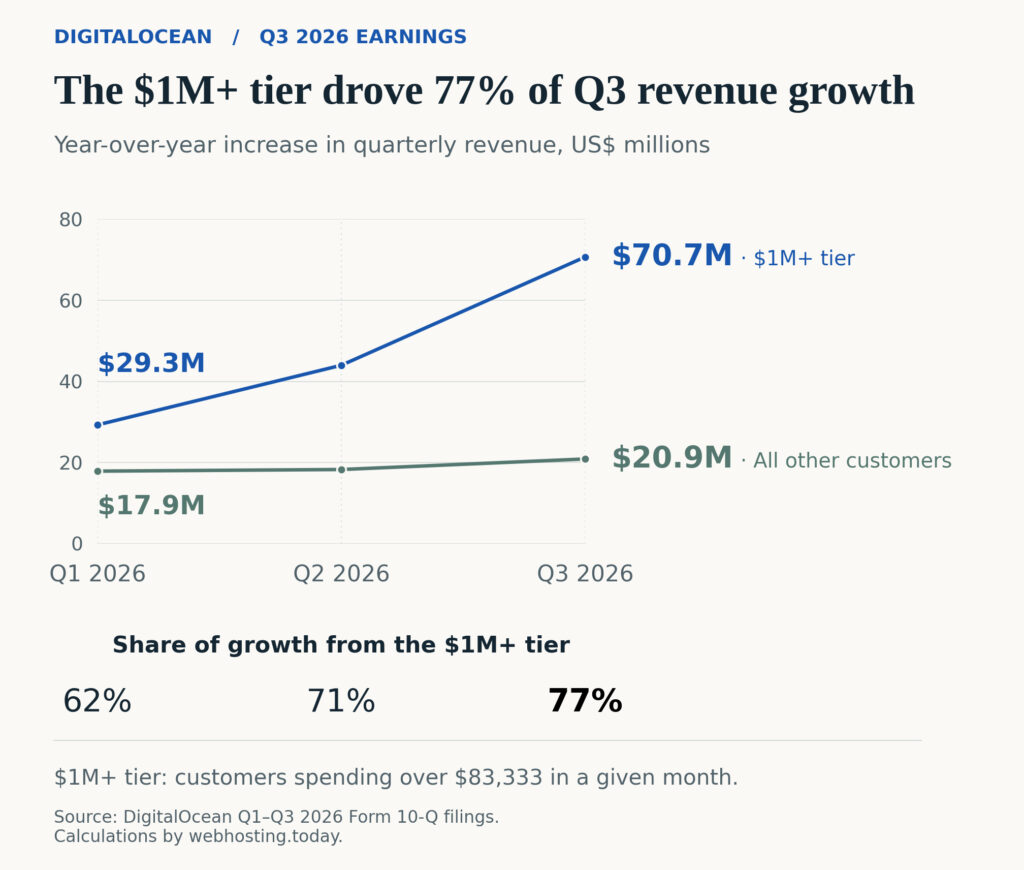
Year-over-year increase in quarterly revenue from the $1M+ tier and from all other customers, first three quarters of 2026. Source: DigitalOcean 10-Q filings; our calculations.
Management compares DigitalOcean with cloud providers whose biggest buyers are hyperscalers and AI labs. On the call, chief executive Paddy Srinivasan put it this way: “As concern grows about customer concentration risk, ours is minimal.” Measured against DigitalOcean’s own history, the share has more than doubled in a year.
Outside the Largest Accounts, Growth Is About 10%
Take the $1M+ tier out, and revenue rose from $203.8 million a year earlier to $224.6 million. That remainder can still include AI spending by smaller customers. The “Developers and other” category, which covers users spending $500 a month or less along with some legacy bare-metal revenue, grew 7.9% to $98.4 million, and its share of revenue fell to 31% from 40%.
DigitalOcean does not report Cloudways revenue separately. The 10-Q counts Managed Hosting, which Cloudways added to the platform, among its PaaS and SaaS products.
The Backlog Shrank After the Nine-Figure Contracts
In the second quarter, DigitalOcean signed its first nine-figure annual customer commitments, and its backlog closed June at $893.8 million. By the end of September, remaining performance obligations stood at $799.7 million, down about 11% in a quarter. DigitalOcean expects to recognize $345.1 million of that total as revenue over the next 12 months, down from $365.9 million at the end of June. After the quarter closed, one customer paid DigitalOcean $107.4 million in advance; the 10-Q does not specify whether that contract is new.
Backlog covers only part of the business. The release notes that it does not account for customers’ “usage beyond their contracted capacity.” On the call, chief financial officer Matt Steinfort also set DigitalOcean apart from long bare-metal deals: “We don’t go and sign five-year contracts that are bare metal with hyperscalers.”
Margins Fall as Leased Servers Arrive
Gross margin fell to 50.1%, from 59.6% a year earlier, and depreciation and amortization rose to $75.1 million from $35.1 million. Steinfort expects the pressure to continue, because depreciation and lease costs start before new data centers bring in much revenue.
Adjusted EBITDA margin was 45%, against guidance of 38% to 39%. The $51.6 million that finance leases and equipment financing cost in the quarter consisted entirely of amortization, depreciation and interest, which EBITDA leaves out. Adjusted free cash flow was $130 million, and it excludes “acquisitions of equipment under financing arrangements, finance leases, and our future contractual commitments,” according to the release. In the first nine months, equipment obtained through finance leases came to $750.0 million, against $105.1 million of cash spent on property and equipment.
The bigger commitments are still ahead. Finance lease and equipment financing obligations reached $923.6 million at the end of September. The 10-Q also lists $2.96 billion of estimated payments on leases, mostly for co-location space in data centers, that had not started as of September 30. They begin between November 2026 and June 2028 and run for 11.1 years on average.
Earnings per Share Fall as the Share Count Rises
Adjusted earnings per share fell to $0.45 from $0.54, as the diluted share count rose 17% and adjusted earnings slipped. Guidance for the fourth quarter is $0.30 to $0.32, against $0.44 a year earlier. Shares outstanding rose to 117.9 million at the end of September from 91.9 million at the end of 2025, mostly through two transactions. In March, DigitalOcean sold 11.9 million shares at $77.00, raising $887.9 million after costs. In July, it bought back $471.8 million of its 2030 convertible notes for $1.47 billion in cash and sold 12.5 million new shares at $117.54. That repurchase also produced a $57.1 million charge, which turned the third quarter into a GAAP net loss of $42.6 million.
The at-the-market program agreed on November 2 with eight banks lets DigitalOcean sell up to $1 billion of shares over time if it chooses to. Steinfort described equipment and asset-backed financing as the main way to fund the build-out. DigitalOcean plans to settle the remaining $312.3 million of 2026 convertible notes, due on December 1, with cash on hand and cash from operations. On November 24, the shares closed at $74.01, well below the $117.54 at which DigitalOcean sold new shares in July.
Final Thoughts
Since February, DigitalOcean has raised the midpoint of its 2026 revenue forecast from $1.09 billion to $1.21 billion, and it now expects revenue to grow at least 60% in 2027. Inference services, according to the company, grew nearly 600% in a year.
The quarter’s revenue growth, though, came mostly from the $1M+ tier, while the rest of the business grew about 10%, and a larger share count pulled earnings per share down. In 2027, DigitalOcean plans to bring about 75 MW of additional data center capacity online. The next few quarters will show how quickly customers use that capacity and whether more of the growth comes from outside the $1M+ tier.
About the Data
Customer-tier revenue and counts, the top 25 share, backlog, leases and share counts come from DigitalOcean’s 10-Q filings for 2026; results, guidance and adjusted figures from its results releases and third-quarter presentation. We calculated gross margins, revenue outside the $1M+ tier and the tier’s contribution to year-over-year revenue growth. Quotes come from Benzinga’s automated transcript of the November 3 call. Share prices are daily closes compiled by Stock Analysis.
Sources
- DigitalOcean Form 10-Q for the quarter ended September 30, 2026 - SEC EDGAR
- DigitalOcean Announces Third Quarter 2026 Financial Results (Form 8-K, Exhibit 99.1) - SEC EDGAR
- Q3 2026 Earnings Presentation - DigitalOcean Investor Relations
- DigitalOcean Form 8-K, November 3, 2026, Equity Distribution Agreement - SEC EDGAR
- DigitalOcean Form 10-Q for the quarter ended June 30, 2026 - SEC EDGAR
- DigitalOcean Form 10-Q for the quarter ended March 31, 2026 - SEC EDGAR
- DigitalOcean Announces Second Quarter 2026 Financial Results (Form 8-K, Exhibit 99.1) - SEC EDGAR
- DigitalOcean Announces Fourth Quarter and Fiscal Year 2025 Financial Results (Form 8-K, Exhibit 99.1) - SEC EDGAR
- DigitalOcean Holdings Q3 2026 Earnings Call Transcript - Benzinga (via Webull)
- DigitalOcean (DOCN) Stock Price History - Stock Analysis
