
Key takeaways
- Future plc (TechRadar, Tom’s Guide): affiliate revenue -24% in H1 2026; 45 editorial jobs cut in January 2026.
- Penske Media: affiliate revenue down more than a third since late 2024; suing Google in federal court over AI Overviews.
- 48% of Google searches now display an AI Overview; Ahrefs measured a 58% drop in clicks to the top organic result when one appears.
- The $13.81 billion affiliate market is growing in 2026 – but spend is leaving review sites for creators and cashback platforms.
- GoDaddy: 13,000 net new customers in Q1 2026 on a base of 20.4 million – effectively exiting acquisition.
- Newfold Digital (Bluehost, HostGator): $3.7 billion in private equity debt, Moody’s Caa3 rating, sold MarkMonitor in January 2026.
Web hosting pays the most generous affiliate bounties on the internet. Bluehost pays $65 or more per qualified sale – on plans that retail below $3 per month at intro pricing – through a program it says is trusted by more than 50,000 affiliates. WP Engine pays $200 minimum or 100% of the first month’s payment, whichever is higher, on a 180-day cookie. Kinsta pays up to $500 per referral plus a 10% lifetime recurring commission. Hostinger’s program starts at 40% of the sale and scales with volume. Those numbers only make sense if a steady stream of buyers keeps arriving through “best web hosting” review pages – and that stream is now measurably drying up. The publishers who operated hosting’s de facto storefront are reporting affiliate revenue declines of 24% to more than a third, cutting editorial staff, and suing Google and OpenAI in federal court. The most efficient customer acquisition channel the hosting industry has ever had is not having a bad quarter. It is being structurally dismantled – and the second-order effects are already visible in the subscriber numbers of the hosting companies that depended on it most.
The Most Generous Bounties on the Internet
The economics that produced a $200 hosting bounty were always unusual. A hosting customer is a subscription with multi-year retention, an attached domain, and a rising renewal price. The standard industry model acquires customers at deep promotional discounts – intro plans at $2 to $4 per month – and recovers margin at renewal, when prices typically double or triple. Affiliate traffic from comparison sites was the ideal input for that model: high purchase intent, price-motivated, arriving at the exact moment of decision. Industry benchmarks commonly place affiliate and referral acquisition costs far below paid search, which can run several hundred dollars per acquired hosting customer in competitive auctions. And unlike paid search, the affiliate channel charged nothing for failure: commissions were paid only on completed signups, making customer acquisition cost fixed, predictable, and entirely performance-based.
Do the arithmetic on Bluehost’s program and the strategy is explicit. A $65 bounty against a first year of intro-priced revenue of roughly $35 means Bluehost paid affiliates nearly twice what the customer was worth in year one. The payback was designed to come at renewal. The channel was not a marketing line item; it was the front end of the renewal-price business model itself. Endurance International Group – the roll-up that owned Bluehost, HostGator, iPage, and dozens of other brands before its $3 billion sale to Clearlake Capital in 2020 folded it into what is now Newfold Digital – scaled to millions of subscribers substantially on this funnel, and an entire generation of “top 10 hosting” sites grew up to harvest it.
The dependency ran both ways. The review sites needed the bounties; the hosting brands needed the shelf space. A handful of high-ranking comparison pages – TechRadar, Tom’s Guide, PCMag, CNET, Forbes Advisor, plus a long tail of niche operations – functioned as the industry’s shared storefront, and providers competed for placement with commission rates, negotiated flat fees, and cookie windows stretching to six months. That storefront’s lease has now been terminated by its landlord: Google.
The Publishers’ P&L Is Where the Damage Shows First
Future plc is the clearest public-market evidence, because it owns two of the most commercially important hosting review properties in the English-speaking world: TechRadar and Tom’s Guide. The numbers across its last two reporting periods tell a compounding story:
- FY2025 (ended 30 Sept 2025): revenue -6% to £739.2 million, pre-tax profit -11%
- H1 2026 (ended 31 March 2026): group revenue -8% to £349.1 million; e-commerce affiliate revenue -24% against a -15% decline in sessions – the affiliate line falling faster than the audience, because the visitors who remain monetize worse
- Tom’s Guide monthly audience: -36% in the 18 months to December 2025, to 1.97 million
- 45 editorial redundancies announced January 2026, concentrated at TechRadar and Tom’s Guide
- CFO stepping down; Stifel downgraded the stock over AI search risk; shares fell 9% on the note
The one line growing – direct advertising, up 8% – is the one that does not depend on a Google referral.
Penske Media, owner of Rolling Stone, Variety, and Billboard, put a number on the same trend in court: its filing states that affiliate revenue has dropped by more than one-third since late 2024, as AI Overviews came to appear on roughly 20% of Google searches that link to its content. Forbes Advisor – for years one of the most aggressive operators in hosting and finance comparison – shows a different failure mode: platform dependency punished directly. After researcher Lars Lofgren documented in September 2024 that an outside company, Marketplace Platforms Limited, was running Forbes’ affiliate business semi-independently while borrowing the Forbes domain’s authority, the property suffered a sharp, sustained ranking collapse that the SEO industry attributes to enforcement of Google’s site reputation abuse policy. Google never confirmed a manual action. It did not need to; the traffic went away either way, and with it the commercial logic of “rent a trusted masthead, fill it with affiliate pages.”
The broader cohort data matches the named cases. Search referral traffic over the past two years, per Hello Partner:
- Small publishers: -60%
- Medium publishers: -47%
- Large publishers: -22%
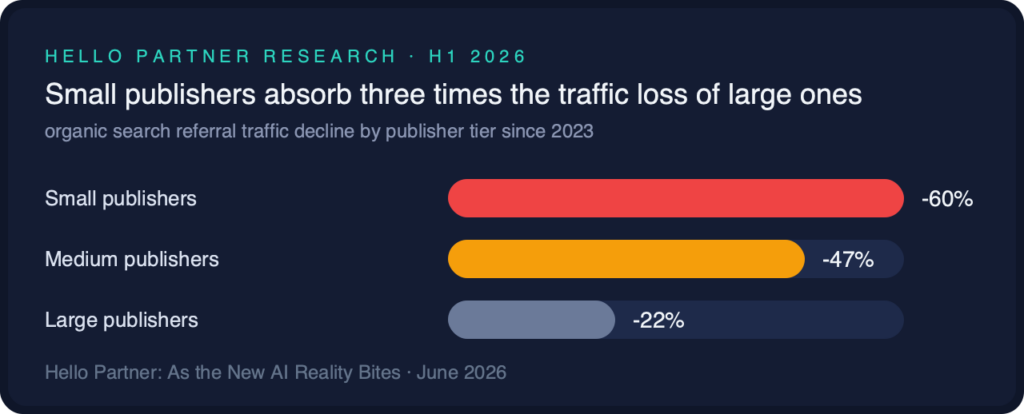
Organic search referral traffic decline by publisher tier since 2023. Source: Hello Partner, June 2026.
Digital Trends went from roughly 8.5 million organic clicks per month in March 2024 to 264,861 in January 2026 – a 97% decline. Chegg, whose business was answering the informational queries AI now answers natively, filed its own antitrust suit against Google and cut more than half its workforce across two rounds of layoffs as AI consumed the query category its business was built on.
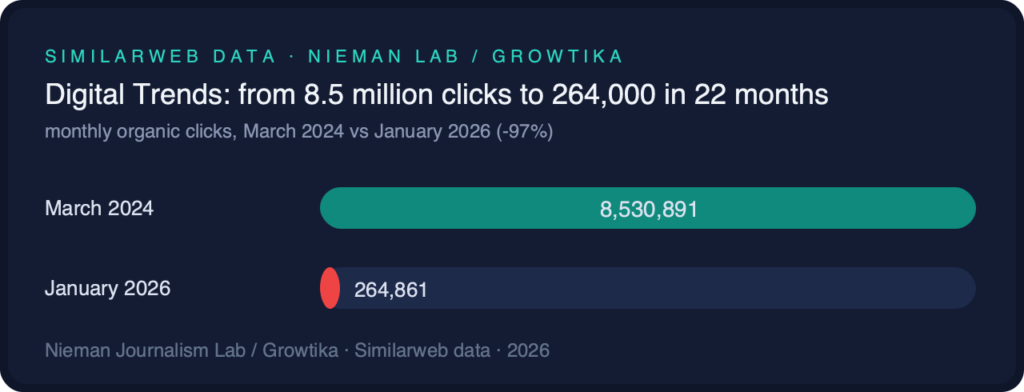
Digital Trends monthly organic clicks, March 2024 vs January 2026. Source: Nieman Journalism Lab / Growtika, Similarweb data.
The Storefront Is Suing the Landlord
When a distribution channel’s biggest operators start suing the platforms they distribute through, the channel is in its terminal phase. That is where hosting’s review-site storefront now stands, on two separate legal fronts.
Penske Media v. Google, filed September 12, 2025, in the U.S. District Court for the District of Columbia, is among the first lawsuits by a major U.S. publisher targeting AI Overviews on antitrust – not copyright – grounds. The 101-page complaint alleges Google leverages its near-90% search monopoly to ingest publisher content into retrieval-augmented AI answers that then compete against the publishers themselves, advancing claims of reciprocal dealing, monopoly leveraging, and unjust enrichment, and seeking treble damages. The complaint’s core argument is that synthesized answers eliminate the site visit that affiliate and advertising revenue depend on.
Ziff Davis v. OpenAI matters even more directly for hosting, because Ziff Davis owns PCMag, CNET, ZDNET, Mashable, and Lifehacker – which makes it the single largest concentration of hosting review and comparison content in the world. Its complaint, filed April 25, 2025, in federal court in Delaware, alleges OpenAI “intentionally and egregiously” exploited its content to build ChatGPT. In December 2025, a federal judge advanced the core copyright claims past OpenAI’s motion to dismiss. Whatever the outcomes, the strategic signal is unambiguous: the publishers who spent two decades selling hosting signups are now litigating for compensation from the AI systems that replaced the page view – and a settlement or licensing regime would formalize the new order, in which the review brand gets paid for being training data and citation fodder rather than for delivering a tracked click. No hosting bounty is paid on a citation.
Google Killed the Independents First
For hosting executives tempted to read this as a sudden shock, the record shows something more uncomfortable: a two-stage demolition, with the first stage executed years before AI Overviews. The case that documented it was HouseFresh, a small independent product-testing site that published “How Google is killing independent sites like ours” in early 2024 and then lost 91% of its Google traffic after the March 2024 core update. HouseFresh’s evidence showed corporate media conglomerates outranking genuine independent testers with affiliate review content of questionable hands-on authenticity – including identical product photos recycled across supposedly independent big-brand reviews. Google’s algorithm updates of 2023–2024 systematically concentrated review traffic into a handful of large media portfolios: Future, Ziff Davis, Dotdash Meredith, Forbes.
Then stage two took it from them. The May 2026 core update penalized a large share of top technology review sites in search visibility, and AI Overviews intercepted the queries that remained. The independents died first; the conglomerates that absorbed their traffic are now watching AI absorb theirs. For a hosting CMO the lesson is not about publishers – it is about compounding platform risk. The affiliate channel concentrated, then broke, on the decisions of exactly one company. Every acquisition strategy with a single-platform dependency carries the same failure mode, and the industry’s twenty-year affiliate program was, in hindsight, a single long position on Google’s willingness to send clicks to middlemen.
Where the “Best Web Hosting” Query Went
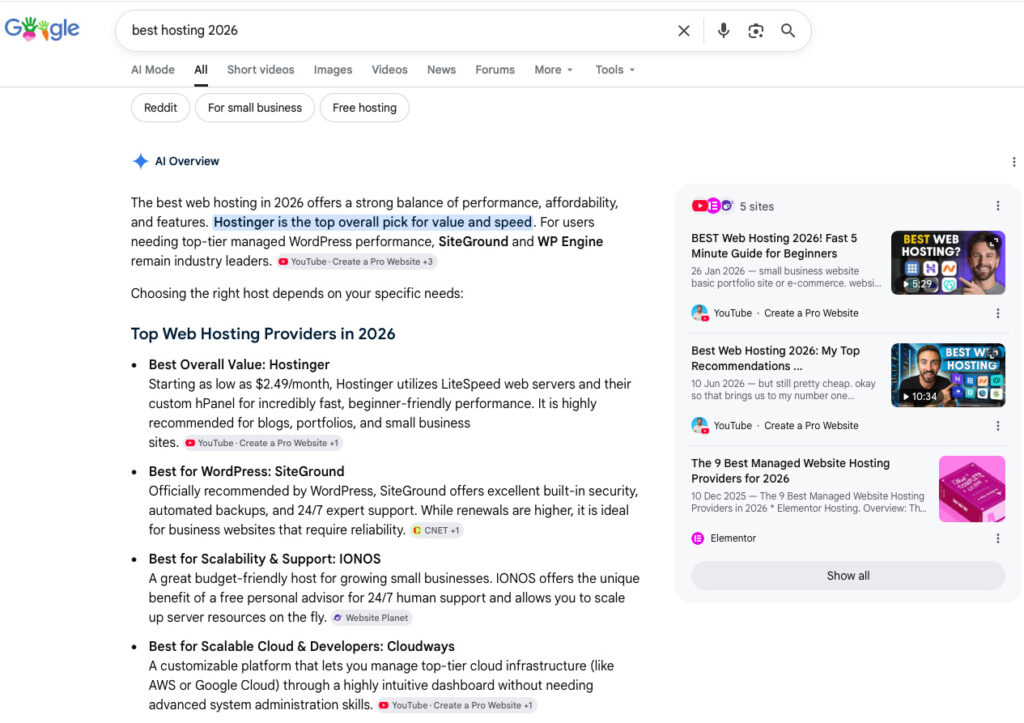
Google AI Overview for “best hosting 2026”, June 2026. Sidebar: five results, all YouTube. No traditional review site in sight, and no affiliate click paid.
The buyer did not disappear; the click did. As of Q1 2026, roughly 48% of all Google searches display an AI Overview, and Ahrefs measured that an AI Overview’s presence cuts clicks to the top organic result by 58%. Zero-click sessions hit 58.5% of U.S. Google searches as early as 2024 per SparkToro, and 69% by mid-2025 per Similarweb. Product-review and comparison queries – precisely the territory hosting affiliates occupy – sit in the highest AI Overview density categories. A prospective customer asking “best WordPress hosting for a small business” increasingly receives a synthesized comparison, with provider names, inside the results page. The review site that used to monetize that moment is reduced to a citation footnote it may or may not receive.
What gets cited is the second structural shift. Semrush’s 13-week study of AI citations – 230,000 prompts and more than 100 million tracked citations across ChatGPT search, Google AI Mode, and Perplexity – found that ChatGPT cited Wikipedia and Reddit roughly five times as often as the next most-cited domains, with Reddit appearing in close to 60% of responses at the study’s peak. Separate research from 5WPR found Wikipedia and Reddit together drive more than a quarter of ChatGPT’s U.S. citations, while the Wall Street Journal, New York Times, and Bloomberg do not appear in the top 20. The pattern for hosting is specific and verifiable: ask an AI assistant for a hosting recommendation, and the answer is more likely to be synthesized from r/webhosting threads than from a professionally tested review carrying an affiliate link.
The same Semrush data carries a warning for anyone planning to simply “win AI citations” as a replacement strategy: citation share is violently unstable. Reddit’s presence in ChatGPT answers collapsed from roughly 60% to about 10% within six weeks during the study period, as OpenAI adjusted retrieval behavior. AI visibility is not owned and not even rented on terms – it is re-decided continuously by model providers, with no notice, no appeal process, and no account manager. Providers building for citation must treat it as a portfolio position across multiple AI surfaces, not a successor to the #1 ranking they used to buy shelf space on.
For hosting providers this is a double exposure. The channel they paid for is losing its audience, and the channel replacing it cannot be bought – Reddit threads carry no affiliate links, no negotiated placements, and a long memory for billing complaints, renewal-price surprises, and support failures. A decade of acquisition spending optimized for review-site shelf space is being replaced by an environment where the only durable input is the actual customer experience.
Affiliate Spend Is Shifting, Not Shrinking
Here is the paradox a CFO should sit with: US advertisers will spend $13.81 billion on affiliate marketing in 2026, up 11.3% from $12.42 billion in 2025, according to eMarketer. The channel is growing through the collapse of its largest publisher category. The spend is redistributing, and the redistribution map is well documented.
Industry analysis splits affiliate publishers into winners and losers by a simple criterion: whether the model survives the death of the search click. Cashback and loyalty publishers retain their position because users must visit their platforms to activate rewards – the click, and therefore the attribution, survives. Coupon publishers are exposed because AI systems surface discount codes directly in the answer. Reviewers and comparison publishers are squeezed from both sides: less organic traffic in, more paid spend needed to replace it. Hosting’s affiliate base was overwhelmingly concentrated in that third, most-exposed category.
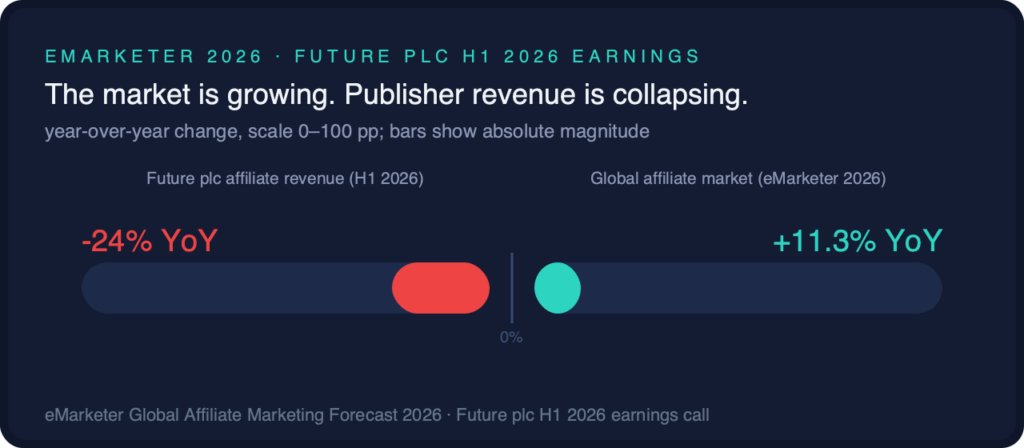
Global affiliate market growth vs Future plc affiliate revenue, H1 2026. Sources: eMarketer Global Affiliate Marketing Forecast 2026; Future plc H1 2026 earnings call.
The growth side of the ledger is creators. YouTube sponsorships grew 54% year-over-year in the first half of 2025 – 65,759 sponsored videos generating 19.1 billion views, per Tubefilter’s Gospel Stats tracking. The strategic distinction matters: a YouTube channel, a newsletter, or a Discord community owns its audience relationship. No algorithm change can take it away, which is exactly why brand budgets are migrating there. Hostinger’s marketing – among the most visible sponsor names across web-development and tech YouTube – has been the template: a provider that pairs aggressive creator sponsorship with a revenue-share affiliate program is buying distribution that AI Overviews cannot intercept.
There is also a quality compensation in the wreckage. Visitors who do arrive through AI citations convert at substantially higher rates – research cited across the industry puts the conversion premium at 4.4 times traditional organic visitors, with cited brands earning 35% more clicks on queries where they appear. Fewer referrals, better referrals. For providers, that means the same bounty buys a more qualified customer – where it still gets paid at all.
The Incumbents’ Numbers Already Tell the Story
If the affiliate funnel’s decline seems abstract, the 2026 financials of the two American hosting giants built on opposite sides of it are not.
GoDaddy has effectively exited the new-customer business. Its Q1 2026 results showed net customer additions of 13,000 – for the entire quarter – on a base of 20.4 million, while average revenue per user grew 9% to $246 and free cash flow hit $473.6 million. The largest SMB hosting platform in the world has concluded that the marginal cost of acquiring a new customer no longer justifies the return, and is monetizing its locked-in base through AI upsells instead. That is what a rational operator does when the acquisition channel’s price-performance breaks: stop buying.
Newfold Digital is what happens when you cannot stop buying. The Bluehost and HostGator parent – the corporate heir of EIG’s affiliate machine – carries approximately $3.7 billion in private equity acquisition debt against a Caa3 rating from Moody’s and sold MarkMonitor in January 2026 to raise liquidity. Newfold’s brands were built by affiliate commissions: recognized by exactly the segment of customers who discovered hosting through review sites. As this publication noted in April, brand recognition built through aggressive affiliate structures does not translate into retention when subscribers compare renewal pricing against the market. The funnel that filled the top of Newfold’s bucket is collapsing at the precise moment the bottom is leaking – and the company’s debt was sized for a world where the funnel ran forever.
The counterexample proves the point rather than refuting it. Ionos added 310,000 net customers in 2025 at a 36.8% adjusted EBITDA margin – growth built on a household brand in its home market, broadcast advertising, and direct distribution, not on English-language review-site placements. The providers still growing are the ones whose acquisition engine never depended on the storefront that is being demolished.
The CAC Problem Hosting Providers Now Own
The strategic damage is not that one marketing channel shrank. It is that the predictable channel shrank, at the same time infrastructure costs are rising across the industry – hardware, memory, licensing, energy – a squeeze this publication has mapped in detail. A provider replacing affiliate volume with paid search swaps a pay-on-conversion CAC for an auction-based one, in an auction where every displaced competitor is bidding for the same diminished click supply. A provider replacing it with creator sponsorships swaps pay-on-conversion for pay-up-front: sponsorship fees are committed before a single customer signs, attribution is murkier, and the measurement model that justified the affiliate line for twenty years – last-click attribution – does not survive contact with a buying journey that runs through an AI answer, two Reddit threads, and a YouTube review before any trackable click occurs.
Exposure varies sharply by provider type. Large diversified brands – GoDaddy with its broadcast brand and direct traffic, the hyperscalers with enterprise sales motions – can absorb the shift, or sidestep it entirely by exiting acquisition. Newfold is the stress case: a portfolio assembled on affiliate-funnel economics, carrying private equity debt, watching the funnel’s front end disappear while renewal-price complaints – preserved forever in the Reddit threads AI now cites – erode the back end. Challenger brands that bought review-site placement to compensate for low brand awareness face the hardest problem: the shelf they paid to be on is being removed, and the new shelf is earned, not sold.
What the Playbook Looks Like Now
Four moves follow from the data, in rough order of urgency.
- Audit the funnel before it audits you. Any provider that cannot state what percentage of new-customer volume originates from search-dependent affiliate publishers is flying blind into a 22–60% erosion of that traffic. The Future plc numbers are a usable proxy: affiliate revenue falling substantially faster than sessions means the decline compounds – fewer visitors, monetizing worse. Growth plans built on flat affiliate volume should be re-forecast now, not at renewal season.
- Restructure commissions for the publishers who survive. Flat bounties were optimized for high-volume review sites; the surviving partners – creators, newsletters, communities, cashback platforms – have smaller, loyal audiences and longer relationships. Recurring revenue-share structures, the model Kinsta and Hostinger already run, align with retained audiences and discourage the churn-and-burn signup quality that flat CPAs invited. The 180-day cookie was built for a comparison shopper; the lifetime commission is built for a trusted recommender.
- Engineer for citation – as a portfolio, not a ranking. Pages with proper schema.org structured data are 2.5 times more likely to appear in AI-generated answers. First-party benchmark data, transparent pricing documentation, and technical content that AI systems can verify and quote are now acquisition assets – the inputs to the synthesized comparison that replaced the review page. But the Semrush volatility data is the governing constraint: citation share can collapse 80% in six weeks on a model provider’s retrieval change. Distribute the position across Google’s AI surfaces, ChatGPT, Perplexity, and the community platforms they all cite, and treat llms.txt files and structured product data as standing infrastructure, not a campaign.
- Treat the customer experience as the marketing budget. If AI recommendations are synthesized from community sentiment, then renewal-price surprises, forced plugin installs, and support failures are no longer retention problems – they are acquisition problems, permanently archived in the threads AI cites. The provider behaviors that the affiliate-funnel era could paper over with commission spend are now the single largest input to the channel that replaced it. That is an uncomfortable inversion for the industry’s discount-and-renew incumbents, and a genuine structural advantage for providers whose Reddit threads read well.
The Channel That Replaces It
The affiliate funnel rewarded whoever ranked. The emerging funnel rewards whoever gets cited – and the citation cannot be purchased, only earned through verifiable data, structured content, and customers who say good things in public. With agentic AI beginning to execute purchases directly – domain registration via AI agents is already live territory this publication has covered – the endpoint is visible: a buying journey in which no human ever sees a results page, a review site, or a banner. The hosting industry spent twenty years and billions of dollars building the most efficient paid-referral machine on the internet. The machine still runs; eMarketer’s growth numbers prove it. It is the road it sits on that is being removed – and the providers that treat 2026 as the year to rebuild acquisition around owned audiences, earned citations, and a customer experience that survives being quoted will buy their next decade of growth at a discount, from competitors still paying for shelf space in a store that is closing.

Sources
- Future plc Reports Revenue Decline in H1 2026 Earnings Call - Investing.com
- Future Plans 45 Editorial Redundancies at Titles Including TechRadar and Tom's Guide - Press Gazette
- Future plc CFO Stepping Down as Company Reports Revenue Declines - Digiday
- Future plc Shares Sink 9% Following Stifel Downgrade Over AI Search Risks - Investing.com
- Penske Media Sues Google, Says AI Overviews Hurt Revenue, Traffic - Search Engine Land
- Penske Media Files Major Antitrust Lawsuit Targeting Google AI Content Use - PPC Land
- Lawsuit Accuses OpenAI of 'Intentionally and Egregiously Exploiting' Content From Major Publisher - eWeek
- Judge Advances Ziff Davis' ChatGPT Copyright Infringement Claims - Courthouse News Service
- How Google Is Killing Independent Sites Like Ours - HouseFresh
- Small Review Site Lost 91% of Its Google Traffic to Affiliate-Focused SEO Content - Search Engine Land
- Forbes Advisor Hit by Google Penalty Over Affiliate Practices - Hello Partner
- As the New AI Reality Bites, Affiliate's Winners Are Already Emerging - Hello Partner
- FAQ on Affiliate Marketing: How AI and Creators Are Reshaping the Channel - eMarketer
- AI Overviews Reduce Clicks by 58% - Ahrefs
- The Most-Cited Domains in AI: A 3-Month Study - Semrush
- Wikipedia and Reddit Now Drive Over 25% of ChatGPT Citations in the US - 5W Research via PR Newswire
- YouTube Sponsorships Surge 54% as Brands Shift Marketing Dollars to Influencers - NetInfluencer
- Bluehost Affiliate Program - Bluehost (official)
- WP Engine Affiliate Program - WP Engine (official)
- Kinsta Affiliate Program - Kinsta (official)
- Hostinger Affiliate Program - Hostinger (official)
- Endurance International Group - Wikipedia
- Traffic to top tech publications has plummeted since 2024, new analysis shows - Nieman Journalism Lab
- Tech Publications Lost 58% of Google Traffic Since 2024 - Growtika
- Chegg Slashes 45% of Workforce, Blames New Realities of AI - CNBC
- Google AI Overviews Statistics 2026 - SeoProfy (citing Advanced Web Ranking data)
- AI Search Traffic Is 4x More Valuable Than Organic - Runmarshal
- Schema Markup Best Practices for AI Citations - Geneo
- AI Overviews Impact on Google CTR: September 2025 Update - Seer Interactive
- Newfold Digital Completes Sale of Markmonitor to Com Laude - PR Newswire
- Newfold Digital's Ratings Downgraded by Moody's Due to Refinancing Risk - Investing.com
- IONOS Reports Successful 2025 Fiscal Year - EQS News (official press release)
- GoDaddy Q1 2026 Earnings Report - The Domains
- GoDaddy Q1 2026 Earnings Call Transcript - The Motley Fool
- Similarweb: Zero-Click Searches Surge to 69% Since Google AI Overviews Launched - Stan Ventures
- Chegg Slashes Nearly Half of Its Workforce as AI Eats Into Its Business - Higher Ed Dive