

At .com and .net, first-time renewal rates are almost half those of later renewals, according to Verisign. Hostinger sees a similar pattern in its VPS business, where the signup cohort reaching its first renewal “usually churns harder than older cohorts.”
For customers on introductory pricing, the first renewal is when the regular price starts to apply. Price is also the factor cited most often in surveys of both providers and customers. Much of what decides whether customers stay, however, is set earlier. It depends on the billing term the host chose to sell, on whether the customer ever put a site or a mailbox to work, and on whether the payment card still works.
Key facts
- Domain use: in Verisign data, .com names configured for email or used for an online presence renewed 9 percentage points more often at their first renewal.
- Billing terms: in our renewal index, the first renewal arrives 12 to 48 months after signup, depending on the term the host sells.
- Failed payments: in Stripe data on subscription businesses across industries, involuntary churn made up 35% of all churn among subscriptions with an average order value under $10.
- GoDaddy: customer retention was about 85% in 2025, and about 90% for customers who had been with the company for more than three years.
The First Renewal Is Where the Base Thins
Verisign’s figures are the clearest public data on the pattern. On the company’s third-quarter call on October 22, chief financial officer John Calys put first-time renewal rates “fairly steady in the mid 40% range” and previously renewed names “in the mid 80% range.” Because 2025 brought a surge of new registrations, more names are now reaching their first renewal, and Verisign expects its third-quarter renewal rate at 74.3%, down from 75.4% a year earlier.
GoDaddy’s figures follow the same shape. Its annual report for 2025 puts customer retention at approximately 85% in each of the past five years except 2024, when it was approximately 84%. For customers who had been with the company for more than three years, it was approximately 90%. The report does not explain how the rate is calculated.
Hostinger’s description comes from a June post on its VPS business, which attributes a dip in spring 2026 to the large February signup cohort reaching its first renewal. IONOS reports churn of “~1% per month” in its half-year presentation, without a definition. The figures are measured differently and cannot be compared. Verisign, GoDaddy and Hostinger each describe a customer base that becomes more stable the longer customers stay.
Price Is the Reason Named First
Two vendor surveys show how providers and customers describe departures. CloudLinux and WebPros asked 446 hosting providers, between October and December 2025, for the top three reasons their customers give when they leave. Price came first, named by 56%, ahead of a move to a SaaS platform at 41%.
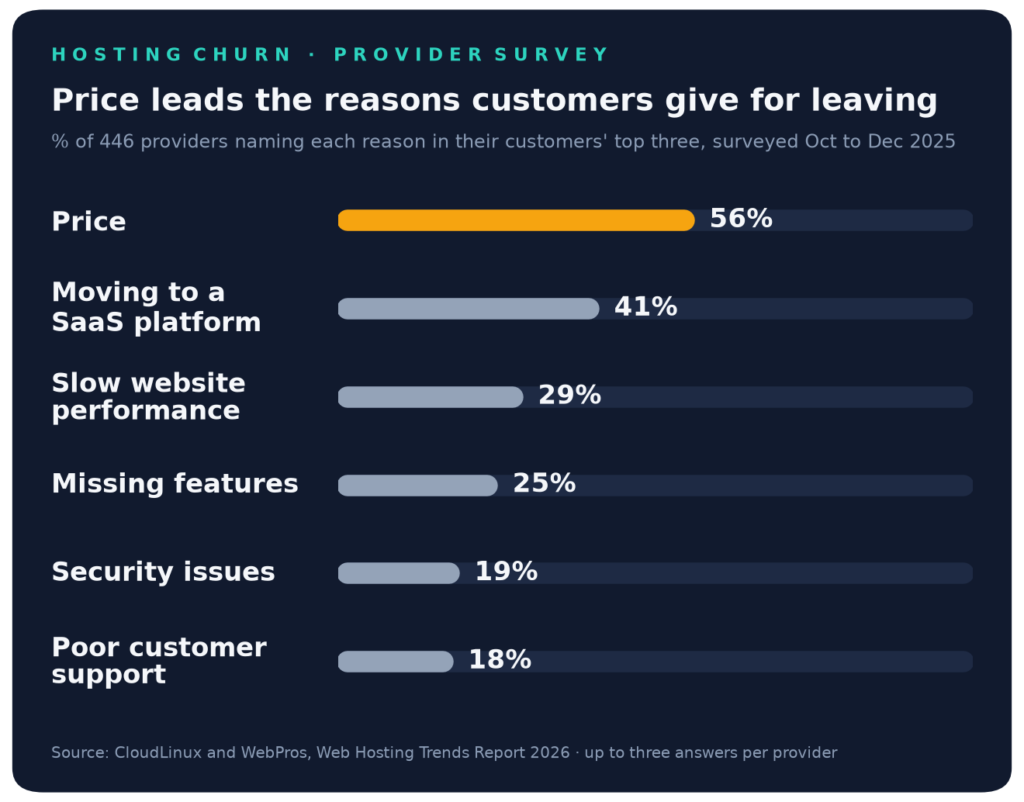
Reasons customers give when they leave, as reported by 446 hosting providers, October to December 2025. Each provider could name up to three. Source: CloudLinux and WebPros.
On the customer side, Liquid Web surveyed 506 business owners, developers and decision-makers in March 2025. Asked what would make them leave their provider, 43% named high costs, 28% slow performance and 26% frequent downtime.
The Host Decides When the First Renewal Arrives
A hosting plan reaches its first renewal when the term the customer bought runs out, and that term is set by the provider. In our Renewal Multiplier Index of July 29, the advertised introductory prices required 12 months at SiteGround, Namecheap and DreamHost, 36 months at GoDaddy, HostGator and Bluehost, and 48 months at Hostinger. The first renewal therefore lands anywhere from one to four years after signup.
The host also sets how large the step is. Across 27 plans from ten providers, renewal prices ran from 1.0 times the introductory price at HostMetro, which renews at the signup price, to 5.3 times at SiteGround’s entry plan. At all eight providers with a full plan range, the entry plan renewed at a higher multiple than the top plan. The steepest relative price increases therefore fall on the cheapest plans. A four-year prepay delays the first renewal decision until the end of that term, when the customer faces the full difference between the introductory and the regular price.
Customers Who Put the Product to Work Stay Longer
What a customer does with the service before the first renewal is also linked to whether it renews. At Nordic Domain Days in May, Verisign presented first-time .com renewal rates by how a domain is used, in slides published by Domain Name Wire. Domains used for an online presence or configured for email renewed at a rate 9 percentage points higher. Domain forwards added 13 points, and websites built with AI-native tools 20 points, a figure Domain Name Wire notes rests on “a very, very small subset of domains.” These figures show an association, not that the setup itself makes customers stay.
The hosts’ own reports describe the same link. GoDaddy’s annual report puts it this way: “customers with a greater number of products with us retain at higher rates and produce higher lifetime value.” IONOS calls customer satisfaction its “most important tool” for retaining customers, and its full-year presentation describes AI site creation with domain, email, hosting, security and support “included from the start, driving higher attach rates and ARPU from day one.”
Hostinger’s VPS data shows where the early risk sits. According to the company, “New VPS users have always been most likely to leave in the first month, usually after running into a server problem they couldn’t solve.” After Hostinger gave its Kodee AI agent direct access to customers’ servers, VPS retention moved from around 66% to an average of 70%, by the company’s own figures.
Customers Who Leave Without Deciding To
Part of churn is not a decision at all. A card expires or a charge is declined, and the subscription lapses. Churnkey, a retention software vendor, analyzed Stripe’s subscription data together with its own records of 5.4 million failed payments over a year. Involuntary churn accounted for 35% of all churn among subscriptions with an average order value under $10, and 19% for those averaging between $100 and $1,000. These figures cover subscription businesses across industries, not hosting providers specifically.
The bands are based on average order value, the size of a typical charge, not on a plan’s monthly price. A $3 plan billed monthly sits in the lowest band, while the same plan prepaid for 36 months is a single charge of about $108. The data compares different groups of subscriptions, however, and does not show what changing a billing term would do. Vendors report that much of this churn can be recovered. According to Stripe, businesses using its billing product “recover 55% of failed payments on average,” and Churnkey reports recovering 70% of the involuntary churn it detected through payment retries, prompts to update card details and reminder messages.
Migrations Open Their Own Exit
Some churn is created by the provider’s own changes. GoDaddy’s retention dipped to approximately 84% in 2024 “due to divestitures, migrations and end of life of certain products as part of our efforts to streamline brands outside of the GoDaddy platform.”
When A2 Hosting became hosting.com in 2025, the company acknowledged migration bugs and “a short-term spike in support tickets.” It also explained that some customers first saw a price adjustment made in September 2024 only at renewal: “Previously, customers were typically only notified at the time of their renewal.” The company now issues invoices 14 days before renewal and added: “We own that and apologize for it.”
Squarespace took a different route after acquiring the Google Domains customer base. It “honored all existing Google Domains customers’ domain renewal prices for at least 12 months after closing the acquisition,” and moved them to its standard rates from September 7, 2024.
For an owner preparing a sale, this is the part of churn a buyer can anticipate. As we noted in our analysis of hosting valuations, retention by signup cohort at renewal feeds directly into a buyer’s model. A planned platform migration adds a renewal risk of its own.
Where Customers Go
In the providers’ survey, 41% cited a move to a SaaS platform such as Wix, Shopify or Squarespace. Market share data from W3Techs, which tracks the technology behind more than 20 million websites, gives a more mixed picture for October 1, 2025 to October 27, 2026:
| Share of websites (W3Techs) | Oct 1, 2025 | Oct 27, 2026 |
|---|---|---|
| By content management system | ||
| No detectable CMS | 28.6% | 32.1% |
| WordPress | 43.3% | 39.6% |
| Shopify | 4.8% | 5.3% |
| Wix | 4.1% | 4.2% |
| Squarespace | 2.4% | 2.4% |
| By hosting provider | ||
| Hostinger | 4.4% | 5.2% |
| Vercel | 0.9% | 2.3% |
Of the large builders, only Shopify gained noticeably, while Wix and Squarespace barely moved. In the CMS data, the largest gain belongs to sites with no CMS that W3Techs can detect. Among hosting providers, Vercel, a platform for deploying applications written in code, more than doubled its share. Hostinger gained the most among traditional hosts, and it no longer sells only hosting. It describes itself as “an agentic platform to build, run, and grow your business online, all in one place.” Other large providers are moving the same way, as we described on October 23.
These are shares of websites, not flows of customers, so they cannot show where any individual customer went or why sites without a CMS are growing.
Moving still holds many customers back. In Liquid Web’s survey, 69% had delayed a switch “due to fears around downtime, migration costs, or technical complexity,” and 70% among shared hosting users. Competitors’ free-migration offers address that hesitation. Migrations at hosting.com are “unlimited and free,” with more than 100,000 completed by the company’s count. Hostinger offers to “migrate an unlimited number of websites for free” on its web, cloud and agency plans, and Kinsta reports moving more than 12,000 websites onto its platform in 2025.
New Rules Put the Renewal in Front of the Customer
Rules on automatic renewal are changing in several places. The California and New York State laws define a consumer as an individual buying for personal, family or household purposes, so hosting bought for a business falls outside them.
- California: the automatic renewal law, as amended for contracts from July 1, 2025, requires express consent and cancellation “exclusively online, at will” for online sign-ups. For terms of a year or longer, customers must be notified 15 to 45 days before renewal.
- New York: under the 2025 budget amendments, a price increase needs the customer’s consent. Without it, the customer must be able to cancel for at least 14 days after the higher charge and receive a pro-rata refund. Cancellation must be as easy as the sign-up, and New York City’s own click-to-cancel rule has applied since October 1, 2026.
- US federal: a court vacated the FTC’s amended negative option rule in July 2025, and the FTC opened a new rulemaking in March 2026.
- EU: a Parliament research briefing expects a Digital Fairness Act proposal in the fourth quarter, currently scheduled for mid-November. In the consultation it cites, 62% of respondents had a subscription renewed without a reminder.
For consumer customers, the rules in force turn a silent renewal into a moment they are reminded of, asked about or able to leave as easily as they signed up.
Final Thoughts
For a hosting provider, the first renewal brings several retention risks into focus, but many of them develop earlier. The term and discount the host sells set when the decision comes and how large the price step is. Whether the customer launched a site or attached email is linked to how that decision goes, and a failed card can end the relationship without any decision at all. Retention at the first renewal is therefore shaped long before the renewal invoice goes out: at the point of sale and in the first weeks of use.
About the Data
Retention figures come from company filings, presentations and an earnings call transcript, and their definitions differ. GoDaddy and IONOS do not define theirs in the documents cited. The Verisign usage data comes from slides presented at Nordic Domain Days and published by Domain Name Wire. The surveys were commissioned by vendors: CloudLinux and WebPros surveyed providers, and Liquid Web surveyed customers. We found no independent customer survey with a published methodology. Involuntary churn figures come from Churnkey and Stripe. W3Techs measures shares of websites, not customer movements. Renewal multipliers come from our index of July 29, 2026.

Sources
- VeriSign (VRSN) Q3 2026 Earnings Call Transcript - The Motley Fool
- Interesting Verisign data about domain usage and renewal rates - Domain Name Wire
- GoDaddy Inc. Annual Report on Form 10-K for 2025 - U.S. Securities and Exchange Commission
- AI-managed VPS: What 914,000 Kodee MCP conversations reveal - Hostinger Blog
- 6-Month 2026 Results Webcast - IONOS Group
- Annual Report 2025 - IONOS Group
- FY 2025 Results Webcast - IONOS Group
- Involuntary churn benchmarks and tactical advice - Churnkey
- Stripe Billing - Stripe
- Web Hosting Trends Report 2026 - CloudLinux and WebPros
- Web Hosting Pain Points in 2025 - Liquid Web
- Free website migration - hosting.com
- Free website migration - Hostinger
- How to migrate a website to Hostinger - Hostinger Support
- Kinsta year in review: the best of 2025 - Kinsta
- Historical trends in the usage statistics of content management systems - W3Techs
- Historical trends in the usage statistics of web hosting providers - W3Techs
- Technologies overview and methodology - W3Techs
- About Hostinger - Hostinger
- Hosting.com update: Improvements, fixes, and what's next - hosting.com Blog
- Google Domains FAQ - Squarespace Domains
- Business and Professions Code, Automatic Renewal and Continuous Service Offers - California Legislative Information
- Assembly Bill A3008C (2025) - New York State Senate
- Governor Hochul Signs New Legislation to Protect Consumers as Part of the FY 2026 Budget - New York State Division of the Budget
- Click to Cancel - NYC Department of Consumer and Worker Protection
- Negative Option Rule, Advance Notice of Proposed Rulemaking - Federal Register
- Towards a digital fairness act - European Parliamentary Research Service