
Cloudways’ first AI Visibility Gap Report argues that AI is making website traffic harder to predict. In the Censuswide survey behind it, conducted in June among 1,000 decision-makers at digital and e-commerce businesses in the UK and US, a quarter of businesses reported infrastructure strain from AI crawlers or bots, and 23% had faced traffic surges that directly affected website performance.
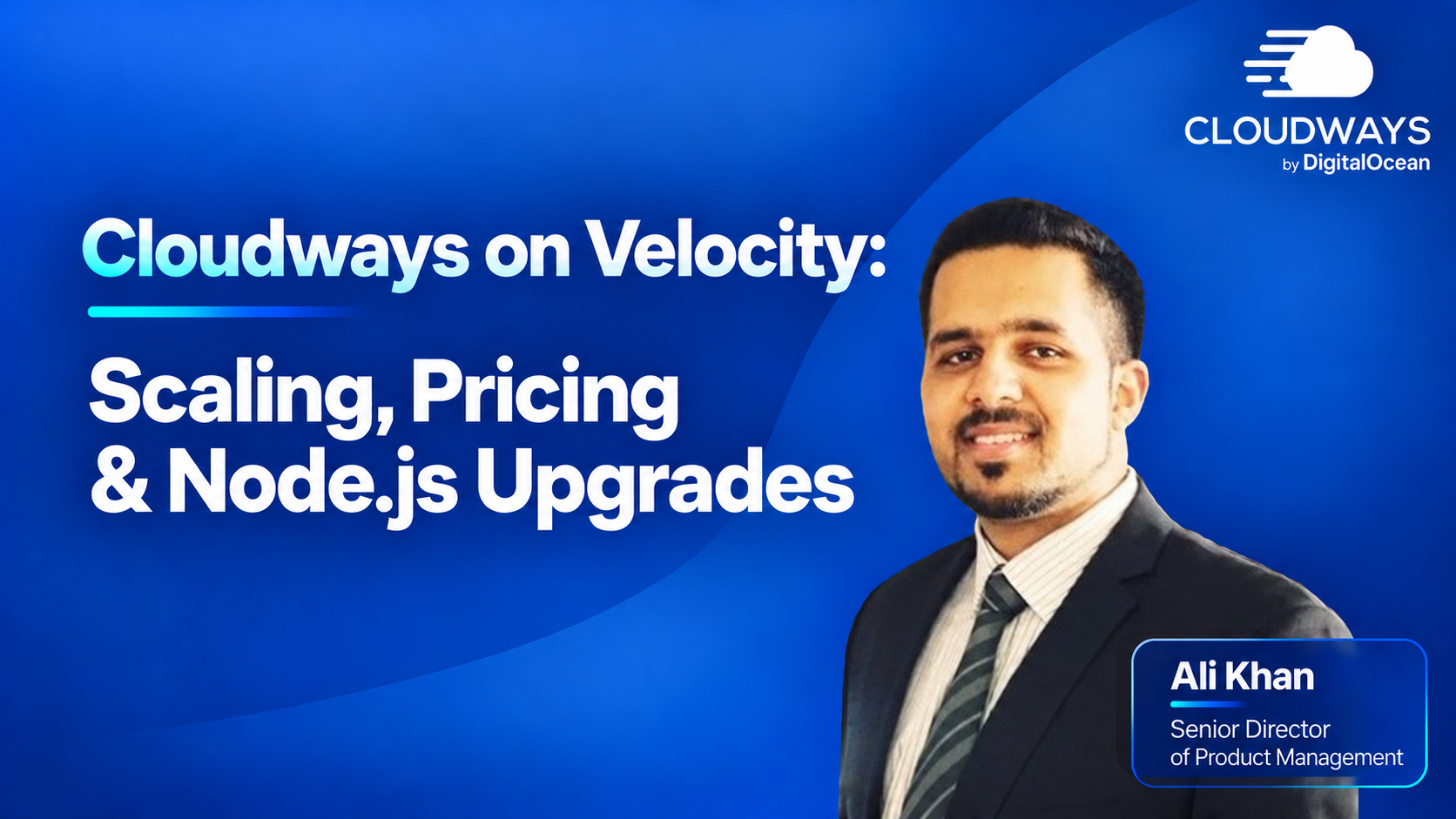
Velocity, the managed Node.js hosting service that Cloudways made generally available on September 14, uses a persistent-server model. Its plans start at a flat $20 a month, with CDN bandwidth beyond a plan’s allocation and offsite backup storage billed on top. According to Ali Khan, senior director of product management at Cloudways, Velocity does not currently scale CPU or RAM automatically. Cloudways’ product page advises customers to “pick the server that fits your workload today, and scale vertically as your product grows.” That raises the question of how Velocity responds to sudden increases in demand.
Cloudways belongs to DigitalOcean, which also sells App Platform, a managed platform-as-a-service that can scale applications automatically. In the interview below, Khan explains how the two products differ, how Velocity handles resource limits, which regions and Node.js versions it supports, and what options are available to agencies.
Two DigitalOcean Products for Node.js
webhosting.today: DigitalOcean already offers the App Platform for Node.js applications. How is Velocity positioned differently, and which type of customer is each product intended for?
Ali Khan: DigitalOcean App Platform and Cloudways Velocity operate at different levels of abstraction. App Platform is a fully managed PaaS. It abstracts the underlying infrastructure and is designed for developers who want to deploy applications and services without thinking about servers. It supports container-based workloads, multiple languages and horizontal autoscaling, making it a strong fit for teams that want a more cloud-native PaaS experience.
Velocity is designed around a persistent, managed server model specifically for Node.js. Applications run on always-on server resources, while Cloudways manages the operational layer including server maintenance, patching, SSL, backups, NGINX and process management. Customers retain control over their application configuration, deployments and Node.js runtime, with flat plan-based pricing rather than pricing each application component independently. Multiple Node.js applications can also share the resources of a single Velocity plan.
The primary audience for Velocity is developers, SaaS teams, AI builders and particularly agencies that want the economics and persistence of a VPS without having to operate the server themselves. For agencies already managing WordPress or PHP workloads on Cloudways, it also gives them a way to bring Node.js applications into the same operational environment. This managed persistent-infrastructure positioning was also central to the product when we launched it.
Limits, Uptime and Regions
webhosting.today: What happens when a server reaches its CPU, RAM or included server bandwidth limits? Is it throttled, stopped, or does the customer need to upgrade the plan?
Ali Khan: Reaching high CPU utilization does not cause Cloudways to automatically stop the server. The application continues operating within the resources available to it, but sustained CPU saturation can naturally result in slower response times. Similarly, if an application exhausts available memory, application processes may become unstable or restart. Customers can monitor CPU, RAM, disk and bandwidth directly from the Velocity dashboard and vertically upgrade the plan when they require additional capacity.
Bandwidth works differently. Exceeding the included bandwidth does not cause the server to be shut down. Additional bandwidth can be charged as overage rather than interrupting the application. Velocity also includes a separate Cloudflare Enterprise CDN bandwidth allocation, with CDN usage above that allocation currently charged at $0.02/GB.
So the important distinction is that Velocity does not currently autoscale CPU or RAM. Instead, customers size the persistent server for their workload and can upgrade as their requirements grow.
webhosting.today: What uptime commitment comes with Velocity?
Ali Khan: Velocity is backed by Cloudways’ 99.99% uptime SLA. It also benefits from the same managed operational model Cloudways uses across the platform, including infrastructure monitoring, automated server management and 24/7 support.
webhosting.today: Which data center regions is Velocity available in at launch, and whose underlying infrastructure does it use?
Ali Khan: Velocity runs on DigitalOcean infrastructure. At launch, customers can deploy Velocity in ten regions: New York, Atlanta, San Francisco, Toronto, London, Amsterdam, Frankfurt, Bangalore, Singapore and Sydney. This allows customers to place their Node.js workloads reasonably close to their primary user base across North America, Europe, Asia and Australia.
Cloudways manages the layer above the infrastructure, including the server environment, deployment workflow, security, backups and ongoing maintenance, while the underlying compute is provided by DigitalOcean.
Node.js Versions and Agency Use
webhosting.today: Which Node.js versions are supported, and who controls upgrades for running applications: the customer or Cloudways?
Ali Khan: Velocity currently supports Node.js 22 LTS and Node.js 24 LTS. Customers select the Node.js version at the application level as part of the deployment configuration, and it can subsequently be changed from Deployment Management followed by a redeployment.
Cloudways manages and maintains the underlying runtime environment and determines which supported LTS releases are available, but customers retain control over which supported Node.js major version their application runs on. We do not silently move a running application to a new major Node.js version. When older versions are deprecated, customers are given an opportunity to make their application compatible with a supported version.
webhosting.today: Can agencies resell Velocity to clients under their own brand, including white-label billing?
Ali Khan: Agencies can absolutely use Velocity to host Node.js applications for their clients and package the hosting as part of their own managed service. In fact, the multi-application model is particularly useful for agencies because multiple client applications can share a Velocity plan while retaining separate deployments, domains, SSL certificates and logs.
However, like other Cloudways product-lines (like Flexible, Autonomous etc.), Velocity itself is not currently white-labelable. Agencies cannot replace the Cloudways interface and product branding with their own.
