

Most domains that left Hostinger’s and Namecheap’s name servers between October 2 and 24 did not move to a competitor, by our count. They switched to name servers that show expired-domain pages: 64% of Hostinger’s outflow went to dns-expired.com, which Hostinger uses for lapsed registrations, and 70% of Namecheap’s went to parity.domains, which serves the page Namecheap shows for expired domains.
That matters for anyone who reads DNS data as a measure of who is winning customers. Between those dates, parity.domains gained more domains than any operator in our data except Cloudflare.
Key facts
- Cloudflare, the next destination, took about 13% of Hostinger’s outflow and 18% of Namecheap’s.
- In our data, the parking services parklogic.com, Above.com and Atom.com were also among the 12 largest gainers.
- Some domains come back: about 6,000 returned to Hostinger’s name servers and 19,000 to Namecheap’s.
- For generic top-level domains, ICANN requires registrars to interrupt an expired domain’s DNS for a minimum period, where the registry permits it, and to explain renewal on any expiry page.
Two Expiry Services Top the Outflow Lists
Our Market Insights data attributes each domain to the operator of its name servers and records where domains go when they change operators. The flow figures for the two companies, for the period ending October 24, look like this:
| Provider | Domains lost | To expiry pages | To Cloudflare |
|---|---|---|---|
| Hostinger | 261,160 | 168,011 | 34,854 |
| Namecheap | 423,049 | 296,225 | 78,236 |
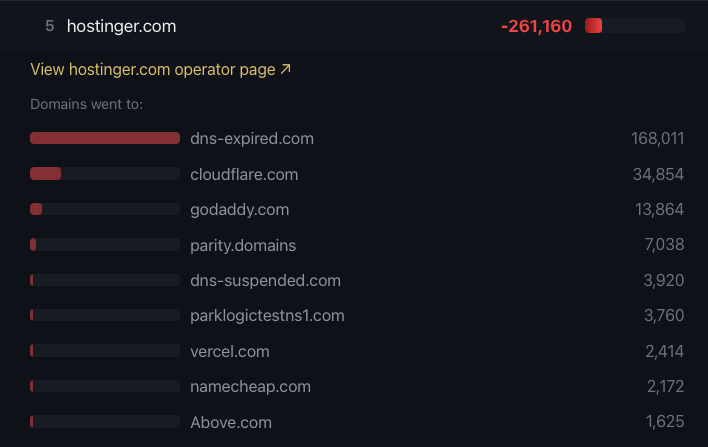
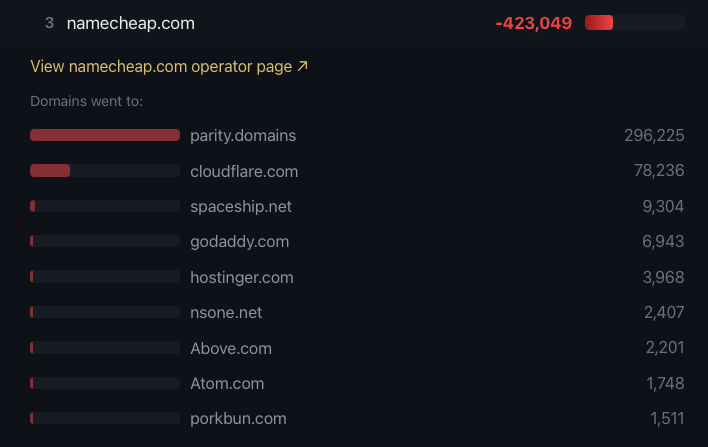
Where domains leaving Hostinger’s and Namecheap’s name servers went, period ending October 24, 2026. Source: our Market Insights.
We checked both services directly on November 4. Hostinger’s expiry name server answers with the text record “This domain is expired at Hostinger!”, and its web page reads “Your domain is expired” with a link to renew. The page behind parity.domains reads “Domain registration has expired”, explains how to renew through a Namecheap account and advertises Namecheap’s domain auctions.
Both services are large in their own right. Across all operators in our data, parity.domains recorded the second-largest gain in the period, 692,837 domains, and held 1.9 million domains on October 24. dns-expired.com gained 199,720, the ninth-largest gain, and held about 496,000. Parking services appear on the same list: parklogic.com gained 508,434 domains, Above.com 426,248 and Atom.com 106,854, so several of the largest gains went to expiry and parking services rather than to hosts.
Some domains also return. In the same period about 6,000 moved from dns-expired.com back to Hostinger’s name servers, and about 19,000 from parity.domains back to Namecheap’s.
Why Expiry Shows Up as a DNS Move
ICANN’s Expired Registration Recovery Policy sets the sequence for generic top-level domains. Country-code domains such as .de follow their registries’ own rules. Registrars must send at least two reminders before expiry, approximately one month and one week ahead, and another within five days after it. For at least the last eight consecutive days that an expired domain can still be renewed, the registrar must interrupt the DNS setup the owner chose, where the registry permits it. If the registrar deletes the domain sooner, the interruption runs from expiry to deletion. If it sends visitors to a web page during that time, the page must say plainly that the registration has expired and explain how to renew.
Moving the domain to a dedicated name server does both jobs at once, which is why expiry appears in DNS data as a move. It would also explain why the expiry pages draw domains from outside each company’s DNS. In our data, parity.domains received about 295,000 domains from Cloudflare’s name servers in the same period, and dns-expired.com about 16,000. The interruption applies to whatever DNS the owner had set.
For most generic top-level domains, the registry must then hold a deleted domain in a 30-day Redemption Grace Period, during which DNS resolution is disabled and only the previous owner can restore it through the registrar that deleted it.
What Happens to Domains That Are Not Renewed
Domains that are not renewed can change hands before they are deleted. Namecheap’s help pages note that a domain not renewed within its renewal grace period “may be auctioned off,” and that it enters the 30-day Redemption Grace Period only if it is not. Once a domain completes the deletion process and becomes available again, backorder services compete to register the valuable ones. One of them appears in our flow data: nicsell, which describes itself as an “RGP domain backorder service for .de & .eu & .at domains,” received about 5,000 domains from IONOS’s name servers in the same period.
What buyers do with such domains is the subject of a recent Domain Name Wire column by Sean Markey. He followed eight expired domains bought at the SnapNames auction platform in September, among them the sites of a breakfast cafe, a neurology practice, several restaurants and a closed regional jail. Some still ranked in Google for their old names while also ranking in Turkey for betting-related searches. The columnist’s own visits to the sites were blocked, and some of their pages redirected to unrelated websites.
Final Thoughts
In the flow data for both companies, the largest outflow went to expiry pages, not to a competitor. That is the main caution for anyone reading DNS data as a measure of competition: a change of name servers does not necessarily mean a change of hosting provider, registrar or customer relationship. Some moves lead to expiry or parking pages, while others reflect changes in DNS management.
For most generic top-level domains, an expired domain can be renewed until the registrar deletes it and restored for 30 days after that. The domains that are not recovered do not disappear, and a domain that still ranks for a closed business’s name can be put to other uses.
About the Data
Flow figures are ours and cover the latest period in our Market Insights data, between the snapshots of October 2 and October 24, 2026. Totals and Namecheap’s destinations come from the churn analysis for name servers, Hostinger’s destinations from its company panel, rounded as displayed. They describe changes between two snapshots of name server data, not verified expirations, renewals or customer churn. We checked both expiry services on November 4, and IP registry records list the addresses behind their pages under Hostinger and Namecheap.
