

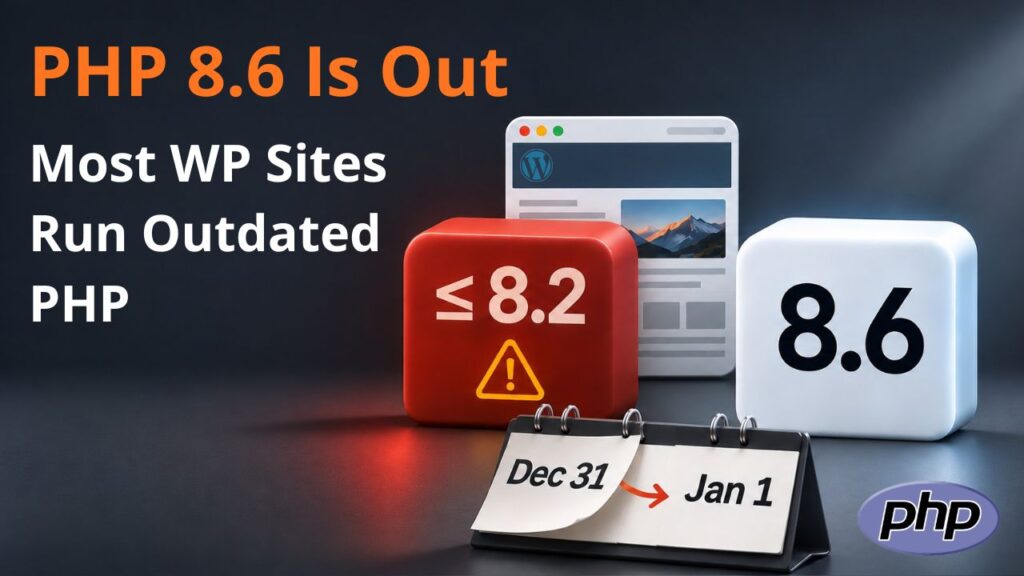
PHP 8.2, the second most common PHP version on WordPress sites, loses security support from the PHP project on December 31. WordPress.org’s November 23 statistics put it on 22.2% of WordPress sites, with another 31.4% on older versions already past end of life.
Four Years of Fixes per PHP Branch
The PHP project supports each branch for four years: two years of bug and security fixes, then two more years of fixes for critical security issues only. PHP 8.4 also moves to security-only support on December 31. WordPress.org recommends PHP 8.3 or newer, although WordPress itself still runs on PHP 7.4 and later.
| PHP branch | Released | Active support until | Security support until | Share of WordPress sites, Nov 23 |
|---|---|---|---|---|
| 8.1 and older | – | Ended | Ended | 31.4% |
| 8.2 | Dec 8, 2022 | Dec 31, 2024 | Dec 31, 2026 | 22.2% |
| 8.3 | Nov 23, 2023 | Dec 31, 2025 | Dec 31, 2027 | 28.2% |
| 8.4 | Nov 21, 2024 | Dec 31, 2026 | Dec 31, 2028 | 11.1% |
| 8.5 | Nov 20, 2025 | Dec 31, 2027 | Dec 31, 2029 | 6.9% |
| 8.6 | Nov 19, 2026 | Dec 31, 2028 | Dec 31, 2030 | 0.1% |
On cPanel servers, PHP can be installed and modified through EasyApache 4, which, according to cPanel’s documentation, follows the php.net calendar. Its profiles offer only supported versions, and packages for older ones remain on its mirrors. The documented policy ends updates for unsupported versions and recommends TuxCare’s Extended Lifecycle Support for PHP where they are needed. Even so, with the November 19 security releases, cPanel shipped a PHP 7.4 package with backported security fixes, and Plesk backported the fixes from PHP 8.2.36 to PHP 8.1, 8.0 and 7.4 on Linux.
Where PHP 8.6 Is Available So Far
Remi’s RPM repository published PHP 8.6.0 packages for Fedora and Enterprise Linux 8 and later on November 20. In hosting control panels, cPanel and Plesk had not listed PHP 8.6 builds in their change logs by November 23. cPanel’s documented process is to test each new PHP version before adding it to EasyApache, and the EasyApache 4 update of November 18 includes PHP 8.6 configuration data but not PHP 8.6 itself. Kinsta wrote on November 20 that it is working to make PHP 8.6 available to its WordPress hosting customers.
Stricter Session Defaults in PHP 8.6
PHP 8.6 changes session defaults: strict mode and HttpOnly session cookies are now enabled by default, and the SameSite cookie attribute is set to Lax. Custom session handlers that do not implement both session ID methods (create_sid(), validateId()) are deprecated. The new language features include partial function application, a Duration class for measuring elapsed time, a polling API for event-loop libraries and a new function, clamp().
Also deprecated are the mbstring regular expression functions, because the Oniguruma library behind them is no longer maintained. Many functions now throw a ValueError for out-of-range values or invalid flags instead of silently ignoring them.
Plugins and Themes Are the Open Question
WordPress 7.2 is scheduled for release on December 8, and its Beta 5 announcement sets the aim of full PHP 8.6 support. As of that beta, all known compatibility issues in WordPress itself were resolved. Before upgrading PHP, site owners are asked to verify that their plugins and themes are compatible. The project’s compatibility table, last updated November 4, lists PHP versions up to 8.5.
A summary of a November 18 call between WordPress and PHP contributors, published on the Make WordPress Core blog, calls the plugin ecosystem “the big unknown.” Testing turned up two issues. A bug that reported TrueType fonts with the wrong file type was fixed in PHP’s seventh release candidate. The other concerns image flipping: WordPress core used to flip images with PHP’s GD image library by passing negative dimensions, a pattern that broke in 8.6. Core now uses the dedicated function, but plugins that copied the old pattern may still break.
That leaves hosting providers with two separate pieces of work: the sites on PHP 8.2 and older, which have no PHP project support from January, and plugin and theme checks before PHP 8.6 goes into wider use.
Sources
- PHP 8.6.0 Released! - PHP (official)
- PHP 8.6 Release Announcement - PHP (official)
- Supported Versions - PHP (official)
- Statistics - WordPress.org
- Requirements - WordPress.org
- About PHP - cPanel & WHM Documentation (official)
- EasyApache 4 Change Log 25 - cPanel & WHM Documentation (official)
- Change Log for Plesk Obsidian - Plesk (official)
- PHP version 8.6 is released! - Remi's RPM repository
- PHP 8.6 ships: Here's what's new in the latest release - Kinsta
- WordPress 7.2 Release Party Schedule - Make WordPress Core
- PHP Compatibility and WordPress Versions - Make WordPress Core
- WordPress 7.2 Beta 5 - WordPress.org News (official)
- PHP & WordPress chat: Nov 2026 - Make WordPress Core
