

I’m subscribed to a ridiculous number of newsletters from hosting providers, registrars and other companies across our industry. Some because I’m a customer, others because I want to understand what they’re offering, how they position their products and, particularly, how they communicate with their customers.
It’s part of my job, and I enjoy observing how different companies approach their go-to-market strategies.
I have enormous respect for hosting companies that have built businesses serving hundreds of thousands or even millions of customers. That’s an extraordinary achievement, and managing relationships at that scale is incredibly challenging.
But after years of collecting these emails, I’ve noticed a few recurring patterns that make me wonder how many opportunities hosting providers might be missing by paying more attention to what they’re promoting than to who they’re communicating with.
Here are four examples that should sound familiar.
Four hosting emails I could happily live without
1. Affiliate programs that have absolutely nothing to do with me.
I receive invitations to recommend hosting services in exchange for commissions. I appreciate the opportunity, but I don’t run an agency or manage websites for clients. I’m probably among the least interesting profiles you could target with this offer.
Now imagine an agency managing 40 customer websites, already purchasing multiple hosting services. Surely that customer makes much more sense to reach out to.
2. A ‘beautiful’ collection of 25 discounted TLDs.
A long selection of domain extensions covering completely different industries, markets and use cases, all conveniently discounted for a limited time.
Some might be interesting, but why should I care about a random collection of extensions with no obvious connection to my business?
I wrote about something similar in my previous webhosting.today article comparing domain promotions with Barcelona’s new generation of kiosks. We have enormous product catalogues, and sometimes we seem determined to put everything on the same shelf.
3. An SSL certificate when my website already has one.
Security is obviously important, and there are legitimate reasons to upgrade a certificate or complement it with additional protection.
But imagine if the provider understood my current security configuration, identified an actual risk or explained a specific benefit relevant to my website.
A simple technical signal could make that conversation considerably more useful.
4. Invitations to webinars about website design and agency workflows.
I’ve received several invitations to sessions about AI-powered website development, design collaboration and managing client projects.
This is valuable content for the right audience, and I’m happy to see providers investing in it. But I don’t build websites for clients or operate a digital agency.
I wonder how many agencies with dozens of active projects could have received a more relevant invitation explaining how that technology would help their business.
Of course, general newsletters have their place. I voluntarily subscribe to many of them, and companies cannot reasonably know everything about someone who simply joined a mailing list.
But things become much more interesting when we look at existing customers.
Hosting providers already have access to valuable information about the services their customers use, their websites, and sometimes even the technical issues or business needs they might be facing.
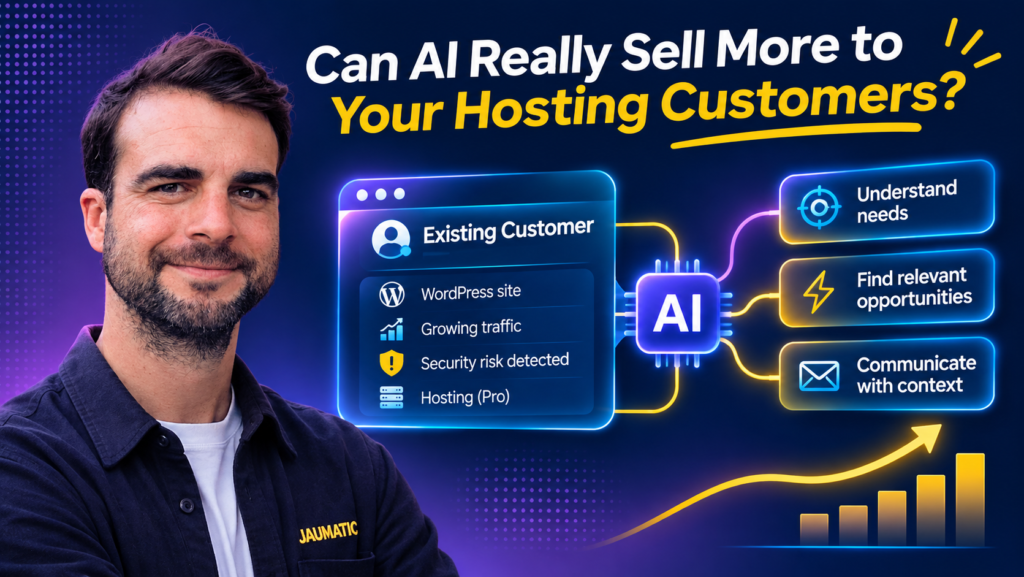
And this is where I believe AI opens up an exciting opportunity. Imagine being able to connect all that information, identify relevant needs and help each customer make better decisions about their digital business, even when managing hundreds of thousands of accounts.
There is considerable commercial potential here, particularly when we think about how much effort the industry puts into acquiring customers compared with growing the relationships we already have.
Are we investing enough in the customers we already have?
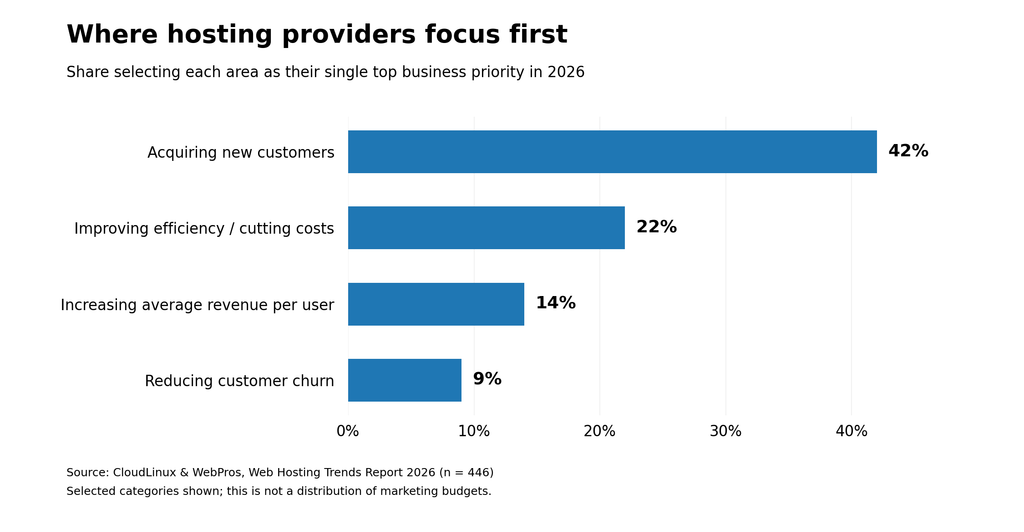
The 2026 Web Hosting Trends Report, published by CloudLinux and WebPros and based on responses from 446 hosting providers, offers an interesting perspective.
When asked about their single most important business priority, 42% selected customer acquisition, compared with 14% prioritizing ARPU growth and 9% reducing churn.
Acquisition naturally remains essential, and these figures represent top priorities rather than actual investment levels. Still, I find the difference interesting.
The same report indicates that 50% of providers plan to expand professional services to increase ARPU. As product portfolios grow, understanding who our customers are, what they already use and what their businesses actually need becomes increasingly important.
There’s considerable potential to improve product adoption, retention and customer relationships by making better use of that knowledge. But I believe we also need to be realistic about how we get there.
Making customers feel understood takes time
There’s an interesting psychological element here.
Imagine running an online store and receiving a message explaining that a vulnerability could affect your checkout process, along with practical recommendations to address it. Or receiving a warning about a potential performance issue before it affects your customers.
These interactions can demonstrate genuine attention to the customer’s business and gradually build trust in the provider.
Empathy, understanding customer needs and building relationships have always been important principles of consultative selling. And I believe we should approach AI-powered communications with those same principles in mind.
AI can analyze data, recognize patterns and help us communicate with greater relevance, but it doesn’t experience empathy the way humans do. Human judgment remains essential in deciding what makes sense to communicate, how to approach customers and which recommendations genuinely serve their interests.
We should also be patient with the results. A single email rarely builds a relationship, and expecting significant upsell conversions from the first campaign or iteration can create unrealistic expectations.
Every interaction gives us an opportunity to learn more about our customers, refine our understanding of their needs and improve future communications. Over time, that consistency can help establish stronger relationships and create better conditions for product adoption and upselling.
How AI can help us get there?
What makes AI particularly interesting is the possibility of applying this approach across thousands or millions of customer relationships, while maintaining human oversight and continuously learning from the results.
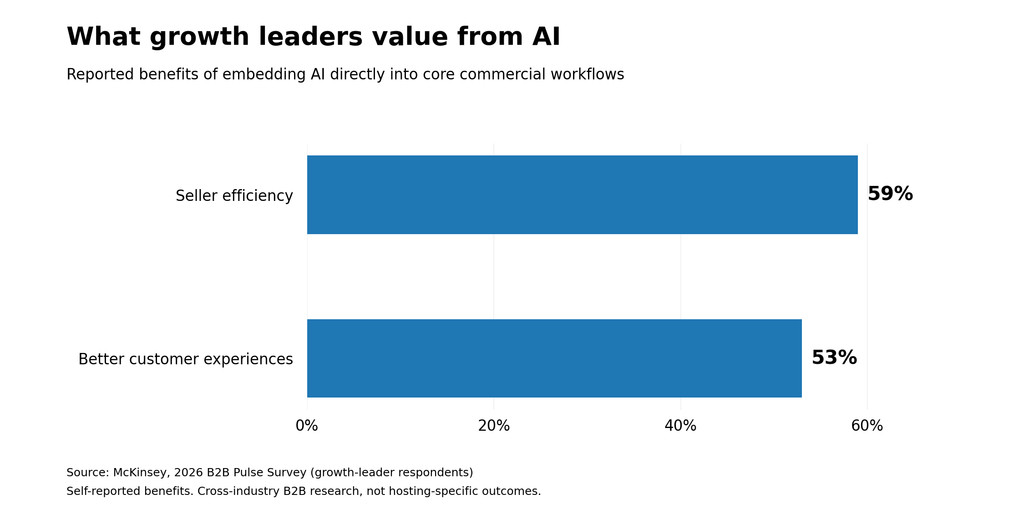
McKinsey’s July 2026 report, The Future of B2B Sales: How Growth Champions Rewire Their Playbooks with AI, offers an interesting perspective on this evolution.
According to its research, growth leaders embedding AI into core commercial workflows identify seller efficiency (59%) and improved customer experience (53%) among the primary benefits.
McKinsey also reports revenue improvements of 5% to 8% and reductions in cost-to-serve ratios of 20% to 30% among companies implementing AI-powered next-best-experience programs.
These findings come from broader B2B environments rather than hosting specifically, but I find the underlying principles particularly relevant.
One example caught my attention. A construction company discovered that its salespeople experienced conversion rates 40% lower when they opened conversations by promoting the brand instead of first understanding buyers’ needs.
It’s a specific case involving human sales conversations, but it reinforces something we’ve known for a long time: understanding the customer matters enormously.
AI gives us new ways to apply that principle at scale. The challenge is turning customer intelligence into genuinely useful interactions rather than simply automating more sales messages.
What could this look like in hosting?
Hosting providers are in a particularly interesting position because of the information they may already have about their customers’ digital operations.
Depending on their infrastructure and access, this could include website technologies, resource consumption, security exposure, domain portfolios and existing subscriptions.
Combined with relevant business context, these signals could help us understand customer needs and anticipate opportunities.
An online store experiencing increasing traffic has different priorities from a small corporate website. An agency managing dozens of WordPress installations may benefit from services that are irrelevant to an individual customer. A business facing repeated security issues might appreciate proactive guidance before another incident occurs.
And sometimes, helping customers make better use of what they already pay for could be the most valuable recommendation.
The exciting possibility is to apply this understanding continuously across thousands or millions of accounts, with AI helping identify opportunities, prioritize them and adapt communications to each situation.
But getting this right requires much more than connecting a language model to a customer database.
Data quality, privacy, technical integrations and commercial judgment all matter. And the people responsible for customer relationships must remain involved in deciding what should be communicated and why.
The real opportunity is in the long game
I believe AI can become an incredibly valuable tool for growing existing customer relationships. But we should be careful about expecting immediate commercial results.
A first campaign might generate some conversions, but it will rarely tell us everything we need to know about our customers. We need to experiment, observe how customers respond, learn from those interactions and continuously improve our understanding.
That means looking beyond immediate upsell conversions. Customer engagement, product adoption, retention, support interactions and long-term profitability all deserve attention.
AI can help make communications more relevant and personal, but customers will ultimately judge us by how useful, timely and trustworthy those interactions feel.
The hosting industry has already achieved incredible things in automation and scaling infrastructure. I believe applying that same ambition to customer relationships could become an important next chapter.
So, can AI help hosting providers sell more to their existing customers? I believe it can. But making it genuinely effective will take patience, human judgment and a commitment to learning about our customers over time.
And perhaps, as a nice side effect, my inbox will eventually receive fewer offers for things I have absolutely no use for. 🙂
I’m curious to hear how hosting providers are approaching this today. Are you already using AI to better understand and communicate with your customers? And what have you learned from your first iterations?
Research references
