
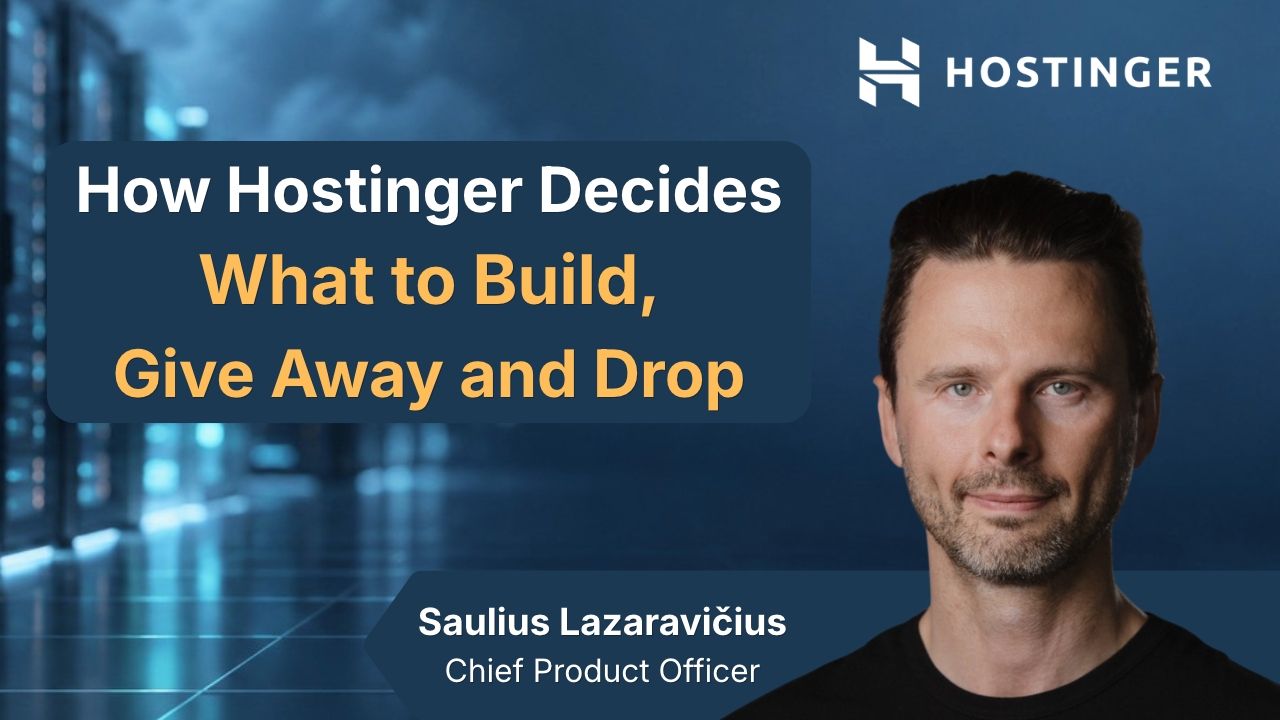
Hostinger stopped being just a web hosting company three or even four years ago, according to its chief product officer, Saulius Lazaravičius. In the latest episode of our podcast, hosted by Konrad Keck, he explained what that means in practice: an “online presence suite” built in-house, with plans that include the essentials instead of upselling them. New products launch early, are measured by usage and can be dropped if they do not work. The company’s AI agent is, in his words, mainly free of charge. He also made the case that, for AI agents, more tools are not always better.
For scale, Hostinger reports that its revenue grew 51% in 2025, to €275.4 million, and that its customer base passed 5 million in June 2026.
From Web Host to “Online Presence Suite”
The suite covers websites, email, email marketing, general marketing and domains, and since the middle of the year an AI assistant, Hostinger Agent, has worked across all of them. In Lazaravičius’s words, it “acts like your personal AI account manager who can help you to set up services, who can help you to get the first traffic, who can help you to troubleshoot things if something doesn’t work as you expect.”
Hosting is still the core. “We are not running away from our roots and we are not giving up on our strength,” he explained. That strength is building “very good and very efficient infrastructure,” and Hostinger now applies the same know-how to AI-generated sites, for example by building integrated backends for them. He sums up the company’s approach as “build first, buy later if needed.” “We love to build and we have strong engineers in house.”
Usage First, Then Revenue
On how Hostinger decides whether a product works, Lazaravičius started from a principle he personally likes: “Each good product at a certain point in time was a bad product.” Good products come from iterating, and Hostinger works in very small iterations, sometimes a week, sometimes days, launching as soon as possible. His main metric is active users, daily, weekly or monthly depending on the product. Then come unit economics. As usage grows, costs should stay in check and preferably fall, which lets Hostinger price products affordably. It can also make sense to give a product away, he added, if it really helps users. The order, in his words, is “users, then revenue, and then profitability.”
Each of Hostinger’s many products has its own team, while a strategy combines them into one user experience. A broad portfolio also means dropping products. “You understand that you are just the one loving your product,” Lazaravičius admitted, and a product can turn out to be “a nice bet, a nice hypothesis” that did not work.
Plans Instead of Pop-Ups
Lazaravičius traced Hostinger’s pricing logic to how much a new business already has to sort out: an idea, a company, a website and marketing. “We never wanted to squeeze as much money as possible from our users,” he added. The aim is one plan that works as a starter package, with everything needed to go online included and no prompts of the “Hey, now buy SSL. Hey, now buy email” kind. The Unlimited plan, in his description, brings together a website, email, email marketing and a domain in one subscription, with the agent guiding users from start to finish. Hostinger’s pricing page lists the domain and mailboxes in that plan as free for the first year, and email marketing as free for a year for up to 100 subscribers.
The agent follows the same logic. Formerly known as Kodee, it was renamed when its capabilities expanded, and by his account it now handles 2 million chats a month, from troubleshooting and activating services to helping users attract their first visitors and improve their SEO. As we reported in September, support and account management in Hostinger Agent remain free. Specialized agentic work uses AI credits, which come with a paid subscription, as top-ups or as an allowance included in Hostinger’s hosting plans. Lazaravičius called the agent “mainly free of charge” and gave the reason: it helps users activate the paid core products, such as websites, email and email marketing, and succeed with them.
AI keeps some prices low, Lazaravičius argued. One of his examples is Hostinger Reach, the company’s email marketing product, which by his account starts at $1.99 a month, while prices across the rest of the industry are “5x at least, maybe 7x higher.” “Why we can have such affordable prices is because of AI, because we built an AI engine in the product which helps with email templates building, and we need a way smaller team to run the product,” he explained. He did not name the services behind the comparison, and Reach prices depend on the number of recipients and the length of the billing term, according to Hostinger’s pricing page.
Customers Want a Website, Not a Stack
Three or five years ago, Lazaravičius recalled, web hosting meant WordPress to most people, plus a domain, sometimes email and DNS records configured by hand. “Now people expect much easier entry into online presence,” he noted. Users “just want a website and they just want to do a few clicks or chat and get it.”
Konrad pointed to the other side of Hostinger’s offer: APIs, MCP servers and other tools for developers. MCP, the Model Context Protocol, lets AI agents use a service’s tools directly. Lazaravičius described a few guiding principles for serving both groups. The first is to spend time with users, whom product teams talk to until patterns emerge, after 20, 30, 50 or 100 conversations.
The second is simplicity. A developer by background who studied applied mathematics, Lazaravičius called himself “always a lazy developer”, and developers, in his experience, would rather not manage servers. So Hostinger’s agent can manage a VPS without the user knowing Linux commands, and “in many cases” that simplicity also suits non-technical users.
An Ecosystem as the Answer to Lovable
In August, Hostinger merged its Website Builder and Horizons into a single product, AI Builder. In Lazaravičius’s description, AI sits at its core, with a drag-and-drop mode for simple sites and an agentic mode for something more custom, such as an app.
Many hosting providers are considering an AI builder of their own, Konrad pointed out, something like the AI app builder Lovable. Lazaravičius acknowledged that many companies now have one, built in-house or integrated through B2B partnerships. Hostinger, he explained, builds around what it sees as its strategic advantage, its ecosystem. In his description, a project built in AI Builder comes with hosting, a domain with DNS records already configured, a mailbox, a CDN, SSL that “you will never get charged for” and built-in security.
“When you build products in-house like we do, you have a full control of user experience,” Lazaravičius argued. Combining third-party products can still work well, he allowed, “but it will always feel that it’s a bit external products, a bit different interface.”
Why 1,000 Agent Tools Can Be Worse Than 50
Another of his principles for serving both developers and non-technical users is that everything in Hostinger’s interface should also be available to agents, either the built-in Hostinger Agent or external ones such as Codex, Claude Code and Gemini, through APIs and MCP. Hostinger Connector, a free add-on, lets developers and their coding agents manage Hostinger websites, domains, servers and other services. More than 19,000 customers had tried it by August, according to Hostinger.
Konrad noted that other providers, Cloudflare among them, are building similar interfaces. Among early AI adopters, Lazaravičius argued, connecting agents to a platform “is like a commodity, is like the feature which everybody has.” Exposing a platform to agents is the easy part, he noted: “you just expose your APIs, wrap them in MCPs and you are done.”
The difference, in his view, lies in the experience, as with ordinary interfaces, where anyone can build a form or a dashboard yet some feel better than others. The test comes when an agent has to write code, deploy it, connect a domain, troubleshoot and check logs, calling a number of tools that is “not too big, not too little, just right to do the job.” In his words, “having 1,000 MCPs could be worse than having 50”, and “the more is not the better.” Choosing which tools to build and expose is “the key here,” and the main challenge Hostinger is working on now.
Competing From a Country of 3 Million
Hostinger’s competitors differ by category, according to Lazaravičius. Among developer platforms they include Vercel and Cloudflare. In e-commerce it is Shopify, and elsewhere web hosting companies and Wix. Coming from Lithuania, a country he put at 3 million people, Hostinger needs “to work harder than others,” he added. “You need to be faster. You need to be agile, humble, curious.”
Next for Hostinger is the agent. What users can do with it “will be a big thing,” Lazaravičius concluded, and it will further simplify how they go online with Hostinger.

Sources
- Financial Times ranks Hostinger among Europe's Long-Term Growth Champions - Hostinger
- Hostinger brings support with business growth into one AI conversation, with a human behind it - Hostinger
- Hostinger brings the full online journey into the agentic era with AI Builder - Hostinger
- Developers are letting AI touch the scary part: production - Hostinger
- Hostinger weekly product updates: Week 42, 2026 - Hostinger
- Web Hosting - Hostinger
- AI email marketing platform built for day one - Hostinger
- Hostinger cuts server response times by up to 35% without expanding infrastructure - Hostinger