
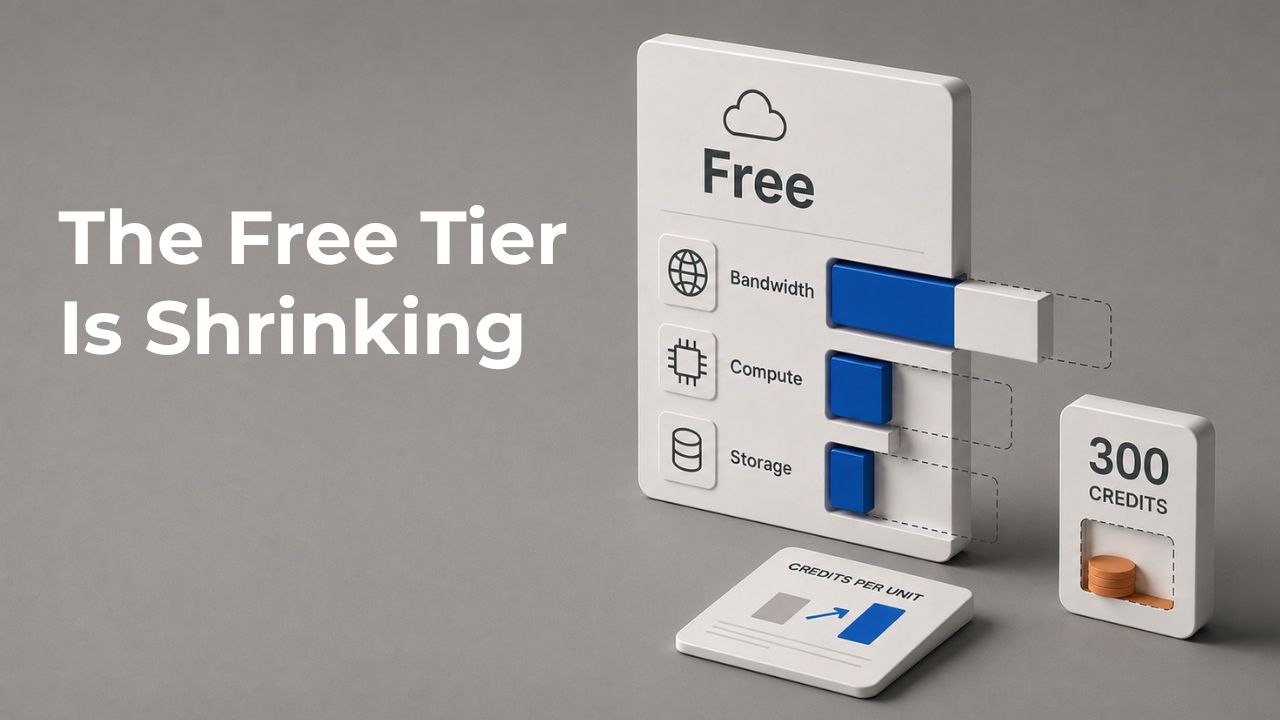
No platform has published a blog post titled “we are ending free hosting for developers.” What has happened instead, across 2025 and 2026, is quieter and collectively more decisive. Fly.io removed its free tier for new customers entirely, only grandfathered Legacy Hobby accounts keep their three free machines; new users start paying from essentially the first deploy. Netlify kept its headline “300 free credits”, and then, on April 14, doubled the credit cost of bandwidth from 10 to 20 credits per gigabyte and of compute from 5 to 10, halving what the unchanged headline number actually buys. Vercel’s Hobby tier survives but prohibits commercial use, pushing anything revenue-shaped to $20 per seat.
The pattern is shrinkflation, not shutdown: the free tier remains on the pricing page while its contents are removed. And the developer free tier was never charity. It was the customer-acquisition engine of an entire platform generation, so its quiet unwinding is a business event: the industry is dismantling the cheapest developer-acquisition channel it ever built, just as a record number of new builders, vibe-coding their first apps, arrive to find the on-ramp tolled.
Key facts
- Fly.io: free tier removed for new customers, only legacy Hobby accounts keep 3 free machines; realistic small-app cost now $8–25/month with egress and storage
- Netlify: headline 300 free credits unchanged, but April 14, 2026 repricing doubled the credit cost of bandwidth (10→20/GB) and compute (5→10/GB-hr), halving effective free capacity
- Railway: killed free in 2023 over crypto-mining abuse, then reversed course in 2026, restoring a small perpetual free allowance ($5 in credits for a new user’s first 30 days, then $1 a month); Vercel Hobby bars commercial use
- The holdouts: Render keeps a true free tier (512 MB, cold starts after 15 minutes); Cloudflare offers 100K Worker requests/day and unlimited-bandwidth Pages, free as strategy, not generosity
- The precedent: Heroku ended free dynos in November 2022 citing abuse, the pattern every successor is now following under 2026’s compute-cost pressure
- Why it matters: free tiers were developer CAC, the talent pipeline that decided which platforms the next decade’s CTOs default to
The Ledger of What Disappeared
Assemble the changes in one place and the direction is unambiguous. Fly.io, the developer-darling edge platform, now starts at $2.02 per month for its smallest machine. Add egress at $0.02/GB and database costs, and a realistic hobby deployment lands at $8–25 per month, per current pricing analyses. Netlify’s April credit repricing is the subtlest variant and therefore the most instructive: no plan was cancelled, no announcement said “less free,” yet a free account’s effective bandwidth allocation dropped from roughly 30 GB to 15 overnight. PythonAnywhere discontinued its $5 entry plan in January. Vercel holds the line on a genuinely usable Hobby tier (a million function invocations, image and edge allowances) but fences it with a commercial-use prohibition that converts any project earning a dollar into a $20-per-seat customer.
The exceptions prove the economics. Render still operates a true free tier (512 MB, 0.1 CPU, services that sleep after fifteen minutes) and markets the fact explicitly, because in a field of retreating competitors, a real free tier is suddenly differentiation. Railway is the instructive reversal. It killed its free plan in 2023 under a wave of crypto-mining abuse and spent the intervening years on trial-credit models. In 2026 it turned a small free allowance back on, once its paying base and its abuse controls, verified accounts and no anonymous prepaid, made the subsidy defensible again. And Cloudflare remains the structural outlier: 100,000 Worker requests per day and unlimited-bandwidth Pages, free at a scale no venture-funded PaaS can match. It can do this because its free tier is amortized across an edge network it runs anyway, and because owning the developer relationship is worth more to Cloudflare than the compute costs, exactly as it was once worth it to Heroku’s investors. Free tiers have not become impossible. They have become affordable only to companies whose business model is something other than selling the compute.
Why Now: The Three Pressures That Killed the Loss Leader
The free tier was always a loss leader with a thesis: developers who learn on your platform deploy their employers’ workloads on it later. Heroku proved the thesis and then, in November 2022, proved its failure mode, ending free dynos and databases under a flood of crypto-mining fraud and abuse that made the marketing expense an operating wound. What 2026 added is that the loss leader’s cost side exploded while its abuse side industrialized.
First, the hardware repricing this publication has mapped across the VPS market (DRAM up 58–63% in a quarter, enterprise SSDs up 48–53%, with no relief before late 2027) raised the unit cost of every idle free container.
Second, abuse went agentic: the same automation wave that now drives a large share of all web requests turned free tiers into harvesting targets for compute, residential proxies, and AI inference at machine scale, and the quiet removal of anonymous prepaid options across platforms is an anti-abuse decision wearing a billing interface.
Third, and least discussed: the vibe-coding wave inverted the funnel’s economics. The thesis assumed scarce developers worth subsidizing. AI-assisted building instead created millions of new builders deploying low-value experimental apps, the demand wave arriving as a hosting opportunity, so a free tier that once subsidized ten thousand learners now subsidizes ten million prompt-built prototypes. The CAC math that justified free when developers were rare collapses when “developer” becomes the default condition of anyone with a chat window.
Where the Displaced Developers Go, and Why It Matters More Than It Looks
The hobby developer evicted from the PaaS free tier has three destinations, and each reshapes a market.
The first is cheap VPS, the Contabo/Hetzner tier, where $4–8 a month buys root on real resources. But that same segment has repriced 18–49% in the year, per this publication’s price map, with Hetzner splitting its own lineup into a two-tier structure. The squeeze is genuinely industry-wide: free PaaS and budget VPS, the two traditional homes of the learning developer, repriced in the same twelve months for the same hardware reasons.
The second destination is the strategic-free platforms, Cloudflare above all. That is precisely why Cloudflare runs the subsidy: every developer who lands there by elimination is one whose mental default for “deploy something” becomes Workers, the lock-in this publication has examined in the Workers-versus-shared-hosting analysis.
The third is not deploying at all, building inside hosted AI builders and app platforms where infrastructure is invisible, the path that removes the customer from the hosting market entirely.
That third path is the C-level point the industry should sit with. The free tier was never primarily about the hobby projects it hosted; it was about defaults formation, the platform a developer learns at twenty becomes the platform they mandate at thirty-five. AWS understood this with credits and education programs; Heroku’s free dynos trained a decade of startup CTOs; GitHub’s free repos made it the industry’s resume. An industry that collectively walls off its on-ramps is running an uncontrolled experiment on where the next cohort’s defaults form, and the current answer is: on the platforms of the two or three companies rich enough to keep subsidizing, or inside AI tools that abstract hosting away altogether. Both outcomes concentrate the future customer base in fewer hands, which should sound familiar: it is the same consolidation logic now visible in M&A and compliance, operating on the demand side.
What to Do About It
For hosting providers: the eviction wave is an acquisition channel with a deadline. Hundreds of thousands of developers are leaving platforms that no longer want their $0. A bounded, abuse-resistant free or near-free developer tier (sleep-on-idle, hard caps, verified accounts, no anonymous prepaid) is now scarce enough to be marketing, as Render is demonstrating. The window lasts until the displaced cohort settles new defaults; defaults, once formed, took Heroku a decade to lose.
Design free as a product, not a discount. The Heroku failure and the Railway retreat teach the same lesson: undifferentiated free compute is an abuse magnet. The survivable versions are shaped, free for static and serverless where marginal cost approaches zero (Cloudflare’s model), free with cold starts (Render’s model), free credits tied to verified identity, free for students and OSS under explicit programs. The goal is the developer relationship, and the relationship survives caps; it does not survive a 404 on the signup page.
For CTOs and buyers: price the platform exit before you build on the platform’s mercy. The teams hit hardest by each free-tier retrenchment were the ones running production-shaped workloads on hobby terms. The 2026 lesson is that entry pricing is a marketing variable that can be repriced: Netlify’s credit change moved the price of “free” without changing a single plan name. Anything that matters should be costed at the paid tier from day one, with the free tier treated as what it has reverted to being: a demo.
Watch the credit-unit trick spread. Netlify’s April move (hold the headline allocation, reprice the unit) is the most copyable maneuver in this story, and it works anywhere pricing is denominated in abstract credits rather than gigabytes and hours. Hosting marketers will be tempted; hosting buyers should learn to read credit tables the way this publication’s renewal-jump analysis taught them to read intro pricing. Opacity in units is the renewal jump’s younger sibling, and the regulatory climate that came for one will eventually come for the other.
The On-Ramp Is the Asset
Every era of this industry has had a free on-ramp that formed the next era’s defaults: shared hosting’s $0 subdomain sites, Heroku’s dynos, GitHub Pages, the PaaS free tier. The 2026 retrenchment is the first time the industry has narrowed the on-ramp during an expansion of the builder population, millions of AI-assisted newcomers arriving to find that “deploy your first app free” increasingly means a credit card form and a per-second meter. The companies still holding the door open are doing it as strategy, and they will collect the strategy’s dividend: the loyalty of the largest new cohort of builders the industry has seen. For everyone else in hosting, the calculation is simple and time-boxed. The cost of a well-designed free tier is now known, the cost of the hardware under it is well documented, and the value of owning a generation’s deployment default is the one line on the spreadsheet that compounds. The free tier was never free. It was the cheapest marketing the infrastructure business ever had, and the industry is about to find out what the expensive kind costs.
About the Data
Platform pricing and free-tier limits come from each provider’s official pricing pages and changelogs, including Netlify’s April 14, 2026 credit-pricing update and the current plan documentation for Vercel, Fly.io, Render and Cloudflare, verified in July 2026. Memory-cost figures (DRAM up 58–63% and enterprise SSD up 48–53% quarter over quarter in 2Q26, with tight supply into late 2027) are from TrendForce. Small-app monthly cost estimates, such as the $8–25 Fly.io range, are drawn from third-party pricing analyses and vary with usage. Railway’s figures reflect its 2026 reinstatement of a small perpetual free allowance.

Sources
- Platforms With a Real Free Tier for Developers in 2026 - Render (official)
- Netlify Pricing - Netlify (official)
- Fly.io Pricing - Fly.io (official)
- Railway Pricing - Railway (official)
- Vercel Pricing - Vercel (official)
- Workers Pricing - Cloudflare (official)
- Heroku's Next Chapter (End of Free Plans) - Heroku (official)
- Memory Contract Price Increases in 2Q26 - TrendForce
- https://www.netlify.com/changelog/2026-04-14-pricing-updates-april-2026/
- Price Adjustment (June 2026) - Hetzner Docs